Written by students who passed Immediately available after payment Read online or as PDF Wrong document? Swap it for free 4.6 TrustPilot
logo-home
Document preview thumbnail
Preview 1 out of 9 pages
Summary

Summary The Search for Consensus 1963-89 Notes

Document preview thumbnail
Preview 1 out of 9 pages

These revision notes provide an in depth summary of this specific chapter of AQA History in the Study of The quest for political stability: Germany, 1871–1991. They can be used directly as lecture notes or can be reduced further to more of a summary of the topic.

Content preview

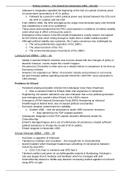
History revision – The Search for Consensus 1963 – 89 (18)
- Adenauer’s resignation signalled the beginning of the end of a period of twenty years
of conservative ascendancy in W Gr politics
o Followed by a period in which political power was shared between the CDU and
the SPD in coalition with the FDP
- From 1969 to 1982, the SPD emerged as the single most dominant party until Schmidt
was unseated by a vote of no confidence
- These years demonstrated that the FRG could operate in conditions of relative stability
under what was in effect a three-party system
- Emergence of the Greens in the 80’s briefly threatened a 4 party system, but support
for the Greens was never strong enough to make them a viable coalition partner
- Although political stability was sustained, this 3 party consensus was challenged by:
o The extra-parliamentary opposition of the 1960’s
o The urban terrorism of the 70’s
o The environmental peace movements of the 1980’s

Ludwig Erhard (CDU) – 1963 – 66
- Initially it seemed Erhard’s intention was to press ahead with few changes of policy or
direction however, events meant this couldn’t happen
- His period as Chancellor is often seen as a relative failure in comparison to his time as
Economics minister
- However, his reputation as ‘father’ of economic miracle and promises to cut income
tax and increase welfare spending ensured CDU/CSU, with FDP, were successful in
1965 election
Problems for Erhard
- Persistent sniping and public criticism from Adenauer (now Party Chairman)
o Was a constant irritant to Erhard, bitter and ungracious in retirement
- Heightening LW student radicalism was also indication that a new political generation
was emerging who wouldn’t allow Erhard in his 1950’s stance
- Emergence of RW National Democratic Party (NPD) threatening an electoral
breakthrough at federal level, also increased political uncertainties
- Economic situation undermined his credibility
o October 1966 – sets out proposals to tackle 1965 economic recession
 Was rejected by his FDP coalition partners
- Subsequent resignation of the FDP cabinet ministers effectively ended his
Chancellorship
- Erhard’s damaged legacy and a set of unfortunate circumstances created sufficient
political turbulence to change the mould of W Gr politics
- Erhard resigned in November 1966
George Kiesinger (CDU) – 1966 – 69
- Had been a supporter of Adenauer
- Talented as mediator and conciliator – this brought him to chancellorship
- Grand Coalition which Kiesinger headed was something of convenience between
CDU/CSU and SPD
o CDU/ CSU had 11 ministers and SPD had 9
- Talented coalition and given its unchallengeable majority in Bundestag, Kiesinger’s
role was largely that of mediator and facilitator which he managed with skill
- Chancellorship steered a middle-way between increasing student agitation on left and
rising NPD on right

Connected book
 image
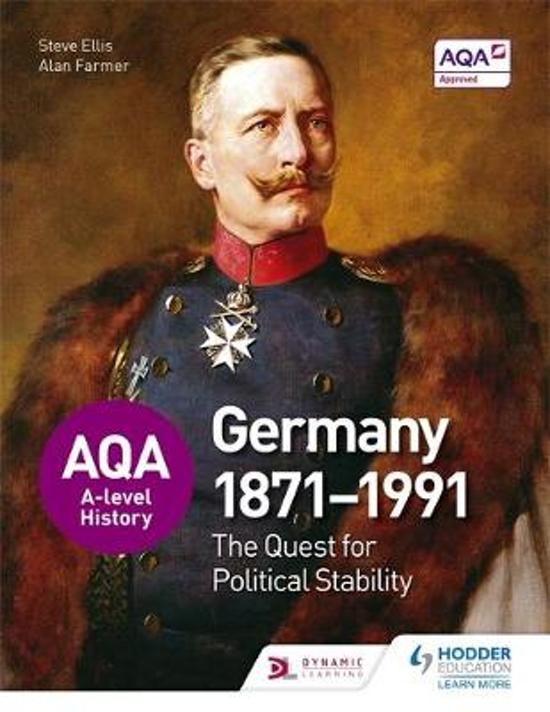
Steve Ellis, Alan Farmer AQA A-level History
Publisher: Unknown ISBN: 9781471837760 Edition: 1

Document information

Study Level
Subject
Summarized whole book?
No
Which chapters are summarized?
Chapter 18
Uploaded on
February 4, 2019
Number of pages
9
Written in
2017/2018
Type
Summary
£3.99
Purchased by 0 students

Wrong document? Swap it for free Within 14 days of purchase and before downloading, you can choose a different document. You can simply spend the amount again.
Written by students who passed
Immediately available after payment
Read online or as PDF

Seller avatar
Reputation scores are based on the amount of documents a seller has sold for a fee and the reviews they have received for those documents. There are three levels: Bronze, Silver and Gold. The better the reputation, the more your can rely on the quality of the sellers work.
callumgallagher
4.3
(107)
Sold
194
Followers
137
Items
99
Last sold
4 months ago


Reviews from verified buyers


Why students choose Stuvia

Created by fellow students, verified by reviews

Quality you can trust: written by students who passed their exams and reviewed by others who've used these revision notes.

Didn't get what you expected? Choose another document

No problem! You can straightaway pick a different document that better suits what you're after.

Pay as you like, start learning straight away

No subscription, no commitments. Pay the way you're used to via credit card and download your PDF document instantly.

Student with book image

“Bought, downloaded, and smashed it. It really can be that simple.”

Alisha Student

Working on your references?

Create accurate citations in APA, MLA and Harvard with our free citation generator.

Working on your references?

Frequently asked questions