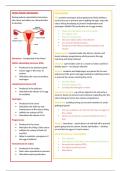
Human female reproduction Contraception
During puberty reproductive hormones Pill: contains oestrogen and progesterone which thickens
also cause secondary sex characteristics cervical mucus to prevent sperm getting through, stops the
to develop. uterus lining developing to prevent implantation and
oestrogen inhibits FSH production so no eggs mature
Makes periods lighter and more regular
Can reduce acne
Doesn’t interrupt sex
Has to be taken daily to be effective
Can increase blood pressure
Temporary side effects include headaches and
nausea
Implant/patch: inserted under the skin by a doctor and
slowly releases progesterone which prevents the egg
Hormones - transported in the blood maturing and being released
Follicle stimulating hormone (FSH) Chemical: spermicides come in a cream or lotion and kill or
Produced in the pituitary gland disable sperm – not always effective
Causes eggs in the ovary to Barriers: condoms and diaphragms are placed by the user
mature and prevent the sperm and egg meeting by collecting semen
Stimulates the ovary to produce or prevent the semen entering the cervix
oestrogen
No side effects
Luteinising hormones (LH) Prevents against STIs
Produced in the pituitary Can become damaged or move
Stimulates the release of an egg Intrauterine devices: e.g.coil are placed in the uterus by a
at ovulation nurse or doctor to prevent early embryos implanting into the
Oestrogen uterus lining but some also release progesterone
Produced in the ovary Abstinence: avoiding having sex around ovulation to avoid
Stimulates the build-up and getting pregnant
maintenance of the uterus lining Not very reliable as it’s hard to tell when an egg is in
Inhibits the release of FSH the oviduct
Stimulates the release of LH Sperm can survive in a woman’s body for up to 7
Progesterone days
Produced in the ovary Surgery: vasectomy – sperm ducts cut and tied off to prevent
Maintains the lining of the uterus sperm going into the semen, female sterilisation – oviducts
Inhibits the release of both LH cut and tied so egg can’t reach uterus
and FSH Using hormones as contraceptives
Helps to maintain a pregnancy if
the egg is fertilised Very effective
Prescribed so side effects are monitored by doctors
Testosterone (in males) No protection against STDs
Produced in the testes Can affect menstrual cycle
Main male reproductive hormone Side effects
Stimulates sperm production
During puberty reproductive hormones Pill: contains oestrogen and progesterone which thickens
also cause secondary sex characteristics cervical mucus to prevent sperm getting through, stops the
to develop. uterus lining developing to prevent implantation and
oestrogen inhibits FSH production so no eggs mature
Makes periods lighter and more regular
Can reduce acne
Doesn’t interrupt sex
Has to be taken daily to be effective
Can increase blood pressure
Temporary side effects include headaches and
nausea
Implant/patch: inserted under the skin by a doctor and
slowly releases progesterone which prevents the egg
Hormones - transported in the blood maturing and being released
Follicle stimulating hormone (FSH) Chemical: spermicides come in a cream or lotion and kill or
Produced in the pituitary gland disable sperm – not always effective
Causes eggs in the ovary to Barriers: condoms and diaphragms are placed by the user
mature and prevent the sperm and egg meeting by collecting semen
Stimulates the ovary to produce or prevent the semen entering the cervix
oestrogen
No side effects
Luteinising hormones (LH) Prevents against STIs
Produced in the pituitary Can become damaged or move
Stimulates the release of an egg Intrauterine devices: e.g.coil are placed in the uterus by a
at ovulation nurse or doctor to prevent early embryos implanting into the
Oestrogen uterus lining but some also release progesterone
Produced in the ovary Abstinence: avoiding having sex around ovulation to avoid
Stimulates the build-up and getting pregnant
maintenance of the uterus lining Not very reliable as it’s hard to tell when an egg is in
Inhibits the release of FSH the oviduct
Stimulates the release of LH Sperm can survive in a woman’s body for up to 7
Progesterone days
Produced in the ovary Surgery: vasectomy – sperm ducts cut and tied off to prevent
Maintains the lining of the uterus sperm going into the semen, female sterilisation – oviducts
Inhibits the release of both LH cut and tied so egg can’t reach uterus
and FSH Using hormones as contraceptives
Helps to maintain a pregnancy if
the egg is fertilised Very effective
Prescribed so side effects are monitored by doctors
Testosterone (in males) No protection against STDs
Produced in the testes Can affect menstrual cycle
Main male reproductive hormone Side effects
Stimulates sperm production