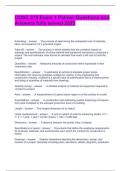
COSC 275 Exam 1 Palmer Questions and
Answers fully solved 2023
Estimating: - answer The process of determining the anticipated cost of materials,
labor, and equipment of a proposed project.
Take-off: - answer The process in which detailed lists are compiled, based on
drawings and specifications, of all the material and equipment necessary to construct a
project. The cost estimator uses this list to calculate how much it will cost to build the
project.
Quantities: - answer Measured amounts of construction items expressed in their
customary units.
Quantification: - answer In estimating an activity to translate project scope
information into resource quantities suitable for costing. In the engineering and
construction industry, a takeoff is a specific type of quantification that is a measurement
and listing of quantities of materials from drawings.
Quantity survey: - answer A detailed analysis of material and equipment required to
construct a project.
Area: - answer A measurement of a given planar region or of the surface of a solid.
Area Method: - answer A construction cost estimating system employing unit square
foot costs multiplied by the adjusted gross floor area of a building.
Length: - answer The longest dimension of an object.
Linear measurement: - answer A unit or system of units for measuring length: 12" =
1', 3' = 1 yard, 1 yard = 0.9144 meters, 1 mile = 5,280 feet.
Dimension: - answer A distance between two points, lines, or planes.
Specifications or specs: - answer Documents that define the qualitative requirements
for products, materials, and workmanship upon which the contract for construction is
based.
Drawings: - answer Graphic illustrations depicting the dimensions, design, and
location of a project. Generally including plans, elevations, details, diagrams, schedules,
, and sections. The Term, when capitalized refers to the graphic portion of a project's
contract documents.
Addendum: - answer A document describing an addition, change, correction, or
modification to contract documents. An addendum is issued by the design professional
during the bidding period or prior to the award of contract, and is the primary method of
informing bidders of modifications to the work during the bidding process. Addenda
become part of the bidding process.
Amendment: - answer A modification of the contract by a subsequent agreement.
This does not change the entire existing contract but does alter the terms of the affected
provisions or requirements.
Grade: - answer 1. The surface or level of the ground.
2. A classification of quality as, for instance, in lumber.
3. The existing or proposed ground level or elevation on a building site or around a
building.
4. The slope or rate of incline or decline of a road, expressed as a percent.
5. A designation of a subfloor, either above grade, on grade, or below grade.
6. In plumbing, the slope of installed pipe, expressed in the fall in inches per foot length
of pipe.
7. The classification of the durability of brick.
8. Any surface prepared to accept paving, conduit, or rails.
Level: - answer 1. A term used to describe any horizontal surface that has all points
at the same elevation and thus does not tilt or slope.
2. In surveying, an instrument that measures heights from an established reference.
3. A spirit level, consisting of small tubes of liquid with bubbles in each. The small tubes
are positioned in a length of wood or metal that is handheld and, by observing the
position of the bubbles, used to find and check level surfaces.
Site: - answer The location of the project geographically, usually defined by legal
boundaries.
Elevation: - answer A vertical distance relative to a reference point.
2. A view or drawing of the interior or exterior of a structure as if projected onto a
vertical plane.
Cut and fill: - answer An operation commonly used in road building and other rock
and earthmoving operations in which the material excavated and removed from one
location is used as fill material at another location.
Fill: - answer The soil or other material used to raise the grade of a site area.
2. A subfloor leveling material.
Answers fully solved 2023
Estimating: - answer The process of determining the anticipated cost of materials,
labor, and equipment of a proposed project.
Take-off: - answer The process in which detailed lists are compiled, based on
drawings and specifications, of all the material and equipment necessary to construct a
project. The cost estimator uses this list to calculate how much it will cost to build the
project.
Quantities: - answer Measured amounts of construction items expressed in their
customary units.
Quantification: - answer In estimating an activity to translate project scope
information into resource quantities suitable for costing. In the engineering and
construction industry, a takeoff is a specific type of quantification that is a measurement
and listing of quantities of materials from drawings.
Quantity survey: - answer A detailed analysis of material and equipment required to
construct a project.
Area: - answer A measurement of a given planar region or of the surface of a solid.
Area Method: - answer A construction cost estimating system employing unit square
foot costs multiplied by the adjusted gross floor area of a building.
Length: - answer The longest dimension of an object.
Linear measurement: - answer A unit or system of units for measuring length: 12" =
1', 3' = 1 yard, 1 yard = 0.9144 meters, 1 mile = 5,280 feet.
Dimension: - answer A distance between two points, lines, or planes.
Specifications or specs: - answer Documents that define the qualitative requirements
for products, materials, and workmanship upon which the contract for construction is
based.
Drawings: - answer Graphic illustrations depicting the dimensions, design, and
location of a project. Generally including plans, elevations, details, diagrams, schedules,
, and sections. The Term, when capitalized refers to the graphic portion of a project's
contract documents.
Addendum: - answer A document describing an addition, change, correction, or
modification to contract documents. An addendum is issued by the design professional
during the bidding period or prior to the award of contract, and is the primary method of
informing bidders of modifications to the work during the bidding process. Addenda
become part of the bidding process.
Amendment: - answer A modification of the contract by a subsequent agreement.
This does not change the entire existing contract but does alter the terms of the affected
provisions or requirements.
Grade: - answer 1. The surface or level of the ground.
2. A classification of quality as, for instance, in lumber.
3. The existing or proposed ground level or elevation on a building site or around a
building.
4. The slope or rate of incline or decline of a road, expressed as a percent.
5. A designation of a subfloor, either above grade, on grade, or below grade.
6. In plumbing, the slope of installed pipe, expressed in the fall in inches per foot length
of pipe.
7. The classification of the durability of brick.
8. Any surface prepared to accept paving, conduit, or rails.
Level: - answer 1. A term used to describe any horizontal surface that has all points
at the same elevation and thus does not tilt or slope.
2. In surveying, an instrument that measures heights from an established reference.
3. A spirit level, consisting of small tubes of liquid with bubbles in each. The small tubes
are positioned in a length of wood or metal that is handheld and, by observing the
position of the bubbles, used to find and check level surfaces.
Site: - answer The location of the project geographically, usually defined by legal
boundaries.
Elevation: - answer A vertical distance relative to a reference point.
2. A view or drawing of the interior or exterior of a structure as if projected onto a
vertical plane.
Cut and fill: - answer An operation commonly used in road building and other rock
and earthmoving operations in which the material excavated and removed from one
location is used as fill material at another location.
Fill: - answer The soil or other material used to raise the grade of a site area.
2. A subfloor leveling material.