Humanistic approach
- Developed in America in the 1950s and supported by Maslow and Rodgers theories.
- Rodgers argued that Freud dealt with the sick half of psychology, so the humanistic
approach concerns itself with the healthy growth of individuals.
- To offer a less deterministic and artificial approach.
Free will – is the idea that we have choices in how we act.
- Free will separates out what is the intention of an individual from what has been
created by other causes.
- This means that we are self-determining and free from the casual influences of the
past.
Humanistic Psychologists hate science – science doesn’t allow the use of free will.
Humanistic psychologists regard personal growth as an essential part of what it is to be
human i.e., changing and developing as a person to become fulfilled, satisfied and goal
orientated.
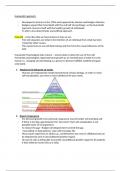
1. Maslow & his hierarchy of needs
Humans are motivated by needs beyond those of basic biology. In order to reach
self-actualization, you have to have satisfied all of your needs.
2. Rogers Congruence
- For personal growth to be achieved congruence must be better self and ideal self.
- If there is too big a gap between the 'two selves' then self-actualization is not
possible (state of incongruence).
- To reduce the gap - Rodgers developed client-centred therapy.
- "counselling' to help patients’ cope with everyday life.
- Many issues experience as adults e.g., worthlessness has roots in childhood and can
be explained by lack of unconditioned positive regard.
- He saw his role as being able to provide unconditional positive regard to his patients
if they failed to receive this as a child.
- Developed in America in the 1950s and supported by Maslow and Rodgers theories.
- Rodgers argued that Freud dealt with the sick half of psychology, so the humanistic
approach concerns itself with the healthy growth of individuals.
- To offer a less deterministic and artificial approach.
Free will – is the idea that we have choices in how we act.
- Free will separates out what is the intention of an individual from what has been
created by other causes.
- This means that we are self-determining and free from the casual influences of the
past.
Humanistic Psychologists hate science – science doesn’t allow the use of free will.
Humanistic psychologists regard personal growth as an essential part of what it is to be
human i.e., changing and developing as a person to become fulfilled, satisfied and goal
orientated.
1. Maslow & his hierarchy of needs
Humans are motivated by needs beyond those of basic biology. In order to reach
self-actualization, you have to have satisfied all of your needs.
2. Rogers Congruence
- For personal growth to be achieved congruence must be better self and ideal self.
- If there is too big a gap between the 'two selves' then self-actualization is not
possible (state of incongruence).
- To reduce the gap - Rodgers developed client-centred therapy.
- "counselling' to help patients’ cope with everyday life.
- Many issues experience as adults e.g., worthlessness has roots in childhood and can
be explained by lack of unconditioned positive regard.
- He saw his role as being able to provide unconditional positive regard to his patients
if they failed to receive this as a child.