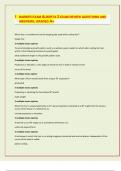
Chapter_01.bnk MULTIPLE CHOICE 1. Which statement accurately describes the primary purpose of the state nurse practice act (NPA)? a. To test and license LPN/LVNs b. To define the scope of LPN/LVN practice c. To improve the quality of care provided by the LPN/LVN d. To limit the LPN/LVN employment placement ANS: b While improving quality of care provided by the LPN/LVN may be a result of the NPA, the primary purpose of the NPA of each state defines the scope of nursing practice in that state. PTS: 1 DIF: Cognitive Level: Comprehension REF: p. 3 OBJ: 3 TOP: NPA KEY: Nursing Process Step: Implementation MSC: NCLEX: Safe, Effective Care Environment: Coordinated Care 2. The charge nurse asks the new vocational nurse to start an intravenous infusion, a skill that the vocational nurse has not been taught during her educational program. How should the vocational nurse respond? a. Ask a more experienced nurse to demonstrate the procedure. b. Look up the procedure in the procedure manual. c. Attempt to perform the procedure with supervision. d. Inform the charge nurse of her lack of training in this procedure. ANS: d The charge nurse should be informed of the lack of training to perform the procedure, and the vocational nurse should seek further training to gain proficiency. Although the other options might be helpful, they are not safe. PTS: 1 DIF: Cognitive Level: Application REF: p. 3 OBJ: 1 TOP: Providing Safe Care KEY: Nursing Process Step: N/A MSC: NCLEX: Safe, Effective Care Environment: Coordinated Care 3. Which patient statement indicates a need for further discharge teaching that the vocational nurse should address? a. "I have no idea of how this drug will affect me." b. "Do you know if my physician is coming back today?" c. "Will my insurance pay for my stay?" d. "Am I going to have to go to a nursing home?" ANS: a Lack of knowledge at discharge about medication effects and side effects is a concern that should be addressed by the vocational nurse. The other concerns in the options are the responsibility of other departments to which the nurse might refer the patient. PTS: 1 DIF: Cognitive Level: Application REF: p. 2 OBJ: 1 TOP: Teaching KEY: Nursing Process Step: Implementation MSC: NCLEX: Safe, Effective Care Environment: Coordinated Care 4. According to most state NPAs, the vocational nurse acting as charge nurse in a long-term care facility acts in which capacity? a. Working under direct supervision of an RN on the unit b. Working with the RN in the building c. Working under general supervision by the RN available on site or by phone d. Working as an independent vocational nurse ANS: c The vocational nurse in the capacity of the charge nurse in a long-term care facility acts with the general supervision of an RN available on site or by phone. PTS: 1 DIF: Cognitive Level: Comprehension REF: p. 3 OBJ: 1 TOP: Charge Nurse/Manager KEY: Nursing Process Step: N/A MSC: NCLEX: Safe, Effective Care Environment: Coordinated Care 5. The nurse is educating a patient that is a member of a health maintenance organization (HMO). Which information should the nurse include? a. Seek the opinion of an alternate health care provider. b. Contact the insurance company for coverage details as services may be limited. c. Provide detailed documentation of all care received for his condition. d. Wait at least 6 months to see a specialist. ANS: b HMOs are a kind of managed care. This is accomplished by paying providers to care for groups of patients for a set capitation fee and by limiting services. Patients are not required to seek a second opinion, provide documentation of care, or wait a specific time period before visiting a specialist. PTS: 1 DIF: Cognitive Level: Application REF: p. 9 OBJ: 9 TOP: Charge Nurse/Manager KEY: Nursing Process Step: Implementation MSC: NCLEX: Safe, Effective Care Environment: Coordinated Care 6. The patient complains to the nurse that he is confused about his "deductible" that he owes the hospital. Which statement accurately explains a deductible? a. An amount of money put aside for the payment of future medical bills b. A one-time fee for service c. An amount of money deducted from the bill by the insurance company d. An annual amount of money the patient must pay out-of-pocket for medical care ANS: d The deductible is the annual amount the insured must pay out-of-pocket prior to the insurance company assuming the cost. This practice improves the profit of the insurance company. PTS: 1 DIF: Cognitive Level: Comprehension REF: p. 7 OBJ: 9 TOP: Health Care Financing KEY: Nursing Process Step: Implementation MSC: NCLEX: Safe, Effective Care Environment: Coordinated Care 7. A patient asks the nurse what Medicare Part A covers. Which response is correct? a. Medicare Part A covers inpatient hospital costs. b. Medicare Part A covers reimbursement to the physician. c. Medicare Part A covers outpatient hospital services. d. Medicare Part A covers ambulance transportation. ANS: a Medicare Part A covers inpatient hospital expenses, drugs, x-rays, laboratory work, and intensive care. Medicare Part B pays the physician, ambulance transport, and outpatient services. PTS: 1 DIF: Cognitive Level: Comprehension REF: p. 8, Box 1-4 OBJ: 9 TOP: Government-Sponsored Health Insurance KEY: Nursing Process Step: Implementation MSC: NCLEX: Safe, Effective Care Environment: Coordinated Care 8. Which is the main cost-containment component of diagnosis-related
Exam (elaborations)
Test Bank for Medical-Surgical Nursing, 5th Edition by Stromberg
Test Bank for Medical-Surgical Nursing 5e 5th Edition by Holly K. Stromberg. ISBN-13: 0210 Unit I. Medical-Surgical Nursing Settings 1. Caring for Medical-Surgical Patients Caring for Medical-Surgical Patients Roles of the LPN/LVN Employment Opportunities Ethical and Legal Practice Quality and Safety Health Care Today Financing of Health Care Providing Holistic Care 2. Critical Thinking, Clinical Judgment, and the Nursing Process Critical Thinking and Clinical Judgment Applying LPN/LVN Standards in Medical-Surgical Nursing Interdisciplinary (Collaborative) Care Plans Unit II. Medical-Surgical Patient Care Problems 3. Fluids, Electrolytes, Acid-Base Balance, and Intravenous Therapy Distribution and Regulation of Body Fluids Osmolality Fluid Imbalances Electrolytes Acid-Base System Acid-Base Imbalances Intravenous Fluid Therapy Nursing Management Community Care 4. Care of Preoperative and Intraoperative Surgical Patients Surgery Technological Approaches in Surgery Autologous Blood for Transfusion Bloodless Surgery Perioperative Nursing Management The Surgical Team The Surgical Suite Anesthesia Potential Intraoperative Complications 5. Care of Postoperative Surgical Patients Immediate Postoperative Care Nursing Management Discharge Planning Community Care 6. Infection Prevention and Control The Infectious Process and Disease The Body’s Defense Against Infection Infection Prevention and Control Health Care–Associated Infections Multidrug-Resistant Organisms (MDROs) Sepsis and Septic Shock Nursing Management Community Care 7. Care of Patients With Pain Theories of Pain Classification of Pain Perception of Pain Acute Versus Chronic Pain Nursing Management Management of Pain Community Care 8. Care of Patients With Cancer The Impact of Cancer Pathophysiology of Cancer Metastasis Genetic Factors Contributing Factors Classification of Tumors Measures to Prevent Cancer Detection of Cancer Nursing Management Common Therapies, Problems, and Nursing Care Common Problems Related to Cancer or Cancer Treatment Caring for the Dying Cancer Patient 9. Chronic Illness and Rehabilitation Chronic Illness Rehabilitation Nursing Management Home Care Unit III. Immune System 10. The Immune and Lymphatic Systems Anatomy and Physiology of the Immune and Lymphatic Systems Protective Mechanisms of the Immune and Lymphatic Systems Immune and Lymphatic System Disorders Nursing Management Common Problems Related to the Immune and Lymphatic Systems 11. Care of Patients With Immune and Lymphatic Disorders Immune Function and Dysfunction Immune Deficiency Conditions Therapeutic Immunosuppression Nursing Management Human Immunodeficiency Virus and Acquired Immunodeficiency Syndrome Nursing Management Human Immunodeficiency Virus Risk in Patients Older Than 50 Years Community Education and Care Autoimmune and Autoinflammatory Disorders Disorders of the Lymphatic System Disorders of Inappropriate Immune Response Nursing Management Unit IV. Respiratory System 12. The Respiratory System Overview of Anatomy and Physiology of the Respiratory System Causes of Respiratory Disorders Respiratory Disorders Nursing Management Common Respiratory Patient Care Problems 13. Care of Patients With Disorders of the Upper Respiratory System Disorders of the Nose and Sinuses Obstruction and Trauma Community Care 14. Care of Patients With Disorders of the Lower Respiratory System Respiratory Infectious Diseases Restrictive Pulmonary Disorders Obstructive Pulmonary Disorders Pulmonary Vascular Disorders Chest Injuries Lung Disorders Common Therapeutic Measures Community Care Unit V. Hematologic System 15. The Hematologic System Overview of Anatomy and Physiology of the Hematologic System Causes of Hematologic Disorders Prevention of Hematologic Disorders Diagnostic Tests and Procedures Nursing Management Common Problems Related to Disorders of the Hematologic System 16. Care of Patients With Hematologic Disorders Disorders of the Hematologic System Nursing Management Coagulation Disorders Therapies Frequently Used in the Management of Hematologic Disorders Community Care Unit VI. Cardiovascular System 17. The Cardiovascular System Overview of Anatomy and Physiology of the Cardiovascular System Cardiovascular Disease Nursing Management Evaluation Common Problems of Patients With Cardiovascular Disorders 18. Care of Patients With Hypertension and Peripheral Vascular Disease Hypertension Nursing Management Arteriosclerosis and Atherosclerosis Peripheral Vascular Disease Nursing Management Nursing Management Nursing Management Venous Disorders Nursing Management Nursing Management Community Care 19. Care of Patients With Cardiac Disorders Disorders of the Heart Nursing Management Inflammatory and Infectious Diseases of the Heart Cardiomyopathy Cardiac Valve Disorders Common Therapies and Their Nursing Implications Community Care 20. Care of Patients With Coronary Artery Disease and Cardiac Surgery Coronary Artery Disease Surgical and Nonsurgical Treatment Options Community Care Unit VII. Neurologic System 21. The Neurologic System Anatomy and Physiology Of The Neurologic System Causative Factors Involved in Neurologic Disorders Prevention of Neurologic Disorders Evaluation of Neurologic Status Nursing Management Common Neurologic Patient Care Problems 22. Care of Patients With Head and Spinal Cord Injuries Traumatic Brain (Head) Injuries Increased Intracranial Pressure Nursing Management Injuries of the Spine and Spinal Cord Nursing Management Back Pain and Herniated Disk (Bulged, Slipped, or Ruptured Disk) 23. Care of Patients With Brain Disorders Seizure Disorders and Epilepsy Nursing Management Transient Ischemic Attack Cerebrovascular Accident (Stroke, Brain Attack) Nursing Management Brain Tumor Nursing Management Infectious and Inflammatory Disorders of the Nervous System Nursing Management Headaches Cranial nerve disorders Nursing Management 24. Care of Patients With Peripheral Nerve and Degenerative Neurologic Disorders Parkinson Disease Nursing Management Multiple Sclerosis Nursing Management Alzheimer Disease Amyotrophic Lateral Sclerosis Guillain-Barré Syndrome Nursing Management Poliomyelitis and Postpolio Syndrome Huntington Disease Myasthenia Gravis Nursing Management Restless Leg Syndrome Community Care Unit VIII. Sensory System 25. The Sensory System: Eye Anatomy and Physiology of the Eye The Eye Nursing Management Common Disorders of the Eye Nursing Care of Patients Having Eye Surgery Community Care 26. The Sensory System: Ear Anatomy and Physiology of the Ear The Ear Nursing Management Common Problems of Patients With Ear Disorders Common Disorders of the Ear Cochlear Implant Nursing Care of Patients Having Ear Surgery Community Care Unit IX. Gastrointestinal System 27. The Gastrointestinal System Anatomy and Physiology of the Gastrointestinal System The Gastrointestinal System Nursing Management 28. Care of Patients With Disorders of the Upper Gastrointestinal System Eating Disorders Nursing Management of Obesity Upper Gastrointestinal Disorders Nursing Management Problem Statement/Nursing Diagnosis and Planning Common Therapies for Disorders of the Gastrointestinal System 29. Care of Patients With Disorders of the Lower Gastrointestinal System Disorders of the Abdomen And Bowel Nursing Management Ostomy Surgery and Care Nursing Management Anorectal Disorders Community Care 30. Care of Patients With Disorders of the Gallbladder, Liver, and Pancreas Disorders of the Gallbladder Disorders of the Liver Nursing Management Nursing Management Disorders Of The Pancreas Community Care Unit X. Musculoskeletal System 31. The Musculoskeletal System Anatomy and Physiology of the Musculoskeletal System Musculoskeletal Disorders Nursing Management 32. Care of Patients With Musculoskeletal and Connective Tissue Disorders Connective Tissue Disorders Nursing Management Inflammatory Disorders of the Musculoskeletal System Nursing Management Nursing Management Community Care Unit XI. Urinary System 33. The Urinary System Anatomy and Physiology of the Urologic System The Urologic System Nursing Management Common Urologic Problems 34. Care of Patients With Disorders of the Urinary System Inflammatory Disorders of the Urinary Tract Obstructions of the Urinary Tract Urologic System Trauma Urologic System Cancers Renal Failure Nursing Management Nursing Management Community Care Unit XII. Endocrine System 35. The Endocrine System Anatomy and Physiology of the Endocrine System The Endocrine System Nursing Management Community Care 36. Care of Patients With Pituitary, Thyroid, Parathyroid, and Adrenal Disorders Disorders of the Pituitary Gland Disorders of the Thyroid Gland Disorders of the Parathyroid Glands Disorders of the Adrenal Glands Community Care 37. Care of Patients With Diabetes and Hypoglycemia Diabetes Mellitus and Hypoglycemia Nursing Management Community Care Unit XIII. Reproductive System 38. The Reproductive System The Female Reproductive System Anatomy and Physiology of the Female Reproductive System Women’s Health Care Health Screening and Assessment Nursing Management Anatomy and Physiology of the Male Reproductive System The Male Reproductive System Nursing Management Care of Patients who Identify as Lgbtqia+ 39. Care of Women With Reproductive Disorders Menstrual Dysfunction Infertility Nursing Management Menopause Nursing Management Disorders of the Female Reproductive Tract Cancer of the Reproductive Tract Disorders of the Breast Nursing Management Home Care Community Care 40. Care of Men With Reproductive Disorders Disorders of the Male Reproductive System Community Care 41. Care of Patients With Sexually Transmitted Infections Common Infections of the Female Reproductive Tract Risk Factors for Transmission of Sexually Transmitted Infections Transmission of Sexually Transmitted Infections Nursing Management Community Care Unit XIV. Integumentary System 42. The Integumentary System Anatomy and Physiology of the Integumentary System The Integumentary System Nursing Management 43. Care of Patients With Integumentary Disorders and Burns Inflammatory Infections Bacterial Infections Viral Infections Fungal Infections Tinea Pedis Parasitic Infections Noninfectious Disorders of Skin Nursing Management Community Care Unit XV. Emergency And Disaster Management 44. Care of Patients in Disasters or Bioterrorism Attacks Disaster Preparedness and Response Psychological Responses to Disaster Preparing for Chemical, Nuclear, or Biological Disasters Active Shooter Debriefing 45. Care of Patients With Emergent Conditions, Trauma, and Shock Prevention of Accidents First Aid and Good Samaritan Laws Psychological and Social Emergencies Emergency Care Metabolic Emergencies Injuries Caused by Extreme Heat and Cold Poisoning Bites and Stings Electrical Injuries and Burns Choking Emergencies Cardiopulmonary Resuscitation Shock Nursing Management Unit XVI. Mental Health Nursing of the Adult 46. Care of Patients With Cognitive Function Disorders Overview of Cognitive Disorders Nursing Management Assessment of Interventions for the Family Community Care 47. Care of Patients With Anxiety, Mood, and Eating Disorders Anxiety and Related Disorders Nursing Management of Anxiety Disorders Depressive Disorders Nursing Management of Depressive Disorders Nursing Management of Bipolar Disorder Patients With Suicidal Ideation Nursing Management of Patients With Suicidal Ideation Eating Disorders Nursing Management of Patients With an Eating Disorder 48. Care of Patients With Substance-Related and Addictive Disorders Substance Use Disorder and Alcohol Use Disorder Disorders Associated With Substance- Related and Addictive Disorders Nursing Management Evaluation Community Care 49. Care of Patients With Thought and Personality Disorders Overview Of Thought Disorders Nursing Management Overview of Personality Disorders
Show more
Read less
Institution
Nursing
Module
Nursing
Whoops! We can’t load your doc right now. Try again or contact support.
Written for
- Institution
- Nursing
- Module
- Nursing
Document information
- Uploaded on
- August 6, 2022
- Number of pages
- 820
- Written in
- 2022/2023
- Type
- Exam (elaborations)
- Contains
- Questions & answers
Subjects
-
medical surgical
-
nursing
-
5th
-
edition
-
holly
-
stromberg
-
test
-
bank
-
exam quizzes
-
multiple choice
-
9780323810210
-
5e
-
test bank
-
holly k stromberg
Content preview
£38.19
Get access to the full document:


100% satisfaction guarantee
Immediately available after payment
Both online and in PDF
No strings attached