

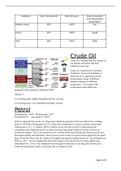
Substance Room Temperature Room Pressure State as standard
room temperature
and pressure
Refinery Gases 20oC 1ATM Gas
Petrol 20oC 1ATM Liquid
Wax 20oC 1ATM Solid
Crude Oil
Crude oil is formed from the remains of
sea animals and plants that died
millions of years ago.
Crude oil is separated by fractional
distillation. Fractional distillation is
when the oil is evaporated, and the
hydrocarbons chains of different
lengths condenses at different
temperatures. The length of the
hydrocarbon chain affects the
properties of the substance (Manfred, 2009).
(Image 1)
Low boiling point: highly flammable and low viscosity
Low boiling point: very flammable and high viscosity
Petrol
Melting point - 100oC - Boiling point 125oC
Flashpoint-43oC Auto ignition- 280oC
Petrol is obtained from crude oil; it has many beneficial properties for its use. Petrol has a melting
point of -100 and a boiling point of 125, on hot days temperatures in many countries can be high
reaching up to 56.7 °C (Migiro, 2019). If petrol was to turn into a solid it would clog up the
combustion and would prevent the car from moving as the liquid would not be able to travel up
towards the engine. This is why petrol has low viscosity (Bitesize) allowing the liquid to travel up to
the engine quickly and efficiently, when it travels it has to turn in to gas by being ignited by the spark
plug, which then flows into the engine, this happens through the flashpoint process. The flashpoint for
petrol is -43oC , the low temperature allows the liquid to turn into gas for it to burn quickly and
efficiently(FPA, 2015), if the flashpoint was too high it would take a very long time for the car to
reach that temperature which would cause the car metals to melt.
Page 1 of 4
room temperature
and pressure
Refinery Gases 20oC 1ATM Gas
Petrol 20oC 1ATM Liquid
Wax 20oC 1ATM Solid
Crude Oil
Crude oil is formed from the remains of
sea animals and plants that died
millions of years ago.
Crude oil is separated by fractional
distillation. Fractional distillation is
when the oil is evaporated, and the
hydrocarbons chains of different
lengths condenses at different
temperatures. The length of the
hydrocarbon chain affects the
properties of the substance (Manfred, 2009).
(Image 1)
Low boiling point: highly flammable and low viscosity
Low boiling point: very flammable and high viscosity
Petrol
Melting point - 100oC - Boiling point 125oC
Flashpoint-43oC Auto ignition- 280oC
Petrol is obtained from crude oil; it has many beneficial properties for its use. Petrol has a melting
point of -100 and a boiling point of 125, on hot days temperatures in many countries can be high
reaching up to 56.7 °C (Migiro, 2019). If petrol was to turn into a solid it would clog up the
combustion and would prevent the car from moving as the liquid would not be able to travel up
towards the engine. This is why petrol has low viscosity (Bitesize) allowing the liquid to travel up to
the engine quickly and efficiently, when it travels it has to turn in to gas by being ignited by the spark
plug, which then flows into the engine, this happens through the flashpoint process. The flashpoint for
petrol is -43oC , the low temperature allows the liquid to turn into gas for it to burn quickly and
efficiently(FPA, 2015), if the flashpoint was too high it would take a very long time for the car to
reach that temperature which would cause the car metals to melt.
Page 1 of 4


