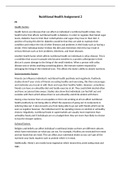
Nutritional Health Assignment 2
P3
Health Factors
Health factors are illnesses that can affect an individual’s nutritional health intake. One
health factor that affects nutritional health is diabetes. In order to regulate their blood sugar
levels, diabetics have to limit their carbohydrates and sugars they have in their diet. A
positive of having this diet for diabetics would be that they are able to maintain their
condition and reduce the risk of other illnesses and problems in their body such as having a
stroke. If the individual doesn’t follow this diet and restrictions then this may result in
serious illnesses such as liver problems, blindness, and heart diseases.
Another health factor which affects nutritional health on individuals is celiac disease. This is
a condition that occurs in people who become sensitive to a protein called gluten in their
diet as it causes damage to the lining of the small intestine. When a person with celiac
disease eats or drinks anything containing gluten, the immune system responds by
damaging the lining of the intestinal tract. This affects the body's ability to absorb nutrients.
Socio-economic Factors
Friends can influence individual’s nutritional health positively and negatively. Positively
studies show if your circle of friends are eating healthy and exercising, this then encourages
and motivates you to join in with them and copy their healthy habits. However, sometimes
friends can have an unhealthy diet and hardly exercise at all. They could drink alcohol often
and have occasional take-aways. Studies also show that individuals can feel left out and
socialize with them which allows them to eat unhealthy and drink alcohol with them.
Having a low income from an occupation or from not working at all can affect nutritional
health positively by not being able to afford the expenses of going out to restaurants or
ordering take out. It also prevents you from being able to go out with friends which can be
seen as negative however, the individual won’t be spending money on alcohol or unhealthy
choices. Negatively, nutritional foods in supermarkets are usually more expensive than
unhealthy foods and if individuals are on a budget then they are more than likely to choose
to buy the cheaper options.
Cultural Factors
Religion and beliefs can affect individual’s nutritional intake as there are different cultures
which have restrictions on what you can eat. For example, Muslims are restricted from meat
and eat foods that are halal. This can affect your nutritional intake as you can’t get all the
nutrients your body requires such as protein which is in meat.
Additionally, Hindu’s are mostly lacto-vegetarian which means they avoid eating meat and
eggs.
, P4
Individual 1
Individual 1 is a 17-year-old girl who has a body weight of 85kg and a height of 5’9. This
means that this child is overweight for their age. This girl has no occupation which could
suggest she has no exercise. Also, she has no medical history however, she is under
investigation for Polycystic Ovary Syndrome. This is an important factor as PCOS can cause
severe weight gain. According to the British Nutrition Society, her daily nutritional
requirements are:
Total Energy Intake- 2462 Kcal
Carbohydrate Intake- 225g- 325g
Protein Intake- 63.75g
Fats Intake- 44g-78g
Sodium- 1600mg
On Saturday 22nd February, Individual 1 consumed 3828 calories of energy. This is 1366
calories more than the daily energy intake requirement is which is a very large amount
above what she should be eating. Additionally, she ate a total of 537g of carbohydrates
which is over double the amount she requires as she should consume between 225 and
325g daily.
However, on Sunday 23rd February, Individual 1 only consumed 898 calories which is
extremely low as their daily requirement should be around 2462 calories daily. This could
suggest she didn’t eat enough that day as all of her other nutrients were under their
average requirements too. For example, she only consumed 109g of carbohydrates which is
around half the amount she should have.
On Thursday 13th February, Individual 1 didn’t consume enough protein as they only had 31g
which is near enough half of what is recommended as she should be consuming around
63.75g. This is something that Individual 1 should work on and try to consume more protein
as insufficient protein reduces lean body mass, muscle strength, and function. On the other
hand, protein was consumed correctly on Sunday 16th February as their intake was 59g and
this is a much better amount because it is much closer to the average daily intake.
Individual 2
Individual 2 is a 55-year-old male who has a body weight of 99kg and a height of 5’10. His
occupation is a lorry driver which suggests there is no physical activity in his job and
therefore, have a higher risk of gaining weight and being unhealthy. His medical history
shows he has high blood pressure and osteoarthritis. According to the British Nutrition
Society, his daily nutritional requirements are:
Total Energy Intake- 2581 Kcal
P3
Health Factors
Health factors are illnesses that can affect an individual’s nutritional health intake. One
health factor that affects nutritional health is diabetes. In order to regulate their blood sugar
levels, diabetics have to limit their carbohydrates and sugars they have in their diet. A
positive of having this diet for diabetics would be that they are able to maintain their
condition and reduce the risk of other illnesses and problems in their body such as having a
stroke. If the individual doesn’t follow this diet and restrictions then this may result in
serious illnesses such as liver problems, blindness, and heart diseases.
Another health factor which affects nutritional health on individuals is celiac disease. This is
a condition that occurs in people who become sensitive to a protein called gluten in their
diet as it causes damage to the lining of the small intestine. When a person with celiac
disease eats or drinks anything containing gluten, the immune system responds by
damaging the lining of the intestinal tract. This affects the body's ability to absorb nutrients.
Socio-economic Factors
Friends can influence individual’s nutritional health positively and negatively. Positively
studies show if your circle of friends are eating healthy and exercising, this then encourages
and motivates you to join in with them and copy their healthy habits. However, sometimes
friends can have an unhealthy diet and hardly exercise at all. They could drink alcohol often
and have occasional take-aways. Studies also show that individuals can feel left out and
socialize with them which allows them to eat unhealthy and drink alcohol with them.
Having a low income from an occupation or from not working at all can affect nutritional
health positively by not being able to afford the expenses of going out to restaurants or
ordering take out. It also prevents you from being able to go out with friends which can be
seen as negative however, the individual won’t be spending money on alcohol or unhealthy
choices. Negatively, nutritional foods in supermarkets are usually more expensive than
unhealthy foods and if individuals are on a budget then they are more than likely to choose
to buy the cheaper options.
Cultural Factors
Religion and beliefs can affect individual’s nutritional intake as there are different cultures
which have restrictions on what you can eat. For example, Muslims are restricted from meat
and eat foods that are halal. This can affect your nutritional intake as you can’t get all the
nutrients your body requires such as protein which is in meat.
Additionally, Hindu’s are mostly lacto-vegetarian which means they avoid eating meat and
eggs.
, P4
Individual 1
Individual 1 is a 17-year-old girl who has a body weight of 85kg and a height of 5’9. This
means that this child is overweight for their age. This girl has no occupation which could
suggest she has no exercise. Also, she has no medical history however, she is under
investigation for Polycystic Ovary Syndrome. This is an important factor as PCOS can cause
severe weight gain. According to the British Nutrition Society, her daily nutritional
requirements are:
Total Energy Intake- 2462 Kcal
Carbohydrate Intake- 225g- 325g
Protein Intake- 63.75g
Fats Intake- 44g-78g
Sodium- 1600mg
On Saturday 22nd February, Individual 1 consumed 3828 calories of energy. This is 1366
calories more than the daily energy intake requirement is which is a very large amount
above what she should be eating. Additionally, she ate a total of 537g of carbohydrates
which is over double the amount she requires as she should consume between 225 and
325g daily.
However, on Sunday 23rd February, Individual 1 only consumed 898 calories which is
extremely low as their daily requirement should be around 2462 calories daily. This could
suggest she didn’t eat enough that day as all of her other nutrients were under their
average requirements too. For example, she only consumed 109g of carbohydrates which is
around half the amount she should have.
On Thursday 13th February, Individual 1 didn’t consume enough protein as they only had 31g
which is near enough half of what is recommended as she should be consuming around
63.75g. This is something that Individual 1 should work on and try to consume more protein
as insufficient protein reduces lean body mass, muscle strength, and function. On the other
hand, protein was consumed correctly on Sunday 16th February as their intake was 59g and
this is a much better amount because it is much closer to the average daily intake.
Individual 2
Individual 2 is a 55-year-old male who has a body weight of 99kg and a height of 5’10. His
occupation is a lorry driver which suggests there is no physical activity in his job and
therefore, have a higher risk of gaining weight and being unhealthy. His medical history
shows he has high blood pressure and osteoarthritis. According to the British Nutrition
Society, his daily nutritional requirements are:
Total Energy Intake- 2581 Kcal