Summary Food Flavour Design
Lipid oxidation
Lipids in food can be:
• Triacylglycerols (non-polar) → glycerol backbone with 3 fatty acids esterified
• Phospholipids (polar) → glycerol backbone with 2 fatty acids and 1 phospho-group (amphiphilic
molecules → used as emulsifiers in food)
Function of lipids inf food:
• Texture, mouthfeel, melting properties
• Structure of foods (think for instance emulsifiers)
• Nutrition because source of energy, essential fatty acids and vitamins
• Cooking (for instance frying)
• Flavour (+ specific flavour – off flavour because of oxidation)
Fatty acids
• Saturated = no double bonds
• Unsaturated = 1 or more double bonds
o Cis: hydrogen atoms are on the same side of the
molecules
o Trans: hydrogen atoms stick out on opposite side of
the molecule → sterically hinder each other
• Methylene interrupted means that the structure of a
polyunsaturated fatty acid is: double bond – single bond – single bond- double bond.
• Nomenclature of unsaturated fatty acids
o First number = number of carbons
o Second number = number of double bonds
o ω nomenclature → ω3 because calculated from the methyl terminal (right) the first
double bond is at place 3.
o Δ nomenclature → Δ9,12,15 because first double bond is on place 9 calculated from the
carboxy terminal (left)
• Composition o fatty acids can be measured after lipid extraction and derivatization into fatty
acid methyl esters by gas chromatography. Profile depends on food source.
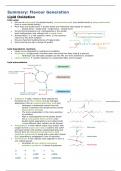
Lipid oxidation reaction
• Reaction between unsaturated fatty acid and oxygen
• Lipid oxidation can be subdivided into 3 mains steps:
o Initiation → light, metals or ROS (reactive species) catalyse the formation of an alkyl
radical (L•) from an unsaturated lipid (LH)
o Propagation → alkyl radical (L•) reacts with oxygen and forms a peroxyl radical (LOO•).
This LOO• will react further with another unsaturated fatty acid (LH) to form an
hydroperoxide (primary lipid oxidation production, LOOH), along with a new alkyl
radical (L•), generating a propagation circle of reactions.
o Termination → non-radical secondary oxidation products are formed (can be volatile
and non-volatile compounds)
, Detail about the different steps
• Initiation (hydrogen abstraction, formation of conjugated diene pattern)
o Hydrogen is abstracted from unsaturated fatty acid (LH) so alkyl radical forms (L•)
o Reaction is catalysed by heat, light, metals or reactive species
o H is abstracted from carbon in between two double bonds because here the dissociation
energy is the lowest.
o The more unsaturated (more double bonds), the more sensitive to oxidation
o After the abstraction of the hydrogen, the double bonds will rearrange (to conjugated
diene system: double – single – double) and two different alkyl radicals will be formed.
o If the original double bond was on 9-10 and 12-13, the new double bonds will be on
10-11 and 12-13 and on 9-10 and 11-12.
• Propagation (reaction with O2 and a new unsaturated fatty acid to form hydroperoxides)
o Alkyl radical (L•) + oxygen → peroxyl radical (LOO•) + unsaturated fatty acid →
hydroperoxide (LOOH) + alkyl radical (L•)
o The oxygen can react with the two alkyl radicals that are formed during initiation. They
do this at one carbon away from the double bond, so 9 and 13 in this example.
• Termination
o (1) Dimers or polymers (non-radical species) are formed by reaction of two radicals
▪ Happens under low oxygen pressure or by peroxyl radicals LOO•
▪ Non-radical species increase oil viscosity
o (2) Degradation of hydroperoxides (primary oxidation products) into (non)-volatiles.
▪ (1) Alkoxy radical (LO•) is formed by loosing OH from hydroperoxide
▪ (2) After that, beta-scission (breaking down into smaller compounds) of the
alkoxy radical teaks place at both sides because radical is unstable → formation
of an aldehyde and a radical molecule.
▪ This radical molecule can react further and forms hydrocarbon and alcohol.
▪ Beta-scission of some molecules can result in formation of hexanal.
Kinetic (time) aspects of lipid oxidation
• Less anti-oxidants over time because they are used
• PUFAs (poly unsaturated fatty acids) decrease over time because they are oxidized
• Oxygen consumption will increase over time because oxygen reacts with alkyl radicals
• Hydroperoxides are formed but also broken down because of beta-scission.
Lipid oxidation
Lipids in food can be:
• Triacylglycerols (non-polar) → glycerol backbone with 3 fatty acids esterified
• Phospholipids (polar) → glycerol backbone with 2 fatty acids and 1 phospho-group (amphiphilic
molecules → used as emulsifiers in food)
Function of lipids inf food:
• Texture, mouthfeel, melting properties
• Structure of foods (think for instance emulsifiers)
• Nutrition because source of energy, essential fatty acids and vitamins
• Cooking (for instance frying)
• Flavour (+ specific flavour – off flavour because of oxidation)
Fatty acids
• Saturated = no double bonds
• Unsaturated = 1 or more double bonds
o Cis: hydrogen atoms are on the same side of the
molecules
o Trans: hydrogen atoms stick out on opposite side of
the molecule → sterically hinder each other
• Methylene interrupted means that the structure of a
polyunsaturated fatty acid is: double bond – single bond – single bond- double bond.
• Nomenclature of unsaturated fatty acids
o First number = number of carbons
o Second number = number of double bonds
o ω nomenclature → ω3 because calculated from the methyl terminal (right) the first
double bond is at place 3.
o Δ nomenclature → Δ9,12,15 because first double bond is on place 9 calculated from the
carboxy terminal (left)
• Composition o fatty acids can be measured after lipid extraction and derivatization into fatty
acid methyl esters by gas chromatography. Profile depends on food source.
Lipid oxidation reaction
• Reaction between unsaturated fatty acid and oxygen
• Lipid oxidation can be subdivided into 3 mains steps:
o Initiation → light, metals or ROS (reactive species) catalyse the formation of an alkyl
radical (L•) from an unsaturated lipid (LH)
o Propagation → alkyl radical (L•) reacts with oxygen and forms a peroxyl radical (LOO•).
This LOO• will react further with another unsaturated fatty acid (LH) to form an
hydroperoxide (primary lipid oxidation production, LOOH), along with a new alkyl
radical (L•), generating a propagation circle of reactions.
o Termination → non-radical secondary oxidation products are formed (can be volatile
and non-volatile compounds)
, Detail about the different steps
• Initiation (hydrogen abstraction, formation of conjugated diene pattern)
o Hydrogen is abstracted from unsaturated fatty acid (LH) so alkyl radical forms (L•)
o Reaction is catalysed by heat, light, metals or reactive species
o H is abstracted from carbon in between two double bonds because here the dissociation
energy is the lowest.
o The more unsaturated (more double bonds), the more sensitive to oxidation
o After the abstraction of the hydrogen, the double bonds will rearrange (to conjugated
diene system: double – single – double) and two different alkyl radicals will be formed.
o If the original double bond was on 9-10 and 12-13, the new double bonds will be on
10-11 and 12-13 and on 9-10 and 11-12.
• Propagation (reaction with O2 and a new unsaturated fatty acid to form hydroperoxides)
o Alkyl radical (L•) + oxygen → peroxyl radical (LOO•) + unsaturated fatty acid →
hydroperoxide (LOOH) + alkyl radical (L•)
o The oxygen can react with the two alkyl radicals that are formed during initiation. They
do this at one carbon away from the double bond, so 9 and 13 in this example.
• Termination
o (1) Dimers or polymers (non-radical species) are formed by reaction of two radicals
▪ Happens under low oxygen pressure or by peroxyl radicals LOO•
▪ Non-radical species increase oil viscosity
o (2) Degradation of hydroperoxides (primary oxidation products) into (non)-volatiles.
▪ (1) Alkoxy radical (LO•) is formed by loosing OH from hydroperoxide
▪ (2) After that, beta-scission (breaking down into smaller compounds) of the
alkoxy radical teaks place at both sides because radical is unstable → formation
of an aldehyde and a radical molecule.
▪ This radical molecule can react further and forms hydrocarbon and alcohol.
▪ Beta-scission of some molecules can result in formation of hexanal.
Kinetic (time) aspects of lipid oxidation
• Less anti-oxidants over time because they are used
• PUFAs (poly unsaturated fatty acids) decrease over time because they are oxidized
• Oxygen consumption will increase over time because oxygen reacts with alkyl radicals
• Hydroperoxides are formed but also broken down because of beta-scission.