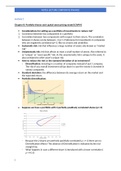
NOTES LECTURE CORPORATE FINANCE
Lecture 1
Chapter 8: Portfolio theory and capital asset pricing model (CAPM)
Considerations for setting up a portfolio of investments to reduce risk”
1. Covariance between two components in a portfolio
2. Correlation between two components with respect to their return. The correlation
between 2 shares can be between -1<p<1. Preference for investments in companies
who are negatively correlated (p=-1) like ice creams and umbrellas.
Systematic risk: risk that influences a large number of assets also known as “market
risk”
Unsystematic risk: risk that affects at most a small number of assets. Also referred to
as “unique” or “asset specific”risk. As the unsystematic risk is unique to the asset, it
also unrelated to other asset’s unique risk.
How to reduce the risk i.e the standard deviation of an investment?
- Diversification: investing in a number of companies instead of just 1 company.
The risk of you overall investment will go down in case the money is invested in
various companies.
Standard deviation: the difference between de average return on the market and
the expected return.
Portfolio diversification:
Suppose we have a portfolio with 2 perfectly positively correlated shares (p=+1)
- Because the 2 shares are perfectly positively correlated ( ρ=+ 1) there are no
Diversification effects! The absence of Diversification is indicated by the red
straight line.
- What happens in case a different share is introduced with a lower correlation (
ρ=+ 0.6 )
1
, NOTES LECTURE CORPORATE FINANCE
- As a result of diversification the blue line makes a turn (compared to the red
line). It now becomes plain that a reduction of risk (lower SD) can be achieved
whilst obtaining a higher return or obtaining a higher return with the same
original risk (=standard deviation)
- Mathematically:
o Expected return is the weighted average of the returns of A and B:
o R portfolio =ωa Ra +(1−ω a) Rb
o The variance of the portfolio returns:
o σ 2portfolio =ω2a σ 2a +2 ωa ( 1−ω a ) ρ ab σ a σ b + ( 1−ω a ) 2σ 2b
o The portfolio variance can also be described as:
o σ 2portfolio =ω2a σ 2a +2 ωa ( 1−ω a ) Cov ( Ra , Rb ) + ( 1−ω a ) 2 σ 2b
o Covariance between 2 shares is defined as:
o Cov ( Ra , R b)=σ ab =ρab σ a σ b
Risk premium r −r f
o Sharpe ratio= =
Standard deviation σ
- Beta (B):
o σ i ,m : covariance with market
o σ 2m : variance of market
o Because Unsystematic risk can be diversified only Systematic risk is priced
in the market
Overview risk:
2
, NOTES LECTURE CORPORATE FINANCE
Portfolio theory: the intention is to make an efficient portfolio where expected
return is balanced against the
risk appreciation. To find the optimal portfolio we use the efficient frontier
- Investors can borrow or lend against the risk free rate rf belonging to the riskfree
assets allowing
a higher return
as of 5 superior
returns can be
realized.
In relation to the market: risk and return: security market line
SML, CAPM and reward-to-risk ratio for an asset:
3
, NOTES LECTURE CORPORATE FINANCE
Definitions Formula:
- The pure time value of money: As measured by the risk-free rate, Rf, this is
reward for merely waiting for your money, without taking any risk.
- The reward for bearing systematic risk: As measured by the market risk
premium, E(RM)-Rf, this component is the reward the market offers for bearing
an average amount of systematic risk in addition to waiting
- The amount of systematic risk: as measured by B1, this is the amount of
systematic risk present in a particular asset or portfolio, relative to that in an
average asset
In equilibrium, the reward-to-risk ratio must be the same for all the assets in the
market:
Alternative theories:
- Arbitrage Pricing Theory: The expected risk premium (r −r f ) is dependent on
certain macroeconomic factors and possible events specific to the company (see
page 213) See as an example the Three factor Model (Fama & French) to explain
the returns of companies. (Bachelor Thesis material / regression Analysis.)
4
Lecture 1
Chapter 8: Portfolio theory and capital asset pricing model (CAPM)
Considerations for setting up a portfolio of investments to reduce risk”
1. Covariance between two components in a portfolio
2. Correlation between two components with respect to their return. The correlation
between 2 shares can be between -1<p<1. Preference for investments in companies
who are negatively correlated (p=-1) like ice creams and umbrellas.
Systematic risk: risk that influences a large number of assets also known as “market
risk”
Unsystematic risk: risk that affects at most a small number of assets. Also referred to
as “unique” or “asset specific”risk. As the unsystematic risk is unique to the asset, it
also unrelated to other asset’s unique risk.
How to reduce the risk i.e the standard deviation of an investment?
- Diversification: investing in a number of companies instead of just 1 company.
The risk of you overall investment will go down in case the money is invested in
various companies.
Standard deviation: the difference between de average return on the market and
the expected return.
Portfolio diversification:
Suppose we have a portfolio with 2 perfectly positively correlated shares (p=+1)
- Because the 2 shares are perfectly positively correlated ( ρ=+ 1) there are no
Diversification effects! The absence of Diversification is indicated by the red
straight line.
- What happens in case a different share is introduced with a lower correlation (
ρ=+ 0.6 )
1
, NOTES LECTURE CORPORATE FINANCE
- As a result of diversification the blue line makes a turn (compared to the red
line). It now becomes plain that a reduction of risk (lower SD) can be achieved
whilst obtaining a higher return or obtaining a higher return with the same
original risk (=standard deviation)
- Mathematically:
o Expected return is the weighted average of the returns of A and B:
o R portfolio =ωa Ra +(1−ω a) Rb
o The variance of the portfolio returns:
o σ 2portfolio =ω2a σ 2a +2 ωa ( 1−ω a ) ρ ab σ a σ b + ( 1−ω a ) 2σ 2b
o The portfolio variance can also be described as:
o σ 2portfolio =ω2a σ 2a +2 ωa ( 1−ω a ) Cov ( Ra , Rb ) + ( 1−ω a ) 2 σ 2b
o Covariance between 2 shares is defined as:
o Cov ( Ra , R b)=σ ab =ρab σ a σ b
Risk premium r −r f
o Sharpe ratio= =
Standard deviation σ
- Beta (B):
o σ i ,m : covariance with market
o σ 2m : variance of market
o Because Unsystematic risk can be diversified only Systematic risk is priced
in the market
Overview risk:
2
, NOTES LECTURE CORPORATE FINANCE
Portfolio theory: the intention is to make an efficient portfolio where expected
return is balanced against the
risk appreciation. To find the optimal portfolio we use the efficient frontier
- Investors can borrow or lend against the risk free rate rf belonging to the riskfree
assets allowing
a higher return
as of 5 superior
returns can be
realized.
In relation to the market: risk and return: security market line
SML, CAPM and reward-to-risk ratio for an asset:
3
, NOTES LECTURE CORPORATE FINANCE
Definitions Formula:
- The pure time value of money: As measured by the risk-free rate, Rf, this is
reward for merely waiting for your money, without taking any risk.
- The reward for bearing systematic risk: As measured by the market risk
premium, E(RM)-Rf, this component is the reward the market offers for bearing
an average amount of systematic risk in addition to waiting
- The amount of systematic risk: as measured by B1, this is the amount of
systematic risk present in a particular asset or portfolio, relative to that in an
average asset
In equilibrium, the reward-to-risk ratio must be the same for all the assets in the
market:
Alternative theories:
- Arbitrage Pricing Theory: The expected risk premium (r −r f ) is dependent on
certain macroeconomic factors and possible events specific to the company (see
page 213) See as an example the Three factor Model (Fama & French) to explain
the returns of companies. (Bachelor Thesis material / regression Analysis.)
4