Strategic Management Summary
Maureen Koek
Chapter 1: The Concept of Strategy
The four common elements in successful strategies:
1. Goals that are consistent and long-term
2. Profound understanding of the competitive environment
a. Understanding the external environment
3. Objective appraisal of resources
4. Effective implementation
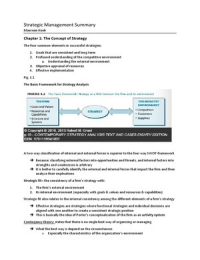
Fig. 1.1
The Basic Framework for Strategy Analysis
A two-way classification of internal and external forces is superior to the four way SWOT-framework
Because: classifying external factors into opportunities and threats, and internal factors into
strengths and weaknesses is arbitrary
It is better to carefully identify the external and internal forces that impact the firm and then
analyze their implications
Strategic fit= the consistency of a firm’s strategy with:
1. The firm’s external environment
2. Its internal environment (especially with goals & values and resources & capabilities)
Strategic fit also relates to the internal consistency among the different elements of a firm’s strategy
Effective strategies are strategies where functional strategies and individual decisions are
aligned with one another to create a consistent strategic position
This is basically the idea of Porter’s conceptualization of the firm as an activity system
Contingency theory: states that there is no single best way of organizing or managing
What the best way is depend on the circumstances
o Especially the characteristics of the organization’s environment
,Strategy is the overall plan for deploying resources to establish a favorable position
A tactic is a scheme for a specific action
Strategic decisions:
- Are important
- Involve a significant commitment of resources
- Are not easily reversible
There is no general theory of strategy
Game theory tried to achieve one, but has only achieved limited success
First, companies used corporate planning (long-term planning)
This didn’t work because companies couldn’t plan this far ahead.
Therefore, Strategic Management focusses on competition as the central characteristic of
the business environment and on performance maximization as the primary goal of strategy
Resource-based view of the firm: Puts emphasis on internal resources and capabilities to identify
how a firm is different from their competitors and design strategies to exploit these differences
Strategy:
- Is focused on achieving certain goals
- Involves allocating resources
- Implies some consistency, integration, or cohesiveness of decisions and actions
Strategy has become less concerned with detailed plans and more about guidelines for
success
, Why do firms need strategy?
Strategy assists the effective management of organizations by:
1. enhancing the quality of decision making
2. facilitating coordination
3. focusing organizations on the pursuit of long-term goals
Strategy improves decision making in several ways:
- It simplifies decision making by constraining the range of decision alternatives considered
and acts as a heuristic – a rule of thumb that reduces the search required to find solution to a
decision problem
- The strategy-making process permits the knowledge of different individuals to be pooled and
integrated
- It facilitates the use of analytic tools
Strategy as a Coordinating Device: communicating the identity, goals and positioning of the company
to all organizational members
Strategy as Target: To set aspirations that can motivate and inspire members.
Strategic intent creates an extreme misfit between resources and ambitions. Top
management challenges the organization to close the gap by building new competitive
advantages -> more about stretch and resource leverage than about fit and resource
allocation
A company’s strategy can be found in three places:
1. In the heads of managers
2. In their articulations of strategy in speeches and written documents
3. In the decisions through which strategy is enacted
Four types of statement through which companies communicate their strategies:
1. The mission statement describes organizational purpose (Why do we exis?t)
2. A statement of principles or values (What we believe in and how we will behave)
3. The vision statement (What we want to be)
4. The strategy statement articulates the company’s competitive game plan, which typically
comprises statements of objectives, business scope, and advantage
Checking strategy statements against the actual decisions and behaviors is essential to close the gap
between rhetoric and reality.
Corporate strategy defines the scope of the firm in terms of the industries and markets in which it
competes (Where?)
- Diversification
- Vertical integration
- Acquisitions and new ventures
- Allocation of resources between the different business of the firm
Business strategy is concerned with how the firm competes within a particular industry or market ->
also referred to as competitive strategy (How?)
Maureen Koek
Chapter 1: The Concept of Strategy
The four common elements in successful strategies:
1. Goals that are consistent and long-term
2. Profound understanding of the competitive environment
a. Understanding the external environment
3. Objective appraisal of resources
4. Effective implementation
Fig. 1.1
The Basic Framework for Strategy Analysis
A two-way classification of internal and external forces is superior to the four way SWOT-framework
Because: classifying external factors into opportunities and threats, and internal factors into
strengths and weaknesses is arbitrary
It is better to carefully identify the external and internal forces that impact the firm and then
analyze their implications
Strategic fit= the consistency of a firm’s strategy with:
1. The firm’s external environment
2. Its internal environment (especially with goals & values and resources & capabilities)
Strategic fit also relates to the internal consistency among the different elements of a firm’s strategy
Effective strategies are strategies where functional strategies and individual decisions are
aligned with one another to create a consistent strategic position
This is basically the idea of Porter’s conceptualization of the firm as an activity system
Contingency theory: states that there is no single best way of organizing or managing
What the best way is depend on the circumstances
o Especially the characteristics of the organization’s environment
,Strategy is the overall plan for deploying resources to establish a favorable position
A tactic is a scheme for a specific action
Strategic decisions:
- Are important
- Involve a significant commitment of resources
- Are not easily reversible
There is no general theory of strategy
Game theory tried to achieve one, but has only achieved limited success
First, companies used corporate planning (long-term planning)
This didn’t work because companies couldn’t plan this far ahead.
Therefore, Strategic Management focusses on competition as the central characteristic of
the business environment and on performance maximization as the primary goal of strategy
Resource-based view of the firm: Puts emphasis on internal resources and capabilities to identify
how a firm is different from their competitors and design strategies to exploit these differences
Strategy:
- Is focused on achieving certain goals
- Involves allocating resources
- Implies some consistency, integration, or cohesiveness of decisions and actions
Strategy has become less concerned with detailed plans and more about guidelines for
success
, Why do firms need strategy?
Strategy assists the effective management of organizations by:
1. enhancing the quality of decision making
2. facilitating coordination
3. focusing organizations on the pursuit of long-term goals
Strategy improves decision making in several ways:
- It simplifies decision making by constraining the range of decision alternatives considered
and acts as a heuristic – a rule of thumb that reduces the search required to find solution to a
decision problem
- The strategy-making process permits the knowledge of different individuals to be pooled and
integrated
- It facilitates the use of analytic tools
Strategy as a Coordinating Device: communicating the identity, goals and positioning of the company
to all organizational members
Strategy as Target: To set aspirations that can motivate and inspire members.
Strategic intent creates an extreme misfit between resources and ambitions. Top
management challenges the organization to close the gap by building new competitive
advantages -> more about stretch and resource leverage than about fit and resource
allocation
A company’s strategy can be found in three places:
1. In the heads of managers
2. In their articulations of strategy in speeches and written documents
3. In the decisions through which strategy is enacted
Four types of statement through which companies communicate their strategies:
1. The mission statement describes organizational purpose (Why do we exis?t)
2. A statement of principles or values (What we believe in and how we will behave)
3. The vision statement (What we want to be)
4. The strategy statement articulates the company’s competitive game plan, which typically
comprises statements of objectives, business scope, and advantage
Checking strategy statements against the actual decisions and behaviors is essential to close the gap
between rhetoric and reality.
Corporate strategy defines the scope of the firm in terms of the industries and markets in which it
competes (Where?)
- Diversification
- Vertical integration
- Acquisitions and new ventures
- Allocation of resources between the different business of the firm
Business strategy is concerned with how the firm competes within a particular industry or market ->
also referred to as competitive strategy (How?)