
GNUR 294 (GNUR 294 (GNUR294))
Loyola University Chicago
Here are the best resources to pass GNUR 294 (GNUR 294 (GNUR294)). Find GNUR 294 (GNUR 294 (GNUR294)) study guides, notes, assignments, and much more.

Exam (elaborations)
GNUR 294|GNUR 294 ATI Comprehensive - Predictor review LATEST UPDATE 2020. 100% PASS.
GNUR 294 Comprehensive ATI Predictor Review/GNUR 294 Comprehensive ATI Predictor Review/GNUR 294 Comprehensive ATI Predictor Review/GNUR 294 Comprehensive ATI Predictor Review
 AsAchiever
Exam (elaborations)
Comprehensive ATI- Predictor review questions with correct answers
Comprehensive ATI- Predictor review 1. A nurse is assessing a client who has left-sided heart failure. Which of the following symptoms should the nurse identify as the highest priority? 2. A nurse in the emergency department is assisting with the suturing of a laceration to the client’s face. Which of the following actions should the nurse take? A nurse is assessing a client 1 hr following delivery and notes that her uterus is boggy and….to the umbilicus. Which of the following actions shoul...
 Hampton

Exam (elaborations)
GNUR 294|GNUR 294 ATI Comprehensive - Predictor review LATEST UPDATE 2020. 100% PASS.
GNUR 294 Comprehensive ATI Predictor Review/GNUR 294 Comprehensive ATI Predictor Review/GNUR 294 Comprehensive ATI Predictor Review/GNUR 294 Comprehensive ATI Predictor Review
 oassignment

Exam (elaborations)
GNUR 294|GNUR 294 ATI Comprehensive - Predictor review LATEST UPDATE 2020. 100% PASS.
GNUR 294 Comprehensive ATI Predictor Review/GNUR 294 Comprehensive ATI Predictor Review/GNUR 294 Comprehensive ATI Predictor Review/GNUR 294 Comprehensive ATI Predictor
oassignment

Exam (elaborations)
GNUR 294 EXAM ;Cardiovasuclar
GNUR 294 EXAM III Autonomic Nervous System • Focus on the sympathetic nervous system • PNS does the opposite of the SNS • Adrenergic- adrenaline • Norepinephrine • Helps to bind with these receptors and make a response in the system • Alpha receptors and beta receptors • Almost al the drugs (from a cardiovascular standpoint) will effect these receptors i.e. beta 2- adrenergic agonists • Sympathetic- fight or flight • All of these things that occur when NE is released and binds ...
oassignment

Other
GNUR 294 EXAM 3 STUDY GUIDE (INFORMATIVE & RATED 100%) | Loyola University Chicago
GNUR 294 EXAM 3 STUDY GUIDE (INFORMATIVE & RATED 100%) | Loyola University Chicago
DrQUIZ

Case
GNUR 294 Case Study Exam III- pharm | RATED 100%
Case Study Exam III • Probably has a lot of stress due to work because he owns his own store, higher level of stress than someone that works a regular job. Also works with wife who works in score, and might not eat the healthiest. • PMH is positive for hypertension, dyslipidemia, and a MI three years ago followed by four-vessel coronary artery bypass surgery. The patient has been asymptomatic since surgery with no complaints for chest pain o No chest pain good because he is perfusing,...
DrQUIZ
Exam (elaborations)
GNUR 294 EXAM III- ANS & Cardiovasuclar | RATED 100%
GNUR 294 EXAM III Autonomic Nervous System • Focus on the sympathetic nervous system • PNS does the opposite of the SNS • Adrenergic- adrenaline • Norepinephrine • Helps to bind with these receptors and make a response in the system • Alpha receptors and beta receptors • Almost al the drugs (from a cardiovascular standpoint) will effect these receptors i.e. beta 2- adrenergic agonists • Sympathetic- fight or flight • All of these things that occur when NE is relea...
DrQUIZ

Exam (elaborations)
GNUR 294 EXAM III- nursing application | rated 100%
GNUR 294 EXAM III Nursing Application- Adrenergic Agonists • Monitor frequently of VS, urinary and cardiac output as appropriate, especially if IV used • Assess for adverse and report adverse effects: tachycardia, HTN, dysrhythmias, tremors, dysrhythmias, tremors, dizziness, headache, or decrease UO. Severe HTN, seizures or angina may signal drug toxicity report immediately • Raising the head of the bed during dyspnea will supplement therapeutic drug effects and optimize the outcome...
DrQUIZ

Exam (elaborations)
GNUR 294 EXAM III Pharmacotherapy of Dyslipidemia | rated 100%
GNUR 294 EXAM III Pharmacotherapy of Dyslipidemia • Lipids are the culprit that help increase the levels of plaque inside the walls • Three types of lipids that the drugs are going to effect • LDL- “bad”, forms the plaque in the vessel walls • HDL- remove LDL from the bloodstream to be metabolized by the liver • Want LDL levels to be low, HDL to be high, the higher the better because the lower LDL • VLDLs- triglycerides, they are closely tied to carbohydrate metabolism...
DrQUIZ
Exam (elaborations)
GNUR 294 EXAM IV Pharmacology of Coagulation Disorders | RATED 100%
GNUR 294 EXAM IV Pharmacology of Coagulation Disorders • Affects the clotting factors- anticoagulants • Prevent platelets aggregation, doesn’t change number of platelets- antiplatelet • Breaks down clot formation- thrombolytic drugs • Anticoagulants & Antiplatelets don’t break down clots • Drugs are geared towards one of these processes • A normal response • When you damage blood vessels, and there is injury the first thing to control hemodynamics and homeostasis, t...
DrQUIZ

Exam (elaborations)
GNUR 294 FINAL EXAM- Pharmacotherapy of Alzheimers & Seizures | RATED 100%
GNUR 294 FINAL EXAM Pharmacotherapy of Alzheimer’s Disease • Builds up these plaques and deposited between the nerve cells • When between the nerve cells cannot transmit nerve signals • Develop mainly in the area in which you learn and retain new information • Long term memory can stay intact, but the ability to learn new information is affected • The nerve fibers and cells become tangled • Begins slowly, the patient is aware that they are losing memory • We know what...
DrQUIZ

Exam (elaborations)
GNUR 294 FINAL EXAM- Pharmacotherapy of Antiinfectives | RATED 100%
Pharmacotherapy of Infectious Diseases • Talking about bacterial infections, most prominent • Antibiotics • They don’t affect viral infections at all • They best most effective approach is prevention i.e. hand washing • Patients may allergies, pregnant, some host factors that will come into play • Antibiotic resistance- acquired, becoming a major proble clinical settings • Organisms to become resistance to the drugs • Bacteria can build up a defense i.e. MRS, VRE, MDRO...
DrQUIZ

Exam (elaborations)
GNUR 294 FINAL EXAM- Pharmacotherapy of Antivirals | RATED 100%
GNUR 294 FINAL EXAM Pharmacotherapy of Non-HIV Viral Infections • Viruses differ from bacteria in the sense they are compromised of a few molecules • Intracellular parasites, present in many places, some very lethal, some can co-exist • The issue with viruses that make them so difficult is because they used the host cell, they are very difficult to kill • Anti-viral drugs are the least effective • Mutate very rapidly, resistance develops because antiviral medication is geared...
DrQUIZ

Exam (elaborations)
GNUR 294 FINAL EXAM- Pharmacotherapy of Edocrine System ( RATED 100% ) : Loyola University Chicago
GNUR 294 FINAL EXAM Pharmacotherapy of the Endocrine System: Diabetes & Thyroid Disorders • In terms of a patient with diabetes we know that it’s a disorder of normal carbohydrate metabolism • Cells rely on glucose for ATP and energy production • Two organs that keep glucose levels within normal range • Pancreas and liver • Beta cell produces-insulin • Alpha- glucagon • Drives the glucose from the bloodstream into the cells to use and then rest goes to liver to be st...
DrQUIZ
Exam (elaborations)
GNUR 294 FINAL Nursing Applications ( RATED 100% ) : Loyola University Chicago
GNUR 294 FINAL Nursing Applications Nursing Applications: Coagulation • Evaluate lab findings (aPTT, PT/INR, bleeding time), CBC, platelets, renal and liver function studies, ABGs as appropriate, lipid profiles. • Monitor vital signs and ECG every 15 mins during first hour of infusion, and then every 30 min during the remainder of the infusion. Continue to monitor vital signs 1h for the first 8h following the infusion • Monitor neurologic status frequently, especially if thrombol...
DrQUIZ
Other
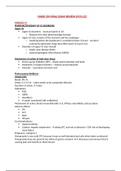
Gnur 294 Final Exam Review(Study Guide) | Rated 100%
GNUR 294 FINAL EXAM REVIEW (M19-22) MODULE 19 PHARMACOTHERAPY OF GI DISORDERS Upper GI • Upper GI disorders – most prevalent in US o Requires the most pharmacologic therapy • Upper GI tract consists of the stomach and the esophagus o Anything below the duodenum is considered lower GI tract – we don’t commonly administer drugs that effect lower GI tract in US • Disorders of upper GI tract include o Peptic ulcer disease (PUD) o Gastroesophageal reflux disease (GERD) Mech...
DrQUIZ

Exam (elaborations)
GNUR 294 Pharm Exam 4 | RATED 100%
GNUR 294 Pharm Exam 4
DrQUIZ

Other
Gnur 294 Exam 3 Review(Study Guide) : Rated 100%
GNUR 294 EXAM 3 REVIEW (M14-18) MODULE 14 PHARMACOTHERAPY OF ENDOCRINE SYSTEM Diabetes Mellitus Diabetes – disorder of CHO metabolism • Cells prefer glucose for energy metabolism • Normal BG level 60-100 mg/dL • If high BG (hyperglycemic) ? pancreas releases insulin ? cells take up glucose from blood and liver produces glycogen (remainder of insulin not used is brought to liver, converted to glycogen and stored) ? BG falls • If low BG (hypoglycemic) ? pancreas releases glucag...
DrQUIZ

Exam (elaborations)
Gnur 294 Exam 3(Verified)
Classification Prototype Routes, Onset, Duration of Action Mechanisms of Action Indications Contraindications Adverse Effects Pregnancy Drug Interactions Nursing Responsibilities • Thyroid Hormone Replacement • Synthetic T4 • Levoyhtroxine (Synthroid, Levothyroid, etc.) o Liothyronine (cytomel) o Liotrix (thyrolar) o Thyroid, desiccated (armour) • PO, IV (myxedema coma) • PO: slow onset • IV: 6-8 hrs • DOA: 1-3 weeks, half life 6-7 days • Identical to thyroid hormone: increasing ...
 STUDYGRADER