

GNUR 294 EXAM IV Pharmacology of Coagulation Disorders | RATED 100%
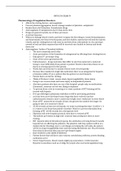
GNUR 294 EXAM IV Pharmacology of Coagulation Disorders • Affects the clotting factors- anticoagulants • Prevent platelets aggregation, doesn’t change number of platelets- antiplatelet • Breaks down clot formation- thrombolytic drugs • Anticoagulants & Antiplatelets don’t break down clots • Drugs are geared towards one of these processes • A normal response • When you damage blood vessels, and there is injury the first thing to control hemodynamics and homeostasis, the blood vessels spasm, and then builds a matrix that will seal the injured vessels, and the clotting factors will come in and then from a thrombosis to clot, and stays around to heal and then enzymes that will be secreted once healed to destroy and break down clot • Anticoagulant/ Indirect Thrombin Inhibitor o The most commonly used today o Acute prevention of clot formation of enlargement by effecting those clotting factors o Only given IV- prototype drug o Some of the newer generations SQ o Unfractionated – drugs molecules that differ in size from molecule to molecule. Going to react differently from patient to patient. Needs to have labs drawn to see that is it a therapeutic level for patient. o Works fast and well, have to monitor blood work very frequently o Because this considered a high risk medication there is an antagonist for heparin: protamine sulfate. If you a patient that has gotten too much heparin o Patient that is at risk for clotting- o Think of Virchow’s triad- venous stasis, hypercoagulability, tissue injury
Document information
- Uploaded on
- February 18, 2021
- Number of pages
- 2
- Written in
- 2020/2021
- Type
- Exam (elaborations)
- Contains
- Questions & answers


