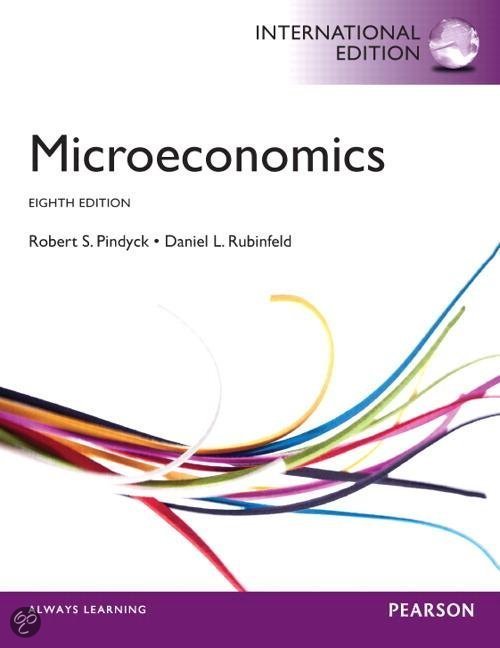
ECON221 MICROECONOMICS ECON 221
STUVIA.CO.ZA
GeekyS – Stuvia.co.za
2013
[MICROECONOMICS]
[Notes for ECON221. Chapters:1-4 , 6-11 & 13. Summarized for exam purposes by using the
prescribed textbook Microeconomics (International Edition) 8thEd. Robert S. Pindyck & Daniel L.
Rubinfeld & class notes ]
, MICROECONOMICS ECON 221
STUVIA.CO.ZA
CHAPTER 1 INTRODUCTION
ECONOMICS
MICRO ECONOMICS MACROECONOMICS
Deals with the behaviour of individual economic Deals with Aggregate economic variables, such
units - Firms, Consumers, Workers & Investors- as Inflation, Economic growth, Total Production,
as well as the markets that these units comprise. Total Income, Unemployment
The extension of microeconomic analysis.
Microeconomic Themes
Microeconomics = about limits Limitations: Limited Time, Limited Resources & Limited Income/
Budget and the choices 1. Ways to make the most of the limitations and 2. How the scarce
resources are allocated.
Microeconomics describes the trade-offs that the role players face and how these trade-offs are best
made.
Consumer, Worker & Firms “Trade-Offs”
Consumer: Workers: Firms:
Limited Income When and where to Limitations in terms of
Spent Income (G&S) vs. enter the workforce? the product
Save Choice of work Limited resources
Labour vs. Leisure
Prices and Markets
Prices determine the “Trade-offs”: Example: Chicken vs. Beef
Firms: Prices are influenced by:
Input prices (cost), output prices Government – Centrally planned
Wages economies.
Consumers: Other market participants – Market
Price of goods and services economies.
, MICROECONOMICS ECON 221
STUVIA.CO.ZA
Theories, Models & Analyses
Theory: Different theories explain the economy.
Consumers Theory:
Describes how consumers maximize their well-being, using their preferences, to make decisions
about trade-offs
Firm Theory:
Describes how trade-offs are best made
Test against observations
Models: Mathematical presentations based on economic theories.
Positive vs. Normative Analysis:
Positive Analysis: Questions that deal with explanation and prediction.
Analysis describing relationships of cause and effect.
What will be the impact of an import quota on foreign cars?
What will be the impact of an increase in the gasoline excise tax?
Normative Analysis: Analysis examining questions of what ought to be.
Often supplemented by value judgements.
Should the Government impose a larger gasoline tax?
Should the G decrease the tariffs on imported cars?
Market
Market Collection of buyers and sellers, through their actual or potential interaction, determine
the prices of products
Buyers: Consumers purchase goods, companies purchase labour inputs.
Sellers: Consumers sell labour, resource owners sell inputs, and firms sell goods.
Market Definition Determination of buyers, Sellers and a range of products that should be
included in a particular market.
Extent of a market Boundaries of a market, both geographical and in terms of range of products
produced and sold within it.
Importance of the Market definition:
Determine the actual and potential competitors.
Price determination & budgeting.
Determine the product boundaries and product characteristics of the market.
Determine the economic policy
Arbitrage Practice of buying at a low price at one location and selling at a higher price in another.
Some markets have on price: price of gold while others have more than one price: laundry
detergent.
Type of Markets:
Perfectly Competitive Market Market with many buyers and sellers, so that no single buyer or
seller has a significant impact on price.
Non-competitive Market: individual firms that jointly affect the price oil.
, MICROECONOMICS ECON 221
STUVIA.CO.ZA
Market Price:Price prevailing in a competitive market.
Real vs. Nominal prices
Nominal Price: Real Price:
Nominal = Now Real=Price of a good Relative to a specific
Absolute price of a good (includes base year
inflation) Adjusted for inflation.
Measures of Prices:
Consumer Price Index (CPI): Measure of aggregate price level.
Inflation1932 = (CPI1932 – CPI1931) / CPI1931 x 100
Producer Price Index (PPI): Measure of aggregate price level for intermediate products and
wholesale goods.
Recap of Chapter 1
Positive and normative analysis;- go beyond explanation to ask such questions as "what is best"?
Markets
Extent of market
Arbitration
Competitive versus non-competitive markets
Real versus nominal prices
CHAPTER 2 DEMAND & SUPPLY
Supply & Demand Analysis
Fundamental & a power tool that can be applied
to a variety of interesting and important
problems, for example:
Understand/ predict how changing world
economic conditions affect market price &
production;
Evaluate impact of policy changers, i.e.
minimum wage
Impact of taxes, tariffs, import quotas on
consumers and producers
, MICROECONOMICS ECON 221
STUVIA.CO.ZA
Supply and Demand
Supply Curve:
Def Relationship between the quantities (Q) of a good /service that producers plan to sell, at each
possible price (P) during a certain period.
Positive slope.
a b
Movement:
On the curve (a) a change in Price
Of the curve (b) other variables than P for example
Lower production cost – supply curve move to the right S' irrespective of P
Quantity stay fixed at Q1- price firms would except to produce
Remember
Determinants:
, MICROECONOMICS ECON 221
STUVIA.CO.ZA
Demand Curve:
Def Relationship between the quantity (Q) of a product/service that potential buyers can afford – the
price (P) and are willing to purchase.
Negative slope.
a b
Movement:
On the curve (b) a change in Price (ΔP)
ONE DEMAND curve
Change in QUANTITY demanded (ΔQd)
NOT a change in DEMAND (Not from Beer Brandy)
Of the curve (a) Change in demand
Determinants: (5)
Substitutes: Two goods for which an increase in the price of one leads to an increase in the quantity demanded
of the other.
Complements: Two goods for which an increase in the price of one, leads to a decrease in the quantity
demanded of the other.
, MICROECONOMICS ECON 221
STUVIA.CO.ZA
The Market Mechanism
Equilibrium (or Market-clearing) price: Price that equates the quantity supplied to the quantity demanded
Qs=Qd
Market Mechanism = Tendency in a free market for price to change until the market clears Equilibrium
Surplus – Excess Supply Shortage – Excess Demand
Market price above equilibrium Market prices below equilibrium
Quantity supplied (Qs) > Quantity demanded (Qd) Quantity supplied (Qs) < Quantity demanded (Qd)
Downward pressure on the price Upward pressure on the P
Quantity demanded increases and quantity Quantity demanded decreases and Q supplied
supplied decreases. Increases
Until Qs=Qd Until Qs=Qd
Changes in Market Equilibrium
, MICROECONOMICS ECON 221
STUVIA.CO.ZA
Conclusion If both the D & S curves shift, the P and Q will depend on:
The relative size and direction of change.
The slope of the curves
Elasticity
Elasticities of Supply & Demand
Elasticity: % change in one variable as a result of a 1% change in another Change in Q resulting from a
change in P.
Price Elasticity of Demand (EPD): % change in quantity demanded of a good resulting from a 1% increase in its
price. E p (%Q) /(%P)
E Q / Q PQ
P / P QP
p
Price Elasticity of Demand:
The % change in a variable is the absolute change in the variable divided by the original level of the variable
Ratio of P/Q at a point on the curve. (Point Elasticity)
Usually a negative number - relationship : if ↑P → ↓Q
Interpretation absolute values
Example: EPD = -2 is 2 in magnitude
EP> -1 EP< -1
Absolute value: Absolute value:
EP> 1→price elastic. EP< 1 → inelastic.
|%Q| > |%P| |%Q| < |% P|
Elasticity depends on the availability of substitutes.
Substitutes:
Product with substitutes will be elastic.
↑P will ↓Q and consumer will buy more of the substitute.
The price elasticity of demand depends not only on the slope of the demand curve but also on the P & Q.
The elasticity, therefore, varies along the curve as price and quantity change. Slope is constant for this
linear demand curve.
Near the top, because price is high and quantity is small, the elasticity is large in magnitude.
The elasticity becomes smaller as we move down the curve.
The steeper the slope of D, the more inelastic the demand is for the goods.
The flatter the slope of D, the more elastic the demand for the product.
STUVIA.CO.ZA
GeekyS – Stuvia.co.za
2013
[MICROECONOMICS]
[Notes for ECON221. Chapters:1-4 , 6-11 & 13. Summarized for exam purposes by using the
prescribed textbook Microeconomics (International Edition) 8thEd. Robert S. Pindyck & Daniel L.
Rubinfeld & class notes ]
, MICROECONOMICS ECON 221
STUVIA.CO.ZA
CHAPTER 1 INTRODUCTION
ECONOMICS
MICRO ECONOMICS MACROECONOMICS
Deals with the behaviour of individual economic Deals with Aggregate economic variables, such
units - Firms, Consumers, Workers & Investors- as Inflation, Economic growth, Total Production,
as well as the markets that these units comprise. Total Income, Unemployment
The extension of microeconomic analysis.
Microeconomic Themes
Microeconomics = about limits Limitations: Limited Time, Limited Resources & Limited Income/
Budget and the choices 1. Ways to make the most of the limitations and 2. How the scarce
resources are allocated.
Microeconomics describes the trade-offs that the role players face and how these trade-offs are best
made.
Consumer, Worker & Firms “Trade-Offs”
Consumer: Workers: Firms:
Limited Income When and where to Limitations in terms of
Spent Income (G&S) vs. enter the workforce? the product
Save Choice of work Limited resources
Labour vs. Leisure
Prices and Markets
Prices determine the “Trade-offs”: Example: Chicken vs. Beef
Firms: Prices are influenced by:
Input prices (cost), output prices Government – Centrally planned
Wages economies.
Consumers: Other market participants – Market
Price of goods and services economies.
, MICROECONOMICS ECON 221
STUVIA.CO.ZA
Theories, Models & Analyses
Theory: Different theories explain the economy.
Consumers Theory:
Describes how consumers maximize their well-being, using their preferences, to make decisions
about trade-offs
Firm Theory:
Describes how trade-offs are best made
Test against observations
Models: Mathematical presentations based on economic theories.
Positive vs. Normative Analysis:
Positive Analysis: Questions that deal with explanation and prediction.
Analysis describing relationships of cause and effect.
What will be the impact of an import quota on foreign cars?
What will be the impact of an increase in the gasoline excise tax?
Normative Analysis: Analysis examining questions of what ought to be.
Often supplemented by value judgements.
Should the Government impose a larger gasoline tax?
Should the G decrease the tariffs on imported cars?
Market
Market Collection of buyers and sellers, through their actual or potential interaction, determine
the prices of products
Buyers: Consumers purchase goods, companies purchase labour inputs.
Sellers: Consumers sell labour, resource owners sell inputs, and firms sell goods.
Market Definition Determination of buyers, Sellers and a range of products that should be
included in a particular market.
Extent of a market Boundaries of a market, both geographical and in terms of range of products
produced and sold within it.
Importance of the Market definition:
Determine the actual and potential competitors.
Price determination & budgeting.
Determine the product boundaries and product characteristics of the market.
Determine the economic policy
Arbitrage Practice of buying at a low price at one location and selling at a higher price in another.
Some markets have on price: price of gold while others have more than one price: laundry
detergent.
Type of Markets:
Perfectly Competitive Market Market with many buyers and sellers, so that no single buyer or
seller has a significant impact on price.
Non-competitive Market: individual firms that jointly affect the price oil.
, MICROECONOMICS ECON 221
STUVIA.CO.ZA
Market Price:Price prevailing in a competitive market.
Real vs. Nominal prices
Nominal Price: Real Price:
Nominal = Now Real=Price of a good Relative to a specific
Absolute price of a good (includes base year
inflation) Adjusted for inflation.
Measures of Prices:
Consumer Price Index (CPI): Measure of aggregate price level.
Inflation1932 = (CPI1932 – CPI1931) / CPI1931 x 100
Producer Price Index (PPI): Measure of aggregate price level for intermediate products and
wholesale goods.
Recap of Chapter 1
Positive and normative analysis;- go beyond explanation to ask such questions as "what is best"?
Markets
Extent of market
Arbitration
Competitive versus non-competitive markets
Real versus nominal prices
CHAPTER 2 DEMAND & SUPPLY
Supply & Demand Analysis
Fundamental & a power tool that can be applied
to a variety of interesting and important
problems, for example:
Understand/ predict how changing world
economic conditions affect market price &
production;
Evaluate impact of policy changers, i.e.
minimum wage
Impact of taxes, tariffs, import quotas on
consumers and producers
, MICROECONOMICS ECON 221
STUVIA.CO.ZA
Supply and Demand
Supply Curve:
Def Relationship between the quantities (Q) of a good /service that producers plan to sell, at each
possible price (P) during a certain period.
Positive slope.
a b
Movement:
On the curve (a) a change in Price
Of the curve (b) other variables than P for example
Lower production cost – supply curve move to the right S' irrespective of P
Quantity stay fixed at Q1- price firms would except to produce
Remember
Determinants:
, MICROECONOMICS ECON 221
STUVIA.CO.ZA
Demand Curve:
Def Relationship between the quantity (Q) of a product/service that potential buyers can afford – the
price (P) and are willing to purchase.
Negative slope.
a b
Movement:
On the curve (b) a change in Price (ΔP)
ONE DEMAND curve
Change in QUANTITY demanded (ΔQd)
NOT a change in DEMAND (Not from Beer Brandy)
Of the curve (a) Change in demand
Determinants: (5)
Substitutes: Two goods for which an increase in the price of one leads to an increase in the quantity demanded
of the other.
Complements: Two goods for which an increase in the price of one, leads to a decrease in the quantity
demanded of the other.
, MICROECONOMICS ECON 221
STUVIA.CO.ZA
The Market Mechanism
Equilibrium (or Market-clearing) price: Price that equates the quantity supplied to the quantity demanded
Qs=Qd
Market Mechanism = Tendency in a free market for price to change until the market clears Equilibrium
Surplus – Excess Supply Shortage – Excess Demand
Market price above equilibrium Market prices below equilibrium
Quantity supplied (Qs) > Quantity demanded (Qd) Quantity supplied (Qs) < Quantity demanded (Qd)
Downward pressure on the price Upward pressure on the P
Quantity demanded increases and quantity Quantity demanded decreases and Q supplied
supplied decreases. Increases
Until Qs=Qd Until Qs=Qd
Changes in Market Equilibrium
, MICROECONOMICS ECON 221
STUVIA.CO.ZA
Conclusion If both the D & S curves shift, the P and Q will depend on:
The relative size and direction of change.
The slope of the curves
Elasticity
Elasticities of Supply & Demand
Elasticity: % change in one variable as a result of a 1% change in another Change in Q resulting from a
change in P.
Price Elasticity of Demand (EPD): % change in quantity demanded of a good resulting from a 1% increase in its
price. E p (%Q) /(%P)
E Q / Q PQ
P / P QP
p
Price Elasticity of Demand:
The % change in a variable is the absolute change in the variable divided by the original level of the variable
Ratio of P/Q at a point on the curve. (Point Elasticity)
Usually a negative number - relationship : if ↑P → ↓Q
Interpretation absolute values
Example: EPD = -2 is 2 in magnitude
EP> -1 EP< -1
Absolute value: Absolute value:
EP> 1→price elastic. EP< 1 → inelastic.
|%Q| > |%P| |%Q| < |% P|
Elasticity depends on the availability of substitutes.
Substitutes:
Product with substitutes will be elastic.
↑P will ↓Q and consumer will buy more of the substitute.
The price elasticity of demand depends not only on the slope of the demand curve but also on the P & Q.
The elasticity, therefore, varies along the curve as price and quantity change. Slope is constant for this
linear demand curve.
Near the top, because price is high and quantity is small, the elasticity is large in magnitude.
The elasticity becomes smaller as we move down the curve.
The steeper the slope of D, the more inelastic the demand is for the goods.
The flatter the slope of D, the more elastic the demand for the product.