Summary classical texts Organization Theory
Overview
1) Taylor
2) Bureaucracy
3) Human relations
4) Organizational culture
5) Technology
6) Environment
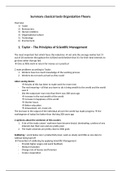
1. Taylor – The Principles of Scientific Management
The most important fact which faces the industries not only the average worker but 19
out of 20 workmen throughout the civilized world believe that it is for their best interests to
go slow rather than go fast
Give as little work in return for money as is practical
2 main problems according to Taylor:
1. Workers have too much knowledge of the working process
2. Workers do not work as hard as they could
Labor-saving device
Results of this has been to make work for more men
- The real meaning = all that you have to do is bring wealth to the world and the world
uses it
- 20x the output per man now than there was 300 years ago
Increase in the real wealth of the world
Increase in happiness of the world
Shorter hours
Better education
Amusement, art, music etc.
The increase in the output of the individual all over the world has made progress the
workingmen of today live better than the king 300 years ago
2 opinions about the workmen of this country
1. A lot of the trade unions’ workmen have become brutal, dominating, careless of any
interests but their own and are pretty poor
2. The trade unionists are pretty close to little gods
Soldiering = work below one’s productivity level, work as slowly and little as one dare to
without being laid off
Prevention of soldiering by applying Scientific Management
- Provide higher wages and quick feedback
- Mental revolution
- Change role of bosses and foremen
- Create cooperation
,Scientific management
The first step taken to remedy the evils of soldiering and development to overcome that evil
An earnest endeavor to make it unnecessary for workmen to be hypocritical in this way,
to deceive themselves and their employers, to live day in and out a life of deceit, forced
upon them conditions
The greatest factor = scientific management is no new set of theories that has been tried on
by anyone at every step
SM has been an evolution, not a theory/invention
In establishments in which SM has been introduced, the average workman is turning out
double the output he was before
Results and benefits of scientific management
- Help individuals, organizations and society at the same time
- Wealth for society, workers and management by:
increase output per individual
cheapening the product
lowering the selling price
increase wages
- Workmen look upon their employers as the best friends they have
The antagonism between workmen and employers is superseded
Why scientific management rather than the old style of management?
- The initiative of the workmen are obtained with absolute regularity
- The new duties and burdens are voluntarily assumed by the men on the management
side
- Men will soldier, but they become the exception and give their true initiative
The principles of scientific management
1) Analysis of each labor process replaces rule-of thumb method
- Time and motion studies divides the work into smaller units
- Scientific investigation and standardization
- Scientific selection of employees
2) Scientific selection, training and development of workers
- In the past the workmen chose his own work and trained himself
- Workmen is studied by a group of men on the management side
3) Cooperation of managers and workers
- Ensure all of the work being done is in accordance with the principles
- Creates a sense of mutuality through which maximum prosperity can be guaranteed
- Offer a plum and let him get out
4) Equal division of the work and the responsibility between the management and the
workmen
- Management take over all work for which they are better fitted than the workmen
- Work done by the workmen is now divided into two large sections and one of those
is handed over to the management
- Represents a democracy co-operation and a genuine division of work
, Another characteristic of scientific management
= the teacher/boss is welcomed, he is not an enemy but a friend. He is there to help the men
get bigger wages and to show him how to do something.
Great mental change
What needs to be done to realize Scientific Management:
- A mental revolution for workers and managers
- A cooperative mind-set
- Needs effort and works as an evolution
Mangers invest in efficiency studies and preparation of work
The text as a whole:
The text is:
- Not a typical academic text
- A speech/keynote to industry leaders
- Missionary zeal/explicitly normative vs. academia’s neutral approach
- Structured, practice based and illustrative
- Provides proofs of Taylor’s arguments based on a limited set of data
Taylor:
- Defenses his own ideas
- Uses missionary zeal and powerful language
- Provides concrete ideas/principles/guidelines
- Places his ideas in the context not a new theory
- Provides examples to prove his approach
2. Bureaucracy – Two Types of Bureaucracy: Enabling and Coercive
Bureaucracy = a task-oriented (rational), rule based (legal) type of coordination
Domination = the probability that a command with a given specific content will be obeyed
by a given groups of persons
Two conflicting views of the human – outcomes of bureaucracy
Negative view the bureaucratic form of organization:
- Stifles creativity
- Fosters dissatisfaction
- Demotivates employees
Positive view the bureaucratic form of organization:
- Provides needed guidance
- Clarifies responsibilities
- Easing role stress
- Helping individuals be and feel more effective
Coercive function of bureaucracy all organization is essentially coercive because
organization entails an abrogation of individual autonomy
- Less psychological and more sociopolitical
Overview
1) Taylor
2) Bureaucracy
3) Human relations
4) Organizational culture
5) Technology
6) Environment
1. Taylor – The Principles of Scientific Management
The most important fact which faces the industries not only the average worker but 19
out of 20 workmen throughout the civilized world believe that it is for their best interests to
go slow rather than go fast
Give as little work in return for money as is practical
2 main problems according to Taylor:
1. Workers have too much knowledge of the working process
2. Workers do not work as hard as they could
Labor-saving device
Results of this has been to make work for more men
- The real meaning = all that you have to do is bring wealth to the world and the world
uses it
- 20x the output per man now than there was 300 years ago
Increase in the real wealth of the world
Increase in happiness of the world
Shorter hours
Better education
Amusement, art, music etc.
The increase in the output of the individual all over the world has made progress the
workingmen of today live better than the king 300 years ago
2 opinions about the workmen of this country
1. A lot of the trade unions’ workmen have become brutal, dominating, careless of any
interests but their own and are pretty poor
2. The trade unionists are pretty close to little gods
Soldiering = work below one’s productivity level, work as slowly and little as one dare to
without being laid off
Prevention of soldiering by applying Scientific Management
- Provide higher wages and quick feedback
- Mental revolution
- Change role of bosses and foremen
- Create cooperation
,Scientific management
The first step taken to remedy the evils of soldiering and development to overcome that evil
An earnest endeavor to make it unnecessary for workmen to be hypocritical in this way,
to deceive themselves and their employers, to live day in and out a life of deceit, forced
upon them conditions
The greatest factor = scientific management is no new set of theories that has been tried on
by anyone at every step
SM has been an evolution, not a theory/invention
In establishments in which SM has been introduced, the average workman is turning out
double the output he was before
Results and benefits of scientific management
- Help individuals, organizations and society at the same time
- Wealth for society, workers and management by:
increase output per individual
cheapening the product
lowering the selling price
increase wages
- Workmen look upon their employers as the best friends they have
The antagonism between workmen and employers is superseded
Why scientific management rather than the old style of management?
- The initiative of the workmen are obtained with absolute regularity
- The new duties and burdens are voluntarily assumed by the men on the management
side
- Men will soldier, but they become the exception and give their true initiative
The principles of scientific management
1) Analysis of each labor process replaces rule-of thumb method
- Time and motion studies divides the work into smaller units
- Scientific investigation and standardization
- Scientific selection of employees
2) Scientific selection, training and development of workers
- In the past the workmen chose his own work and trained himself
- Workmen is studied by a group of men on the management side
3) Cooperation of managers and workers
- Ensure all of the work being done is in accordance with the principles
- Creates a sense of mutuality through which maximum prosperity can be guaranteed
- Offer a plum and let him get out
4) Equal division of the work and the responsibility between the management and the
workmen
- Management take over all work for which they are better fitted than the workmen
- Work done by the workmen is now divided into two large sections and one of those
is handed over to the management
- Represents a democracy co-operation and a genuine division of work
, Another characteristic of scientific management
= the teacher/boss is welcomed, he is not an enemy but a friend. He is there to help the men
get bigger wages and to show him how to do something.
Great mental change
What needs to be done to realize Scientific Management:
- A mental revolution for workers and managers
- A cooperative mind-set
- Needs effort and works as an evolution
Mangers invest in efficiency studies and preparation of work
The text as a whole:
The text is:
- Not a typical academic text
- A speech/keynote to industry leaders
- Missionary zeal/explicitly normative vs. academia’s neutral approach
- Structured, practice based and illustrative
- Provides proofs of Taylor’s arguments based on a limited set of data
Taylor:
- Defenses his own ideas
- Uses missionary zeal and powerful language
- Provides concrete ideas/principles/guidelines
- Places his ideas in the context not a new theory
- Provides examples to prove his approach
2. Bureaucracy – Two Types of Bureaucracy: Enabling and Coercive
Bureaucracy = a task-oriented (rational), rule based (legal) type of coordination
Domination = the probability that a command with a given specific content will be obeyed
by a given groups of persons
Two conflicting views of the human – outcomes of bureaucracy
Negative view the bureaucratic form of organization:
- Stifles creativity
- Fosters dissatisfaction
- Demotivates employees
Positive view the bureaucratic form of organization:
- Provides needed guidance
- Clarifies responsibilities
- Easing role stress
- Helping individuals be and feel more effective
Coercive function of bureaucracy all organization is essentially coercive because
organization entails an abrogation of individual autonomy
- Less psychological and more sociopolitical