
RMCP - Lecture 1 – Introduction
Example complex problem: installing windmills on ocean horizon. There are different
stakeholders (business, scientists, citizens) involved, which do not agree on the solution
Complex problem:
1. Unpredictable
2. Multi-dimensional (facts/values/perspectives)
3. Multiple actors
4. Rules & regulation
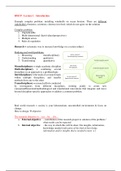
Research = systematic way to increase knowledge on a certain subject
Studying real world problems:
1. Measuring transdisciplinary
2. Understanding qualitative
3. Transforming quantitative
Monodisciplinary = single academic discipline
Multi-disciplinary = combining several
disciplines in an approach to a problem/topic
Interdisciplinary = the study of a research topic
within multiple disciplines, and transfer
methods from one to the other
Transdisciplinary = research efforts conducted
by investigators from different disciplines, working jointly to create new
conceptual/theoretical/methodological and translational innovations that integrate and move
beyond discipline-specific approaches to address a common problem.
-
Real world research = society is your laboratorium, uncontrolled environment & focus on
change.
How to design → objective
The research objective is …(a)… by …(b)…
a. External objective - contribution of the research project to solution of the problem /
what results can be expected
b. Internal objective - the way in which this will be done / the insights, information,
knowledge needed (indication of the kind of knowledge,
information and/or insights that is needed to meet ‘a’)
,
, RMCP – Lecture 2 – Theories and concepts
Concept – something conceived in the mind (perception!!!). An abstract notion or idea that we
use to apply general terms to things, persons, event etc.
- Observable
- Distinguishable
- Variable
Theoretical and conceptual framework as part of your research project
Conceptual framework – theoretical background, synthesis of literature on how to explain a
phenomenon. The understanding of how the particular variables in the study connect with each
other. It identifies the variables required in the research investigation → “sets the stage” for the
presentation of the particular research question that drives the investigation being reported
based on the problem statement.
The conceptual framework lies within a much broader framework, called the theoretical
framework – support from time-tested theories that embody the findings of many researchers
on why and how a particular phenomenon occurs.
Problem statement – context and issues that caused the researcher to conduct the study.
Conceptual model - to use or not to use
Use Don’t use
Allow us to think Might also stop thinking
Structure our research Create selective views / bias
Avoid misunderstanding Make research less open and flexible
Avoid miscommunication
The conceptual framework is crucial to unlock knowledge from the world and it helps you to
understand your main RQ/Objective, formulate empirical/sub-questions that guide your data
collection (fieldwork), analyse your results and make your research understandable to others
(embed in current knowledge & allows for generalisation).
Example complex problem: installing windmills on ocean horizon. There are different
stakeholders (business, scientists, citizens) involved, which do not agree on the solution
Complex problem:
1. Unpredictable
2. Multi-dimensional (facts/values/perspectives)
3. Multiple actors
4. Rules & regulation
Research = systematic way to increase knowledge on a certain subject
Studying real world problems:
1. Measuring transdisciplinary
2. Understanding qualitative
3. Transforming quantitative
Monodisciplinary = single academic discipline
Multi-disciplinary = combining several
disciplines in an approach to a problem/topic
Interdisciplinary = the study of a research topic
within multiple disciplines, and transfer
methods from one to the other
Transdisciplinary = research efforts conducted
by investigators from different disciplines, working jointly to create new
conceptual/theoretical/methodological and translational innovations that integrate and move
beyond discipline-specific approaches to address a common problem.
-
Real world research = society is your laboratorium, uncontrolled environment & focus on
change.
How to design → objective
The research objective is …(a)… by …(b)…
a. External objective - contribution of the research project to solution of the problem /
what results can be expected
b. Internal objective - the way in which this will be done / the insights, information,
knowledge needed (indication of the kind of knowledge,
information and/or insights that is needed to meet ‘a’)
,
, RMCP – Lecture 2 – Theories and concepts
Concept – something conceived in the mind (perception!!!). An abstract notion or idea that we
use to apply general terms to things, persons, event etc.
- Observable
- Distinguishable
- Variable
Theoretical and conceptual framework as part of your research project
Conceptual framework – theoretical background, synthesis of literature on how to explain a
phenomenon. The understanding of how the particular variables in the study connect with each
other. It identifies the variables required in the research investigation → “sets the stage” for the
presentation of the particular research question that drives the investigation being reported
based on the problem statement.
The conceptual framework lies within a much broader framework, called the theoretical
framework – support from time-tested theories that embody the findings of many researchers
on why and how a particular phenomenon occurs.
Problem statement – context and issues that caused the researcher to conduct the study.
Conceptual model - to use or not to use
Use Don’t use
Allow us to think Might also stop thinking
Structure our research Create selective views / bias
Avoid misunderstanding Make research less open and flexible
Avoid miscommunication
The conceptual framework is crucial to unlock knowledge from the world and it helps you to
understand your main RQ/Objective, formulate empirical/sub-questions that guide your data
collection (fieldwork), analyse your results and make your research understandable to others
(embed in current knowledge & allows for generalisation).



