

Course 2.4
BRAIN & COGNITION – PERCEPTION
#1 A KEEN EYE
Learning Goals: A) What are the parts of the eye & their functions? (structure of the retina); What is the yellow &
the blind spot?
B) What happens to the light when it enters the eye? (how is an image projected on the retina?);
Which parts play which role?; What kind of eye conditions & diseases are there?
C) Which part of the eye is responsible for illusion?; How does the enhancement of edges occur?
Why do the same 2 shades of grey appear to have a different illuminance in different contexts?
-> no actual brain processes
Literature: Goldstein Chapter 3; but all books should be fine
1
,THE VISUAL SYSTEM
Light
- the physical stimulus for sight is electromagnetic radiation (light) – each particle of light = photon
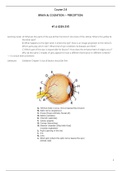
Structure of the Eye
- most vertebrate eyes have a similar basic structure -> they contain light-sensitive receptors protected within a
dishlike structure through which light enters
- each eye lies in a protective bony socket within the skull; is a spherical structure about 20-25mm in diameter
- Sclera
-> outer covering (“the white”); a strong elastic membrane
- maintains its shape by means of fluid pressure from within
- Cornea
= transparent covering of the front of the eye
-> region where the sclera bulges forward to from a clear, domelike window (13 mm in diameter)
-> the first optically active element – serves as a simple fixed lens that begins to gather light &
concentrate it
= accounts for about 80% of the eye’s focusing power
-> is fixed in place – can’t adjust its focus
- doesn’t contain blood vessles/blood & has a rich supply of transparent nerve endings -> forces eye to
close & produce tears if cornea is scratched (regenerates quickly)
- Aqueous Humor
-> behind the cornea; filled with a watery fluid (similar to cerebro-spinal fluid)
-> transports oxygen; removes waste
- Iris
-> coloured membrane, surrounding a central hole
-> 2 layers: outer (colour); inner (blood)
-> function: to control the amount of light entering the eye
- Pupil
-> hole in the iris
-> size is controlled by the pupillary light reflex (bright light: may contract to 2mm; dim light: may dilate to
more than 8mm) – is an important function
-> with a small pupil: imperfections in the lens produce fewer distortions; depth of focus is vastly
increased p
-> with a large pupil: discriminating details is less important – increased sensitivity because of the letting
more light enter the eye
-> also changes size as a function of emotional & attentional variables (high interest -> large pupil)
2
,Crystalline Lens
- located directly behind the pupillary aperture
- curvature determines the amount by which the light is bend -> shape
is critical in bringing an image into focus
= supplies the remaining 20% of the eye’s focusing power
-> can change its shape to adjust the eye’s focus for stimuli
located @ different distances
- Accommodation
= hinders seeing blurred objects because the image is out of
focus
-> process by which the lens varies
- changing focus by changing its shape
-> natural shape: spherical; when ciliary muscles relax:
lens flatten -> distant objects should be in focus)
-> when lens is rounder – near objects are in focus(->
ciliary muscles at the front of the eye tighten & increases
the curvature of the lens -> gets thicker )
-> this bends the light rays passing through the lens to pull the
focus back to A -> creates sharp image on retina
= enables you to bring both near & far objects into focus
- Limits:
- age important in determining the focusing ability of the lens (decreases with age – inner layers
of the lens die & lose some of their elasticity) -> refractive error (presbyopia)
-> near point (= the distance @ which your lens no
longer adjust to bring close objects into focus) -> this
distance increases as a person gets older (presbyopia)
- isn’t perfectly transparent – tinted yellow (density increases with age – people of different age can have different
perceptions of colour)
-> screens out some of the ultraviolet light & blue light (alters our perception of colour)
- Emmetropic
= normal accommodative/focusing ability
Retina
- Vitreous Humor
= jelly-like substance in the large chamber of the eye
= the screen of neural elements at the back of the eye where the image, which is formed by the optical system, is
focused
- most salient feature: the network of blood vessels lining the inner cavity of the eye
- sheet of neural elements extends over most of the interior of the eye
- Pigment Epithelium
- backs the retina up
= light-absorbing dark layer
- reduces the amount of reflected & scattered light that could blur or fog the image
- consists of three major layer of neural tissue (changes light/transduced into a neural response)
1) outermost layer
-> closest to scleral wall; contains photoreceptors (rods & cones)
-> horizontal cells (= short dendrites & a long horizontal process that extends some distance across the retina;
3
, modify the visual signal & allow adjacent cells to communicate & interact)
2) next layer
-> consists of bipolar cells; one end makes synapses with the photoreceptors, the other with the
ganglion cells
-> amacrine cells (= large cells, interact with spatially adjacent units; modify the visual signal & allow adjacent cells
to communicate & interact)
3) third layer
-> consists of large retinal ganglion cells
The Fovea
- most important section; is located in the region around the optic axis (= imaginary line from the center of the
retina that passes through the centre of the pupil)
- Macula Lutea aka. Yellow Spot
- Fovea Centralis (central pit)
= critical in visual perception
- contains only cones
Night Blindness
= individual whose retinas contain no rods – lose all sense of sight & become functionally blind as soon as the
light dims beyond a certain point
Day Blindness
= lack functioning cones
-> find normal levels of daylight quite painful & totally lack colour vision + very poor visual acuity
- under dim levels of illumination they function normally
FOCUSING LIGHT ONTO THE RETINA
Light: The Stimulus for Vision
- vision is based on visible light (= band of energy within the electromagnetic spectrum)
Electromagnetic Spectrum
= continuum of electromagnetic energy that is produced by electric charges
- is radiated as waves
- energy can be described by its wavelength (= distance between the peaks of the electromagnetic waves)
-> can range from extremely short-wavelength gamma rays (about 1012 meters) to long-wavelength radio
waves (about 10+4 meters)
4
BRAIN & COGNITION – PERCEPTION
#1 A KEEN EYE
Learning Goals: A) What are the parts of the eye & their functions? (structure of the retina); What is the yellow &
the blind spot?
B) What happens to the light when it enters the eye? (how is an image projected on the retina?);
Which parts play which role?; What kind of eye conditions & diseases are there?
C) Which part of the eye is responsible for illusion?; How does the enhancement of edges occur?
Why do the same 2 shades of grey appear to have a different illuminance in different contexts?
-> no actual brain processes
Literature: Goldstein Chapter 3; but all books should be fine
1
,THE VISUAL SYSTEM
Light
- the physical stimulus for sight is electromagnetic radiation (light) – each particle of light = photon
Structure of the Eye
- most vertebrate eyes have a similar basic structure -> they contain light-sensitive receptors protected within a
dishlike structure through which light enters
- each eye lies in a protective bony socket within the skull; is a spherical structure about 20-25mm in diameter
- Sclera
-> outer covering (“the white”); a strong elastic membrane
- maintains its shape by means of fluid pressure from within
- Cornea
= transparent covering of the front of the eye
-> region where the sclera bulges forward to from a clear, domelike window (13 mm in diameter)
-> the first optically active element – serves as a simple fixed lens that begins to gather light &
concentrate it
= accounts for about 80% of the eye’s focusing power
-> is fixed in place – can’t adjust its focus
- doesn’t contain blood vessles/blood & has a rich supply of transparent nerve endings -> forces eye to
close & produce tears if cornea is scratched (regenerates quickly)
- Aqueous Humor
-> behind the cornea; filled with a watery fluid (similar to cerebro-spinal fluid)
-> transports oxygen; removes waste
- Iris
-> coloured membrane, surrounding a central hole
-> 2 layers: outer (colour); inner (blood)
-> function: to control the amount of light entering the eye
- Pupil
-> hole in the iris
-> size is controlled by the pupillary light reflex (bright light: may contract to 2mm; dim light: may dilate to
more than 8mm) – is an important function
-> with a small pupil: imperfections in the lens produce fewer distortions; depth of focus is vastly
increased p
-> with a large pupil: discriminating details is less important – increased sensitivity because of the letting
more light enter the eye
-> also changes size as a function of emotional & attentional variables (high interest -> large pupil)
2
,Crystalline Lens
- located directly behind the pupillary aperture
- curvature determines the amount by which the light is bend -> shape
is critical in bringing an image into focus
= supplies the remaining 20% of the eye’s focusing power
-> can change its shape to adjust the eye’s focus for stimuli
located @ different distances
- Accommodation
= hinders seeing blurred objects because the image is out of
focus
-> process by which the lens varies
- changing focus by changing its shape
-> natural shape: spherical; when ciliary muscles relax:
lens flatten -> distant objects should be in focus)
-> when lens is rounder – near objects are in focus(->
ciliary muscles at the front of the eye tighten & increases
the curvature of the lens -> gets thicker )
-> this bends the light rays passing through the lens to pull the
focus back to A -> creates sharp image on retina
= enables you to bring both near & far objects into focus
- Limits:
- age important in determining the focusing ability of the lens (decreases with age – inner layers
of the lens die & lose some of their elasticity) -> refractive error (presbyopia)
-> near point (= the distance @ which your lens no
longer adjust to bring close objects into focus) -> this
distance increases as a person gets older (presbyopia)
- isn’t perfectly transparent – tinted yellow (density increases with age – people of different age can have different
perceptions of colour)
-> screens out some of the ultraviolet light & blue light (alters our perception of colour)
- Emmetropic
= normal accommodative/focusing ability
Retina
- Vitreous Humor
= jelly-like substance in the large chamber of the eye
= the screen of neural elements at the back of the eye where the image, which is formed by the optical system, is
focused
- most salient feature: the network of blood vessels lining the inner cavity of the eye
- sheet of neural elements extends over most of the interior of the eye
- Pigment Epithelium
- backs the retina up
= light-absorbing dark layer
- reduces the amount of reflected & scattered light that could blur or fog the image
- consists of three major layer of neural tissue (changes light/transduced into a neural response)
1) outermost layer
-> closest to scleral wall; contains photoreceptors (rods & cones)
-> horizontal cells (= short dendrites & a long horizontal process that extends some distance across the retina;
3
, modify the visual signal & allow adjacent cells to communicate & interact)
2) next layer
-> consists of bipolar cells; one end makes synapses with the photoreceptors, the other with the
ganglion cells
-> amacrine cells (= large cells, interact with spatially adjacent units; modify the visual signal & allow adjacent cells
to communicate & interact)
3) third layer
-> consists of large retinal ganglion cells
The Fovea
- most important section; is located in the region around the optic axis (= imaginary line from the center of the
retina that passes through the centre of the pupil)
- Macula Lutea aka. Yellow Spot
- Fovea Centralis (central pit)
= critical in visual perception
- contains only cones
Night Blindness
= individual whose retinas contain no rods – lose all sense of sight & become functionally blind as soon as the
light dims beyond a certain point
Day Blindness
= lack functioning cones
-> find normal levels of daylight quite painful & totally lack colour vision + very poor visual acuity
- under dim levels of illumination they function normally
FOCUSING LIGHT ONTO THE RETINA
Light: The Stimulus for Vision
- vision is based on visible light (= band of energy within the electromagnetic spectrum)
Electromagnetic Spectrum
= continuum of electromagnetic energy that is produced by electric charges
- is radiated as waves
- energy can be described by its wavelength (= distance between the peaks of the electromagnetic waves)
-> can range from extremely short-wavelength gamma rays (about 1012 meters) to long-wavelength radio
waves (about 10+4 meters)
4




