1 – Conceptualization, Operationalization & Data Preparation
Academic research:
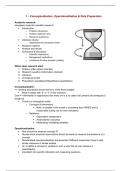
Hourglass model for scientific research:
Introduction
o Problem introduction
o Problem statement and
o Research question(s)
Literature review
o (Hypotheses &) conceptual model
Research method
Analysis and results
Conclusion & discussion
o Scientific implications
o Management implications
o Limitations & further research (validity)
Where does research start:
1. Problem (often action oriented)
2. Research question (information oriented)
3. Literature
4. Conceptual model
5. Propositions (qualitative)/Hypotheses (quantitative)
Conceptualization:
=> ‘drawing boundaries around terms to make them tangible’
What is meant with ‘X’ or ‘Y’ in this research
Goal => elimination of vagueness (how many cm is a so called ‘tall’ person) and ambiguity (‘I
bought a)
Come to a conceptual model
o Concepts (& dimension)
Note: a variable in the model is something that VARIES and is
measurable (using one or more indicators)
o Relations:
Dependent/ independent
Antecedents/ outcomes
Moderating/ mediating variables
Operationalization:
How should we measure concept X?
Decide which empirical observations should be made to measure the existence of a
concept
Standardised operationalisations are essential if different researchers have to take
similar measures of similar entities.
Or: to define a concept or variable in such a way that we can measure it
quantitatively.
translation into specific indicators and measuring questions.
,Collecting data:
(population/ sampling/ non-response => generalizability)
Exploratory/descriptive/causal research?
Qualitative/quantitative?
Survey?
Experiment?
Measurement level?
o On what scale did you measure your variable?
o
o
,Data Preparation:
Data analysis often comes in 2 stages:
1. Inspection and preparing data for actual analysis:
o Inspect data (items)
Which variable/measurement scales/coding schemes
Get a feeling for your data, descriptive, graphs
Cleaning your dataset
Oddities, missing/wrong values, outliers.
o Combining variables/items into new dimensions/ factors
2. Actual analysis, testing your hypothesis:
o Regression, cluster
Inspect data:
Missing data
o Listwise deletion → but you’ll be missing a lot of data then.
o Pairwise → So only delete the missing variables if the rest is reliable.
Weird values & outliers
o If impossible value → make it a missing value (or go back to respondent if
possible)
o Otherwise, outlier
What’s the effect on analysis?
Should we use in analysis?
, 2 – Factor Analysis
Marketing concepts are more often too complicated for 1 scales and are measured using
multi-item scales, e.g.:
These are called LATENT variables, or CONCEPTS or CONSTRUCTS
Yet, multi-item scales often have many (and overlapping) items which makes further analysis
complicated.
Multi-item scales: A scale consisting of multiple items, where an item is a single question or
statement to be evaluated.
o
Multicollinearity (if correlation is too high: if variables are highly correlated, it’s hard to
distinguish their individual effects in subsequent analyses)
Complexity
So, data reduction & simplification:
1. Factor analysis → to test or to dig up the constructs.
o To reduce a large(r) set of variables into a smaller set of uncorrelated, on
beforehand unknown, factors or dimensions.
o To test a theoretically assumed known factor structure in a set of items
(“does the factor solution in my data comply with the assumed/ hypothesized
factor structure?”)
2. Reliability analysis → then use this to test.
o To test the reliability of the known/ found underlying dimensions (by
measuring the internal consistency of a known set of items in each
o dimension)
After factor analysis (“Is the factor found ‘strong enough’ to continue
analysis with?”)
After using a set of items validated as a scale by theory (“Is the
theoretical scale also validated or ‘strong enough’ in my research?”)
Factor analysis: what is it about?
Purpose:
o Reduction of a large quantity of data by finding common variance to:
Retrieve underlying dimensions in your dataset, or,
Test if the hypothesized dimensions also exist in your dataset.
Variance → a measure of how data points differ from the mean.
Common variance → amount of variance that is shared among a set of items. If
one goes up it is likely that the other will also go up (unless it’s a reverse scale).
Two central questions:
1. How to reduce a large(r) set of variables into a smaller set of uncorrelated factors?
o Unknown number and structure
o Hypothesized number and structure
Whether the hypothesized dimensionality is visible in my dataset
2. How to interpret these factors (= underlying dimensions), and scores on these
factors?
Academic research:
Hourglass model for scientific research:
Introduction
o Problem introduction
o Problem statement and
o Research question(s)
Literature review
o (Hypotheses &) conceptual model
Research method
Analysis and results
Conclusion & discussion
o Scientific implications
o Management implications
o Limitations & further research (validity)
Where does research start:
1. Problem (often action oriented)
2. Research question (information oriented)
3. Literature
4. Conceptual model
5. Propositions (qualitative)/Hypotheses (quantitative)
Conceptualization:
=> ‘drawing boundaries around terms to make them tangible’
What is meant with ‘X’ or ‘Y’ in this research
Goal => elimination of vagueness (how many cm is a so called ‘tall’ person) and ambiguity (‘I
bought a)
Come to a conceptual model
o Concepts (& dimension)
Note: a variable in the model is something that VARIES and is
measurable (using one or more indicators)
o Relations:
Dependent/ independent
Antecedents/ outcomes
Moderating/ mediating variables
Operationalization:
How should we measure concept X?
Decide which empirical observations should be made to measure the existence of a
concept
Standardised operationalisations are essential if different researchers have to take
similar measures of similar entities.
Or: to define a concept or variable in such a way that we can measure it
quantitatively.
translation into specific indicators and measuring questions.
,Collecting data:
(population/ sampling/ non-response => generalizability)
Exploratory/descriptive/causal research?
Qualitative/quantitative?
Survey?
Experiment?
Measurement level?
o On what scale did you measure your variable?
o
o
,Data Preparation:
Data analysis often comes in 2 stages:
1. Inspection and preparing data for actual analysis:
o Inspect data (items)
Which variable/measurement scales/coding schemes
Get a feeling for your data, descriptive, graphs
Cleaning your dataset
Oddities, missing/wrong values, outliers.
o Combining variables/items into new dimensions/ factors
2. Actual analysis, testing your hypothesis:
o Regression, cluster
Inspect data:
Missing data
o Listwise deletion → but you’ll be missing a lot of data then.
o Pairwise → So only delete the missing variables if the rest is reliable.
Weird values & outliers
o If impossible value → make it a missing value (or go back to respondent if
possible)
o Otherwise, outlier
What’s the effect on analysis?
Should we use in analysis?
, 2 – Factor Analysis
Marketing concepts are more often too complicated for 1 scales and are measured using
multi-item scales, e.g.:
These are called LATENT variables, or CONCEPTS or CONSTRUCTS
Yet, multi-item scales often have many (and overlapping) items which makes further analysis
complicated.
Multi-item scales: A scale consisting of multiple items, where an item is a single question or
statement to be evaluated.
o
Multicollinearity (if correlation is too high: if variables are highly correlated, it’s hard to
distinguish their individual effects in subsequent analyses)
Complexity
So, data reduction & simplification:
1. Factor analysis → to test or to dig up the constructs.
o To reduce a large(r) set of variables into a smaller set of uncorrelated, on
beforehand unknown, factors or dimensions.
o To test a theoretically assumed known factor structure in a set of items
(“does the factor solution in my data comply with the assumed/ hypothesized
factor structure?”)
2. Reliability analysis → then use this to test.
o To test the reliability of the known/ found underlying dimensions (by
measuring the internal consistency of a known set of items in each
o dimension)
After factor analysis (“Is the factor found ‘strong enough’ to continue
analysis with?”)
After using a set of items validated as a scale by theory (“Is the
theoretical scale also validated or ‘strong enough’ in my research?”)
Factor analysis: what is it about?
Purpose:
o Reduction of a large quantity of data by finding common variance to:
Retrieve underlying dimensions in your dataset, or,
Test if the hypothesized dimensions also exist in your dataset.
Variance → a measure of how data points differ from the mean.
Common variance → amount of variance that is shared among a set of items. If
one goes up it is likely that the other will also go up (unless it’s a reverse scale).
Two central questions:
1. How to reduce a large(r) set of variables into a smaller set of uncorrelated factors?
o Unknown number and structure
o Hypothesized number and structure
Whether the hypothesized dimensionality is visible in my dataset
2. How to interpret these factors (= underlying dimensions), and scores on these
factors?