
Furr: Chapters 1
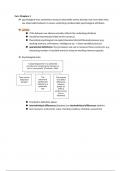
➔ psychological tests sometimes measure observable events directly; but more often they
use observable behavior to assess underlying unobservable psychological attributes
➔ validity:
◆ if the behavior we observe actually reflects the underlying attribute
◆ should be theoretically linked to the construct
◆ theoretical psychological concepts/characteristics/attributes/processes (e.g.
working memory, self-esteem, intelligence etc. = latent variable/construct
◆ operational definitions: the procedures we use to measure these constructs; e.g.
measuring number of recalled words to measure working memory capacity
➔ Psychological tests:
◆ Cronbach’s definition above
◆ interindividual differences (between) vs intraindividual differences (within)
◆ test=measure, instrument, scale, inventory, battery, schedule, assessment
, ◆ Use:
● criterion referenced: a cutoff test score is established as the criterion and
people are divided into two groups; people who score below and people
who score above the criterion
○ the line between criterion and norm referenced tests is not that
strict
○ cutoff points are not determined at random and is always based
on some expected level of performance
● norm-referenced test: a person’s test score is compared with scores from
a reference/normative sample (=a sample that is representative of a
broader population) to see how a person compares to other people
◆ Timing:
● speeded: time-limited tests, people aren’t expected to finish all the
questions, people are evaluated in terms of how many questions they fit
into the given time— questions are similar to each other in difficulty
● power: not time limited, expected to answer all the questions, evaluated
based on how many questions they get right, items differ in difficulty level
◆ Indicator:
● reflective/effect indicators: a hypothetical construct determines the
person’s performance in the given test; most typical in psychology and
the focus of this course
● formative/causal indicators: indicators are what defines the constructs—
e.g. socioeconomic status is determined by combining income, education
level, employment etc.
➔ Psychometrics:
◆ science that evaluates attributes of psychological tests
◆ type of info generated, reliability, validity
, ◆ Francis Galton-founding father
◆ psychometrics goes beyond differential psychology (=study of individual
differences)
➔ Challenges in psychological measurement:
◆ participant reactivity: knowing that you are being evaluated can alter behavior
● demand characteristics: try to figure out the purpose & change behavior
to accommodate the researcher
● social desirability: trying to impress the researcher
● malingering: changing behavior to convey a poor impression of the
person doing the assessment
◆ composite scores: often, each question is scored and then the scores are
summed or combined to create a composite score to reflect the whole construct
◆ score sensitivity: the measure’s ability to discriminate between meaningful
amounts of the dimension being measured
Furr: Chapter 2
➔ each psychological attributes exists to some degree of quantity
➔ Scaling: the way numerical values are assigned to psychological attributes
➔ differences in scaling have important implications for the use and interpretation of test
scores
➔ e.g. an IQ scores is used to represent level of intelligence
, ➔ Property of identity:
◆ the individuals within a category should be same/similar to each other in terms
of a psychological attribute; and they should be different from the individuals
outside the category in terms of the same attribute
◆ requires at least 2 mutually exclusive categories: 1 person cannot be
simultaneously in both categories
◆ categories should be exhaustive (=kapsamli): all members of the
group/population should fit into one of the categories
◆ the categories can be labeled with names, letters or numbers
◆ numbers in this context don’t have true mathematical value!
◆ the difference between groups represent differences in type (absence vs
presence of sth), not the amount/degree
➔ property of order:
◆ info about relative amount of an attribute people possess
◆ rank
◆ numbers serve as labels, could be replaced with letters
◆ we still don’t know the degree of differences between people, only the order
➔ property of quantity
◆ info about the magnitude of differences between people
◆ quantitative values
◆ numerals=real numbers, continuous, with units of measurement
◆ absolute zero=indicates absence of sth
● addition, subtraction, multiplication, division
◆ relative/arbitrary zero= e.g. 0 celsius isn’t absence of heat
● for psychological attributes, tests could yield results of 0 but this doesn’t
mean true absence of the attribute (e.g. intelligence, aptitude etc. can’t
truly be absent)
● addition, subtraction
➔ psychological tests sometimes measure observable events directly; but more often they
use observable behavior to assess underlying unobservable psychological attributes
➔ validity:
◆ if the behavior we observe actually reflects the underlying attribute
◆ should be theoretically linked to the construct
◆ theoretical psychological concepts/characteristics/attributes/processes (e.g.
working memory, self-esteem, intelligence etc. = latent variable/construct
◆ operational definitions: the procedures we use to measure these constructs; e.g.
measuring number of recalled words to measure working memory capacity
➔ Psychological tests:
◆ Cronbach’s definition above
◆ interindividual differences (between) vs intraindividual differences (within)
◆ test=measure, instrument, scale, inventory, battery, schedule, assessment
, ◆ Use:
● criterion referenced: a cutoff test score is established as the criterion and
people are divided into two groups; people who score below and people
who score above the criterion
○ the line between criterion and norm referenced tests is not that
strict
○ cutoff points are not determined at random and is always based
on some expected level of performance
● norm-referenced test: a person’s test score is compared with scores from
a reference/normative sample (=a sample that is representative of a
broader population) to see how a person compares to other people
◆ Timing:
● speeded: time-limited tests, people aren’t expected to finish all the
questions, people are evaluated in terms of how many questions they fit
into the given time— questions are similar to each other in difficulty
● power: not time limited, expected to answer all the questions, evaluated
based on how many questions they get right, items differ in difficulty level
◆ Indicator:
● reflective/effect indicators: a hypothetical construct determines the
person’s performance in the given test; most typical in psychology and
the focus of this course
● formative/causal indicators: indicators are what defines the constructs—
e.g. socioeconomic status is determined by combining income, education
level, employment etc.
➔ Psychometrics:
◆ science that evaluates attributes of psychological tests
◆ type of info generated, reliability, validity
, ◆ Francis Galton-founding father
◆ psychometrics goes beyond differential psychology (=study of individual
differences)
➔ Challenges in psychological measurement:
◆ participant reactivity: knowing that you are being evaluated can alter behavior
● demand characteristics: try to figure out the purpose & change behavior
to accommodate the researcher
● social desirability: trying to impress the researcher
● malingering: changing behavior to convey a poor impression of the
person doing the assessment
◆ composite scores: often, each question is scored and then the scores are
summed or combined to create a composite score to reflect the whole construct
◆ score sensitivity: the measure’s ability to discriminate between meaningful
amounts of the dimension being measured
Furr: Chapter 2
➔ each psychological attributes exists to some degree of quantity
➔ Scaling: the way numerical values are assigned to psychological attributes
➔ differences in scaling have important implications for the use and interpretation of test
scores
➔ e.g. an IQ scores is used to represent level of intelligence
, ➔ Property of identity:
◆ the individuals within a category should be same/similar to each other in terms
of a psychological attribute; and they should be different from the individuals
outside the category in terms of the same attribute
◆ requires at least 2 mutually exclusive categories: 1 person cannot be
simultaneously in both categories
◆ categories should be exhaustive (=kapsamli): all members of the
group/population should fit into one of the categories
◆ the categories can be labeled with names, letters or numbers
◆ numbers in this context don’t have true mathematical value!
◆ the difference between groups represent differences in type (absence vs
presence of sth), not the amount/degree
➔ property of order:
◆ info about relative amount of an attribute people possess
◆ rank
◆ numbers serve as labels, could be replaced with letters
◆ we still don’t know the degree of differences between people, only the order
➔ property of quantity
◆ info about the magnitude of differences between people
◆ quantitative values
◆ numerals=real numbers, continuous, with units of measurement
◆ absolute zero=indicates absence of sth
● addition, subtraction, multiplication, division
◆ relative/arbitrary zero= e.g. 0 celsius isn’t absence of heat
● for psychological attributes, tests could yield results of 0 but this doesn’t
mean true absence of the attribute (e.g. intelligence, aptitude etc. can’t
truly be absent)
● addition, subtraction



