Literature - Communication Consultancy
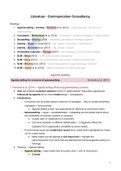
Readings:
1. Agenda setting + framing = Fernando et al. (2014)!"!#$%%&'(!)($'*)!+!,-',$.'#!-'!
(.$$'/)#0&'(!
2. Inoculation = Niederdeppe et al. (2015)!"!&'-,12)%&-'!+!')..)%&3$!#%.)%$(&$#!&'!0$)2%0!4-2&,&$#
3. Storytelling = Denning (2006) "!#%-.5%$22&'(!')..)%&3$#!6-.!#%.)%$(&,!71#&'$##
4. Identity = Hogan & Coote (2014)!"!-.(8!,12%1.$!+!&''-3)%&-'!+!4$.6-.9)',$
5. Identity = Schneider et al. (2013)!"!-.(8!,2&9)%$!+!,12%1.$
6. Uncertainty reduction = Flanagin (2007) "!&'6-!$:,0)'($!&'!-'2&'$!)1,%&-'#!;$<)5=
7. ELM = Bögel (2015) "!>?@!,-991'&,)%&-'!4.-,$##&'(
8. ELM = Hung (2014) "!A1)2!$'%$.%)&'9$'%!4)%0!9-*$2!+!,$2$7.&%5!$'*-.#$9$'%
9. ELM = Bleakley et al. (2015) "!B9-%&-')2!)44$)2#!6-.!#1().!7$3$.)($#!.$*1,%&-'
10. ELM = Jordan et al. (2012) "!C$*&)!&'%$.3$'%&-'!6-.!#1().!7$3$.)($#
Agenda Setting
Agenda setting for concerns of greenwashing Fernando et al. (2014)
D8!E$.')'*-!$%!)28!;FGDH=!"!I($'*)!?$%%&'(!&'621$',&'(!(.$$'/)#0&'(!,-',$.'#!
● Aim: see whether consumer opinions online on ‘greenwashed’ ads (public agenda) are
in uenced by agenda set by online media (blogs + newspapers).
● Introduction:
○ >-'#19$.#!).$!'-!2-'($.!4)##&3$!.$,$&3$.#!-6!9$##)($#!"!%0$5!,-J,.$)%$!)*3$.%&#&'(!
9$##)($#!+!9-.$!&'3-23$*8!
■ Agenda-setting is then now appropriate for listening to consumers online.
○ Greenwashing = vague + unsubstantiated + misleading environmental claims about
the credentials of a person, product or company.
■ Usually seen w/ skepticism by consumers.
■ >)'!0)3$!7),K2)#0!-'!*&66$.$'%!#%)K$0-2*$.#!"!&%!'$()%&3$25!)66$,%#!%0$!
.$41%)%&-'!-6!)'!-.()'&L)%&-'!;)942&6&$*!75!#-,&)2!9$*&)=8!
○ Environmental issues are unobtrusive issues (only visible when highlighted by media,
not on a daily basis).
■ Mass media can set agenda at sub-issue level = highlight the
subcomponents of an issue that are selected (second-level agenda setting (i.e.
framing)).
● M0$-.&$#!"!I($'*)!?$%%&'(
○ Agenda setting = mass media tells the public what + who to think about.
■ 2 levels:
1
, ■ 1. First-level: transferring salience of objects from one agenda into the other
(i.e. issues + people + companies, etc.)
■ 2. Second-level (i.e. framing): transferring salience of attributes of objects
from one agenda into the other.
● Increases the salience of selective aspects of an issue in the public’s
mind.
● Attributes can be substantive or a ective.
○ Substantive = cognitive characteristics
○ A ective = positive, negative, neutral
○ Agenda setting relationship can be reciprocal = media in uences public agenda +
public agenda in uences media.
■ Inter-media agenda-setting e ects: online & traditional mass media can set
each other’s agenda.
● Hypotheses:
○ D8!NOP!72-(#!"!>-'#19$.!72-(#!;-'$J/)5=Q Greenwashing attributes salient in NGO
blogs will in uence substantive greenwashing attributes salient in online consumer
discussions.
○ 2. Online newspaper blogs!R!>-'#19$.!72-(#!;%/-J/)5=: Bidirectional agenda-
setting relationship exists between online newspaper blogs & online consumer
discussions (+ they mutually in uence each other’s discussions).
○ 3. Online newspaper articles!R!>-'#19$.!72-(#!;%/-J/)5=: Bidirectional agenda-
setting relationship exists between online newspaper articles & online consumer
discussions (+ mutually in uence each other’s discussions).
● Method:
○ Leximancer (text analysis tool that discovers keywords + associated concepts).
○ Data gathered was publicly available.
○ Content analysis on themes + attributes of environmental issues (trained 2 coders)
○ Studied for year 2009 + divided in 4 quarters (periods of 3 months).
○ 4 sources:
■ Greenpeace (activist organization)
2
, ■ The Guardian (UK newspaper w/ editorial articles)
■ EnviroMedia (promoted by University of Oregon + users can upload ads +
discuss claims)
■ NYT (US newspaper)
● Results:
○ 2 themes:
■ 1. Marketing communication credibility =
● Questioned veracity of claims + considered unauthentic.
● Subthemes = energy, campaign, product content, investment, waste
management.
■ 2. Impact on natural environment =
● In relation to climate change + associated impacts.
● Sub-themes = CO2 emissions, global warming, vehicle emissions,
deforestation.
○ H1 = Partial support: Not one-way BUT two-way relationship = NGO blogs R
Consumer blogs (unlike predicted).
■ NGO issue salience was transferred to the public agenda in 1 time period only.
○ H2 = Support: Online newspaper blogs!R!>-'#19$.!72-(#!
○ H3 = Support: Online newspaper articles!R!>-'#19$.!72-(#
● Conclusion:
○ Agenda setting helps companies to avoid being labeled as ‘greenwashing’ by
consumers.
■ It can help to build brand salience w/ green advertising + market
communication tools.
○ Stakeholders’ skepticism increases unless companies ful ll their green marketing
claims.
■ Lack of commitment toward the implementation of credible green policies is
also seen as greenwashing.
■ E-.!%0&#!"!O.$$'!)*#!91#%!,2$).25!,-991'&,)%$!%0$!$'3&.-'9$'%)2!4$.6-.9)',$!
-6!)!6&.98
● Why? To avoid consumer confusion on green issues + create
awareness.
○ Strong agenda-setting in uence when media R consumers are from the same
geography.
■ Newspapers (i.e., NYT) from the same country as consumers in uence
consumer agenda.
■ Consumer discussions in uenced stakeholders from same country only (e.g.
Greenpeace, NYT)
■ Importance of local online media "!S%!,-12*!9)K$!#$2$,%&3$!)#4$,%#!-6!)'!
&##1$!9-.$!-.!2$##!#)2&$'%!;$8(8!)!,-94)'5T#!4-#&%&3$!,.$*$'%&)2#=8
○ Advertisers must develop tailored messages based on each stakeholder’s concern.
3
, ■ It needs to account for perceptions + concerns of the various stakeholders
(e.g. consumers + NGOs + media).
■ For increasing trust, it needs to increase both source + environmental
message credibility.
Inoculation
Inoculation & Narrative Strategies Niederdeppe et al. (2015)
F8!N&$*$.*$44$!$%!)28!;FGDU=!"!S'-,12)%&-'!1#&'(!')..)%&3$!#%.)%$(&$#!
● Aim: to assess whether inoculation and/or narrative messages counter the impact of
industry anti-policy messages delivered both (1) at same time + (2) w/ delay (1 week).
● Theories:
○ Framing = attributes are made salient when giving info about an issue or event (e.g.
words, images, phrases, and presentation styles).
■ Emphasis framing = making salient a speci c problem de nition / causal
interpretation / moral evaluation / treatment recommendation.
● This framing is:
○ (1) Dynamic = monitors + counters frames promoted by the
opposition (counterframing).
○ (2) Asymmetrical!V!.$#-1.,$#!).$!&97)2)',$*!7$%/$$'!(.-14#!
4.-9-%&'(!*&66$.$'%!6.)9$#!"!W#1)225!4-/$.612!(.-14#!,)'!
#4.$)*!0&(0$.!6.)9$!$:4-#1.$!%0)'!2$##!4-/$.612!-'$#8!!
● People evaluate a frame’s applicability to their preference in policy.
○ E.)9$#!&',21*$!"!).(19$'%#!+!$3&*$',$!V!%0$#$!)##-,&)%$!
4$-42$T#!7$2&$6#!%-!4-2&,5!-4&'&-'#8!
● E ects:
○ 1. Create new connections between belief + policy support
○ 2. Change beliefs that in uence one’s policy support
(persuasion e ect)
○ 3. Change weight of beliefs in predicting support (applicability
e ect)
■ How = Strengthens link between a belief + policy
support.
■ This means that frames change the level of agreement
one has w/ a message (i.e. perceived strength of
message).
○ Note: Frame e ects are stronger in:
■ People w/ less knowledge on a topic (as evidence
suggests).
■ Their exposure to the frame is more frequent + recent.
4
Readings:
1. Agenda setting + framing = Fernando et al. (2014)!"!#$%%&'(!)($'*)!+!,-',$.'#!-'!
(.$$'/)#0&'(!
2. Inoculation = Niederdeppe et al. (2015)!"!&'-,12)%&-'!+!')..)%&3$!#%.)%$(&$#!&'!0$)2%0!4-2&,&$#
3. Storytelling = Denning (2006) "!#%-.5%$22&'(!')..)%&3$#!6-.!#%.)%$(&,!71#&'$##
4. Identity = Hogan & Coote (2014)!"!-.(8!,12%1.$!+!&''-3)%&-'!+!4$.6-.9)',$
5. Identity = Schneider et al. (2013)!"!-.(8!,2&9)%$!+!,12%1.$
6. Uncertainty reduction = Flanagin (2007) "!&'6-!$:,0)'($!&'!-'2&'$!)1,%&-'#!;$<)5=
7. ELM = Bögel (2015) "!>?@!,-991'&,)%&-'!4.-,$##&'(
8. ELM = Hung (2014) "!A1)2!$'%$.%)&'9$'%!4)%0!9-*$2!+!,$2$7.&%5!$'*-.#$9$'%
9. ELM = Bleakley et al. (2015) "!B9-%&-')2!)44$)2#!6-.!#1().!7$3$.)($#!.$*1,%&-'
10. ELM = Jordan et al. (2012) "!C$*&)!&'%$.3$'%&-'!6-.!#1().!7$3$.)($#
Agenda Setting
Agenda setting for concerns of greenwashing Fernando et al. (2014)
D8!E$.')'*-!$%!)28!;FGDH=!"!I($'*)!?$%%&'(!&'621$',&'(!(.$$'/)#0&'(!,-',$.'#!
● Aim: see whether consumer opinions online on ‘greenwashed’ ads (public agenda) are
in uenced by agenda set by online media (blogs + newspapers).
● Introduction:
○ >-'#19$.#!).$!'-!2-'($.!4)##&3$!.$,$&3$.#!-6!9$##)($#!"!%0$5!,-J,.$)%$!)*3$.%&#&'(!
9$##)($#!+!9-.$!&'3-23$*8!
■ Agenda-setting is then now appropriate for listening to consumers online.
○ Greenwashing = vague + unsubstantiated + misleading environmental claims about
the credentials of a person, product or company.
■ Usually seen w/ skepticism by consumers.
■ >)'!0)3$!7),K2)#0!-'!*&66$.$'%!#%)K$0-2*$.#!"!&%!'$()%&3$25!)66$,%#!%0$!
.$41%)%&-'!-6!)'!-.()'&L)%&-'!;)942&6&$*!75!#-,&)2!9$*&)=8!
○ Environmental issues are unobtrusive issues (only visible when highlighted by media,
not on a daily basis).
■ Mass media can set agenda at sub-issue level = highlight the
subcomponents of an issue that are selected (second-level agenda setting (i.e.
framing)).
● M0$-.&$#!"!I($'*)!?$%%&'(
○ Agenda setting = mass media tells the public what + who to think about.
■ 2 levels:
1
, ■ 1. First-level: transferring salience of objects from one agenda into the other
(i.e. issues + people + companies, etc.)
■ 2. Second-level (i.e. framing): transferring salience of attributes of objects
from one agenda into the other.
● Increases the salience of selective aspects of an issue in the public’s
mind.
● Attributes can be substantive or a ective.
○ Substantive = cognitive characteristics
○ A ective = positive, negative, neutral
○ Agenda setting relationship can be reciprocal = media in uences public agenda +
public agenda in uences media.
■ Inter-media agenda-setting e ects: online & traditional mass media can set
each other’s agenda.
● Hypotheses:
○ D8!NOP!72-(#!"!>-'#19$.!72-(#!;-'$J/)5=Q Greenwashing attributes salient in NGO
blogs will in uence substantive greenwashing attributes salient in online consumer
discussions.
○ 2. Online newspaper blogs!R!>-'#19$.!72-(#!;%/-J/)5=: Bidirectional agenda-
setting relationship exists between online newspaper blogs & online consumer
discussions (+ they mutually in uence each other’s discussions).
○ 3. Online newspaper articles!R!>-'#19$.!72-(#!;%/-J/)5=: Bidirectional agenda-
setting relationship exists between online newspaper articles & online consumer
discussions (+ mutually in uence each other’s discussions).
● Method:
○ Leximancer (text analysis tool that discovers keywords + associated concepts).
○ Data gathered was publicly available.
○ Content analysis on themes + attributes of environmental issues (trained 2 coders)
○ Studied for year 2009 + divided in 4 quarters (periods of 3 months).
○ 4 sources:
■ Greenpeace (activist organization)
2
, ■ The Guardian (UK newspaper w/ editorial articles)
■ EnviroMedia (promoted by University of Oregon + users can upload ads +
discuss claims)
■ NYT (US newspaper)
● Results:
○ 2 themes:
■ 1. Marketing communication credibility =
● Questioned veracity of claims + considered unauthentic.
● Subthemes = energy, campaign, product content, investment, waste
management.
■ 2. Impact on natural environment =
● In relation to climate change + associated impacts.
● Sub-themes = CO2 emissions, global warming, vehicle emissions,
deforestation.
○ H1 = Partial support: Not one-way BUT two-way relationship = NGO blogs R
Consumer blogs (unlike predicted).
■ NGO issue salience was transferred to the public agenda in 1 time period only.
○ H2 = Support: Online newspaper blogs!R!>-'#19$.!72-(#!
○ H3 = Support: Online newspaper articles!R!>-'#19$.!72-(#
● Conclusion:
○ Agenda setting helps companies to avoid being labeled as ‘greenwashing’ by
consumers.
■ It can help to build brand salience w/ green advertising + market
communication tools.
○ Stakeholders’ skepticism increases unless companies ful ll their green marketing
claims.
■ Lack of commitment toward the implementation of credible green policies is
also seen as greenwashing.
■ E-.!%0&#!"!O.$$'!)*#!91#%!,2$).25!,-991'&,)%$!%0$!$'3&.-'9$'%)2!4$.6-.9)',$!
-6!)!6&.98
● Why? To avoid consumer confusion on green issues + create
awareness.
○ Strong agenda-setting in uence when media R consumers are from the same
geography.
■ Newspapers (i.e., NYT) from the same country as consumers in uence
consumer agenda.
■ Consumer discussions in uenced stakeholders from same country only (e.g.
Greenpeace, NYT)
■ Importance of local online media "!S%!,-12*!9)K$!#$2$,%&3$!)#4$,%#!-6!)'!
&##1$!9-.$!-.!2$##!#)2&$'%!;$8(8!)!,-94)'5T#!4-#&%&3$!,.$*$'%&)2#=8
○ Advertisers must develop tailored messages based on each stakeholder’s concern.
3
, ■ It needs to account for perceptions + concerns of the various stakeholders
(e.g. consumers + NGOs + media).
■ For increasing trust, it needs to increase both source + environmental
message credibility.
Inoculation
Inoculation & Narrative Strategies Niederdeppe et al. (2015)
F8!N&$*$.*$44$!$%!)28!;FGDU=!"!S'-,12)%&-'!1#&'(!')..)%&3$!#%.)%$(&$#!
● Aim: to assess whether inoculation and/or narrative messages counter the impact of
industry anti-policy messages delivered both (1) at same time + (2) w/ delay (1 week).
● Theories:
○ Framing = attributes are made salient when giving info about an issue or event (e.g.
words, images, phrases, and presentation styles).
■ Emphasis framing = making salient a speci c problem de nition / causal
interpretation / moral evaluation / treatment recommendation.
● This framing is:
○ (1) Dynamic = monitors + counters frames promoted by the
opposition (counterframing).
○ (2) Asymmetrical!V!.$#-1.,$#!).$!&97)2)',$*!7$%/$$'!(.-14#!
4.-9-%&'(!*&66$.$'%!6.)9$#!"!W#1)225!4-/$.612!(.-14#!,)'!
#4.$)*!0&(0$.!6.)9$!$:4-#1.$!%0)'!2$##!4-/$.612!-'$#8!!
● People evaluate a frame’s applicability to their preference in policy.
○ E.)9$#!&',21*$!"!).(19$'%#!+!$3&*$',$!V!%0$#$!)##-,&)%$!
4$-42$T#!7$2&$6#!%-!4-2&,5!-4&'&-'#8!
● E ects:
○ 1. Create new connections between belief + policy support
○ 2. Change beliefs that in uence one’s policy support
(persuasion e ect)
○ 3. Change weight of beliefs in predicting support (applicability
e ect)
■ How = Strengthens link between a belief + policy
support.
■ This means that frames change the level of agreement
one has w/ a message (i.e. perceived strength of
message).
○ Note: Frame e ects are stronger in:
■ People w/ less knowledge on a topic (as evidence
suggests).
■ Their exposure to the frame is more frequent + recent.
4