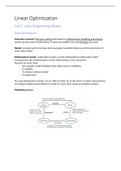
Linear Optimization
Part 1: Linear Programming Models
Operations Research
Operation research: Decision making tool based on mathematical modelling and analysis
used to process the transformation of data into insights into making better decisions
Model: structure which has been built purposely to exhibit features and characteristics of
some other object.
Mathematical model: model that involves a set of mathematical relationships which
correspond to the characterization of the relationships in the real world.
Reasons we need them:
- Get a greater understanding of the object we are modelling
- To simplify
- To analyze mathematically
- To experiment
By using mathematical model, we are able to make use of the share in similar characteristics
of settings fundamentally different in order to solve them easier and maybe similarly.
Modelling process
,Decision making model
When building them have to ask 3 questions:
1. What are the decision alternatives? Which decisions do we have to make?
2. Under what restrictions is the decision made?
3. What is an appropriate objective criterion for evaluating the alternatives? How can
we say this decision is better than another one?
1. Decisions variables: the unknowns that should be determined by the decision maker
Parameters: technical factors which are fixed and not under control of the decision
maker
2. Constraints: physical limitations
3. Objective function: measure used to compare different decisions.
Can represent all this information mathematically:
Mathematical Programming problem
MAX (MIN) 𝑓(𝑥$ … 𝑥& )
s.t. 𝑔) (𝑥$ … 𝑥& ) ≤, =, ≥ 𝑏) 𝑖 = 1, … 𝑚
𝑥3 ∈ 𝑋3 𝑗 = 1, … 𝑛
ð Linear Optimization problem if 𝑓 and 𝑔) are linear for 𝑖 = 1, … 𝑚
ð Continuous Optimization problem if all variables 𝑥3 for 𝑗 = 1, … 𝑛 are continuous.
Will focus on:
ð Single objecting problems: minimize or maximize one objective function
ð Deterministic problem: all parameters are known
Linear programming (linear and continuous functions)
Assumptions:
1) Proportionality & Additivity (Linear problem)
- Contribution of decision variables is proportional to the value of that variable
- Contributions of decision variables are independent and total contribution is the sum
of the individual contributions.
2) Divisibility (Continuous problem)
- Decision variable allowed to take fractional values
3) Certainty (deterministic problem)
- Input parameters are known with certainty
, Characteristics:
ð Decision variables 𝑥$ … 𝑥& are continuous
ð Objective function is linear: 𝑐$ 𝑥$ + ⋯ + 𝑐& 𝑥& with 𝑐$ … 𝑐& the objective function
coefficients
ð Constraints are linear inequalities or equations: 𝑎)$ 𝑥$ + ⋯ + 𝑎$& 𝑥& ≥ 𝑜𝑟 = 𝑜𝑟 ≤ 𝑏)
with 𝑎)$ … 𝑎)& the technical coefficients and 𝑏) the right-hand side of constraint
Feasible solution: any vector (𝑥$ … 𝑥& ) that satisfies all constraints
Feasible set / feasible region: set of all feasible solutions
Optimal solution: feasible solution that yields the best objective function value
Optimal value: best objective function value
Steps to build a LP:
Step 1: determine the decision variables
Step 2: express the objective function in term of the decision variable
Step 3: express the constraints in terms of decision variables
When we cannot have fractional solutions, we will have an integer programming problem.
Need to define the constraints as 𝑥) integer for 𝑖 = 1, … 𝑛. !! we cannot obtain these just by
rounding the LP optimal solution!!
In reality many capital budgeting problems violate the divisibility assumption cause in many
of them it is unreasonable to allow 𝑥) to be fractions => will get a binary modelling problem:
0 or 1, invest or not.
Blending models: typical application of mixed integer-linear programming. Blending of
several resources or materials in order to create one or more products corresponding to a
demand. (see example slide 49)
Dynamic models: decision maker makes decisions at more than one point in time. The
decisions made in the current period influence the decisions made during future periods.
(see example slide 57)
In real life are dynamic models more complex.
- Cost may not be a linear function of quantity (Proportionality violated)
- Future demands may not be known with certainty (Certainty violated)
- Quarter to quarter variations in quantity may result in extra costs (production
smoothing costs)
- Salvage value: value assigned to the inventory left at the end of the last period as an
indicative worth of the final period’s inventory.
Take a close look at all the examples!
Part 1: Linear Programming Models
Operations Research
Operation research: Decision making tool based on mathematical modelling and analysis
used to process the transformation of data into insights into making better decisions
Model: structure which has been built purposely to exhibit features and characteristics of
some other object.
Mathematical model: model that involves a set of mathematical relationships which
correspond to the characterization of the relationships in the real world.
Reasons we need them:
- Get a greater understanding of the object we are modelling
- To simplify
- To analyze mathematically
- To experiment
By using mathematical model, we are able to make use of the share in similar characteristics
of settings fundamentally different in order to solve them easier and maybe similarly.
Modelling process
,Decision making model
When building them have to ask 3 questions:
1. What are the decision alternatives? Which decisions do we have to make?
2. Under what restrictions is the decision made?
3. What is an appropriate objective criterion for evaluating the alternatives? How can
we say this decision is better than another one?
1. Decisions variables: the unknowns that should be determined by the decision maker
Parameters: technical factors which are fixed and not under control of the decision
maker
2. Constraints: physical limitations
3. Objective function: measure used to compare different decisions.
Can represent all this information mathematically:
Mathematical Programming problem
MAX (MIN) 𝑓(𝑥$ … 𝑥& )
s.t. 𝑔) (𝑥$ … 𝑥& ) ≤, =, ≥ 𝑏) 𝑖 = 1, … 𝑚
𝑥3 ∈ 𝑋3 𝑗 = 1, … 𝑛
ð Linear Optimization problem if 𝑓 and 𝑔) are linear for 𝑖 = 1, … 𝑚
ð Continuous Optimization problem if all variables 𝑥3 for 𝑗 = 1, … 𝑛 are continuous.
Will focus on:
ð Single objecting problems: minimize or maximize one objective function
ð Deterministic problem: all parameters are known
Linear programming (linear and continuous functions)
Assumptions:
1) Proportionality & Additivity (Linear problem)
- Contribution of decision variables is proportional to the value of that variable
- Contributions of decision variables are independent and total contribution is the sum
of the individual contributions.
2) Divisibility (Continuous problem)
- Decision variable allowed to take fractional values
3) Certainty (deterministic problem)
- Input parameters are known with certainty
, Characteristics:
ð Decision variables 𝑥$ … 𝑥& are continuous
ð Objective function is linear: 𝑐$ 𝑥$ + ⋯ + 𝑐& 𝑥& with 𝑐$ … 𝑐& the objective function
coefficients
ð Constraints are linear inequalities or equations: 𝑎)$ 𝑥$ + ⋯ + 𝑎$& 𝑥& ≥ 𝑜𝑟 = 𝑜𝑟 ≤ 𝑏)
with 𝑎)$ … 𝑎)& the technical coefficients and 𝑏) the right-hand side of constraint
Feasible solution: any vector (𝑥$ … 𝑥& ) that satisfies all constraints
Feasible set / feasible region: set of all feasible solutions
Optimal solution: feasible solution that yields the best objective function value
Optimal value: best objective function value
Steps to build a LP:
Step 1: determine the decision variables
Step 2: express the objective function in term of the decision variable
Step 3: express the constraints in terms of decision variables
When we cannot have fractional solutions, we will have an integer programming problem.
Need to define the constraints as 𝑥) integer for 𝑖 = 1, … 𝑛. !! we cannot obtain these just by
rounding the LP optimal solution!!
In reality many capital budgeting problems violate the divisibility assumption cause in many
of them it is unreasonable to allow 𝑥) to be fractions => will get a binary modelling problem:
0 or 1, invest or not.
Blending models: typical application of mixed integer-linear programming. Blending of
several resources or materials in order to create one or more products corresponding to a
demand. (see example slide 49)
Dynamic models: decision maker makes decisions at more than one point in time. The
decisions made in the current period influence the decisions made during future periods.
(see example slide 57)
In real life are dynamic models more complex.
- Cost may not be a linear function of quantity (Proportionality violated)
- Future demands may not be known with certainty (Certainty violated)
- Quarter to quarter variations in quantity may result in extra costs (production
smoothing costs)
- Salvage value: value assigned to the inventory left at the end of the last period as an
indicative worth of the final period’s inventory.
Take a close look at all the examples!