

ISO OSI Model
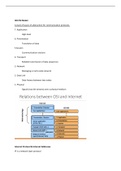
A stack of layers of abstraction for communication protocols.
7. Application
High-level
6. Presentation
Translation of data
5.Session
Ccommunication sessions
4. Transport
Reliable transmission of data sequences
3. Network
Managing a multi-node network
2. Data Link
Data frames between two nodes
1. Physical
Signals (raw bit streams) over a physical medium
Internet Protocol & Internet Addresses
IP is a network layer protocol
, Its job is to send packets (datagrams) from one point in the network to another
Each destination is specified by an IP address
– IPv4: Each address has four 8-bit numbers
– Represented as doted decimals – An 8-bit number can take values between 0 and 255
– A typical address therefore looks like 209.176.201.118 or 127.0.0.1
– <4.3 billion possible addresses => starting 2011 Ipv4 address exhaustion
– IPv6 allows a larger number of addresses (among other advantages)
– 128-bit address ~= 3.4* 10^38 addresses (340 trillion trillion trillion IP addresses)
IP Addresses: Static or Dynamic
– Static is useful in “infrastructural” situations (google.com, uu.nl, your web-server)
– Dynamic addresses change every time a machine logs on (Sergey’s laptop connects to
Eduroam)
– Dynamic addresses are assigned by Dynamic Host Configuration Protocol (DHCP)
IP is connectionless, unreliable, lightweight, and universal.
ARP/NDP & ICMP: Accompanying Protocols
Address Resolution Protocol (ARP) finds out the physical address (MAC) corresponding to an
IP address
In IPv6, the functions of ARP are performed by NDP (Neighbor Discovery Protocol)
Internet Control Message Protocol (ICMP):
Defines the format of control messages that are sent to the sender indicating that a
problem has occurred.
Transmission Control Protocol Characteristics
TCP is connection-oriented
, The client & the server must establish a connection before any data can transferred
between them.
TCP is reliable
TCP knows that the data is received at the other end, and that it is received correctly
TCP ensures that the data that arrives out of sequence is put back in order
TCP implements flow control, so a sender cannot overwhelm a receiver with data
TCP Communication: Making a Connection
Three-way handshake:
First, the requesting client sends to the server a SYN packet (SYN stands for
synchronize) with a unique, random number.
Once the server has received SYN, it agrees to the connection by returning a SYN- ACK
packet (ACK stands for acknowledgment) including the client's sequence number plus 1. It
also transmits its own sequence number to the client.
Finally, the client acknowledges the receipt of the SYN-ACK segment by sending its own ACK
packet, which in this case contains the server's sequence number plus 1.
A stack of layers of abstraction for communication protocols.
7. Application
High-level
6. Presentation
Translation of data
5.Session
Ccommunication sessions
4. Transport
Reliable transmission of data sequences
3. Network
Managing a multi-node network
2. Data Link
Data frames between two nodes
1. Physical
Signals (raw bit streams) over a physical medium
Internet Protocol & Internet Addresses
IP is a network layer protocol
, Its job is to send packets (datagrams) from one point in the network to another
Each destination is specified by an IP address
– IPv4: Each address has four 8-bit numbers
– Represented as doted decimals – An 8-bit number can take values between 0 and 255
– A typical address therefore looks like 209.176.201.118 or 127.0.0.1
– <4.3 billion possible addresses => starting 2011 Ipv4 address exhaustion
– IPv6 allows a larger number of addresses (among other advantages)
– 128-bit address ~= 3.4* 10^38 addresses (340 trillion trillion trillion IP addresses)
IP Addresses: Static or Dynamic
– Static is useful in “infrastructural” situations (google.com, uu.nl, your web-server)
– Dynamic addresses change every time a machine logs on (Sergey’s laptop connects to
Eduroam)
– Dynamic addresses are assigned by Dynamic Host Configuration Protocol (DHCP)
IP is connectionless, unreliable, lightweight, and universal.
ARP/NDP & ICMP: Accompanying Protocols
Address Resolution Protocol (ARP) finds out the physical address (MAC) corresponding to an
IP address
In IPv6, the functions of ARP are performed by NDP (Neighbor Discovery Protocol)
Internet Control Message Protocol (ICMP):
Defines the format of control messages that are sent to the sender indicating that a
problem has occurred.
Transmission Control Protocol Characteristics
TCP is connection-oriented
, The client & the server must establish a connection before any data can transferred
between them.
TCP is reliable
TCP knows that the data is received at the other end, and that it is received correctly
TCP ensures that the data that arrives out of sequence is put back in order
TCP implements flow control, so a sender cannot overwhelm a receiver with data
TCP Communication: Making a Connection
Three-way handshake:
First, the requesting client sends to the server a SYN packet (SYN stands for
synchronize) with a unique, random number.
Once the server has received SYN, it agrees to the connection by returning a SYN- ACK
packet (ACK stands for acknowledgment) including the client's sequence number plus 1. It
also transmits its own sequence number to the client.
Finally, the client acknowledges the receipt of the SYN-ACK segment by sending its own ACK
packet, which in this case contains the server's sequence number plus 1.



