
PHONETICS
RP: received (generally accepted) pronunciation
Interference
Phonological interference
You use the ‘rules of pronunciation’ of your first language, your mother tongue, when you speak
English.
Grammatical interference
You use the grammar rules of your native language when you speak English.
Vocab interference
You use vocab from your native language when you speak English.
Homophones
Words with the same sound (eyes – ice).
Phonemes
One symbol is one speech sound.
Vowels
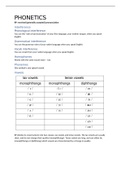
RP divides its vowel system into two classes, lax vowels and tense vowels. The lax vowels are usually
short, and do not change their quality (monophthongs). Tense vowels are long, and can either be
monophthongs or diphthongs which vowels are characterised by a change in quality.
, In unstressed syllables, fewer vowels occur. These are called weak vowels. The most common of
them is shwa.
Consonants
Obstruents: with some form of obstruction of the outgoing airstream (blockage)
Plosives: total obstruction – sudden release
Fricatives: a narrowing in the vocal tract resulting in friction of the outgoing airstream
Affricates: combination between plosive and fricative
Sonorants: with a relatively free escape of the outgoing airstream
Nasal: through the nose
Approximants: with a near-contact between the articulators through the mouth
Fortis: strong muscular effort, voiceless (not vibrating)
- obstruents mentioned first in each pair
Lenis: weak muscular effort, voiced (vibrating vocal cords)
- obstruents mentioned second in each pair
RP: received (generally accepted) pronunciation
Interference
Phonological interference
You use the ‘rules of pronunciation’ of your first language, your mother tongue, when you speak
English.
Grammatical interference
You use the grammar rules of your native language when you speak English.
Vocab interference
You use vocab from your native language when you speak English.
Homophones
Words with the same sound (eyes – ice).
Phonemes
One symbol is one speech sound.
Vowels
RP divides its vowel system into two classes, lax vowels and tense vowels. The lax vowels are usually
short, and do not change their quality (monophthongs). Tense vowels are long, and can either be
monophthongs or diphthongs which vowels are characterised by a change in quality.
, In unstressed syllables, fewer vowels occur. These are called weak vowels. The most common of
them is shwa.
Consonants
Obstruents: with some form of obstruction of the outgoing airstream (blockage)
Plosives: total obstruction – sudden release
Fricatives: a narrowing in the vocal tract resulting in friction of the outgoing airstream
Affricates: combination between plosive and fricative
Sonorants: with a relatively free escape of the outgoing airstream
Nasal: through the nose
Approximants: with a near-contact between the articulators through the mouth
Fortis: strong muscular effort, voiceless (not vibrating)
- obstruents mentioned first in each pair
Lenis: weak muscular effort, voiced (vibrating vocal cords)
- obstruents mentioned second in each pair



