Workgroup 1 – 08/04/2021
Unraveling the concept of governance
Learning goals:
Students are able to provide a description of the concept of governance;
Students can explain the concept of networks in governance theory;
Students can explain that governance can be studied at different levels (micro, meso, macro),
using different theoretical lenses.
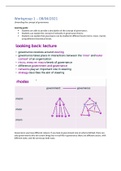
Governance you have different colours: if you look at government only at what is defined, there are
only governments who do certain things but in real-life in governance there are different actors, with
different tasks, and the arrows go both ways.
,Preparation:
1. How is governance defined and described in the articles of Peters (2001), Rhodes (2007),
Scholten (2018) and Riley (2006)?
Peters
This article talks about multi-level governance, its more and more about influence of society.
Political power and institutional capability is less derived from formal constitutional powers
and more from a capacity to wield and coordinate resources from public and private actors
and interests. So there is a development from a ‘command and control’ system towards an
‘enabling’ state, where the state is not proactively governing society but defining objectives
and mustering resources to pursue their goal’
The article states there is a shift from an government perspective towards an governance
perspective, meaning that the current governance and intergovernmental relationships are becoming
increasingly negotiated and contextual.
Working group:
Example: Hugo de Jonge is discussing today COVID0-19 rules with other countries hollowing out,
because Netherlands also needs to negotiate with others.
This article has similarities with Rhodes by hollowing out of the state and they both talk
about enabling state.
Talk about intergovernmental relationships. Difference: Rhodes also talks about
decentralization but also relationships inside a organisation but also relationships which are
not governmental.
Peter is the focus more on government, more than Rhodes.
Rhodes
He talks about policy network analysis en decentred theory. He says that policies emerge from the
bargaining between the networks’ members and that exchange theory is very important for policy
network. A few elements of this idea of governance are:
, Any organization is dependent upon other organizations for resources and in order to
achieve their goals, the organizations have to exchange resources.
Although decision-making within the organization is constrained by other organizations, the
dominant coalition retains some discretion. The appreciative system of the dominant
coalition influences which relationships are seen as a problem and which resources will be
sought.
The dominant coalition employs strategies within known rules of the game to regulate the
process of exchange.
Variations in the degree of discretion are a product of the goals and the relative power
potential of interacting organizations. This relative power potential is a product of the
resources of each organization, of the rules of the game and of the process of exchange
between organizations’.
Governance is as governing with and through networks
Working group:
Unraveling the concept of governance
Learning goals:
Students are able to provide a description of the concept of governance;
Students can explain the concept of networks in governance theory;
Students can explain that governance can be studied at different levels (micro, meso, macro),
using different theoretical lenses.
Governance you have different colours: if you look at government only at what is defined, there are
only governments who do certain things but in real-life in governance there are different actors, with
different tasks, and the arrows go both ways.
,Preparation:
1. How is governance defined and described in the articles of Peters (2001), Rhodes (2007),
Scholten (2018) and Riley (2006)?
Peters
This article talks about multi-level governance, its more and more about influence of society.
Political power and institutional capability is less derived from formal constitutional powers
and more from a capacity to wield and coordinate resources from public and private actors
and interests. So there is a development from a ‘command and control’ system towards an
‘enabling’ state, where the state is not proactively governing society but defining objectives
and mustering resources to pursue their goal’
The article states there is a shift from an government perspective towards an governance
perspective, meaning that the current governance and intergovernmental relationships are becoming
increasingly negotiated and contextual.
Working group:
Example: Hugo de Jonge is discussing today COVID0-19 rules with other countries hollowing out,
because Netherlands also needs to negotiate with others.
This article has similarities with Rhodes by hollowing out of the state and they both talk
about enabling state.
Talk about intergovernmental relationships. Difference: Rhodes also talks about
decentralization but also relationships inside a organisation but also relationships which are
not governmental.
Peter is the focus more on government, more than Rhodes.
Rhodes
He talks about policy network analysis en decentred theory. He says that policies emerge from the
bargaining between the networks’ members and that exchange theory is very important for policy
network. A few elements of this idea of governance are:
, Any organization is dependent upon other organizations for resources and in order to
achieve their goals, the organizations have to exchange resources.
Although decision-making within the organization is constrained by other organizations, the
dominant coalition retains some discretion. The appreciative system of the dominant
coalition influences which relationships are seen as a problem and which resources will be
sought.
The dominant coalition employs strategies within known rules of the game to regulate the
process of exchange.
Variations in the degree of discretion are a product of the goals and the relative power
potential of interacting organizations. This relative power potential is a product of the
resources of each organization, of the rules of the game and of the process of exchange
between organizations’.
Governance is as governing with and through networks
Working group: