Regulation of Plant Development
Lecturers: Christa Testerink (CT), Tijs Ketelaar (TK) and Richard Immink (RI)
Week 1
Lecture 1 – General introduction (RI) 2
Lecture 2 – Hormonal regulation (RI) 7
Lecture 3 – Embryogenesis (RI) 16
Lecture 4 – Root Developmental Patterning (RI) 22
Week 2
Lecture 5 – Auxin transport (TK) 31
Lecture 6 – Cell wall (TK) 45
Lecture 7 – Cell polarity and polar growth (TK) 60
Lecture 8 – Introduction, environmental control of shoot development (CT) 69
Week 3
Lecture 9 – Plasticity of root development (CT) 72
Lecture 10 – Root dynamics & hydrotropism (CT) 78
Lecture 11 – Shoot Apical Meristem (SAM) & Leaf Development (RI 81
Lecture 12 – Physics in morphogenesis I (TK) 90
Week 4
Lecture 13 – Paper: Developmental Patterning by Mechanical Signals in Arabidopsis (TK) 98
Lecture 14 – Thermomorphogenesis (CT and guest Scott Hayes) 101
Week 5
Computer case 1 – Flower initiation (RI) 104
Lecture 15 – Shade avoidance (CT and guest Ronald Pierik) 123
Week 6
Computer case 2 – ABC model (RI) 128
Lecture 16 – Evolution of root nodule formation (RI) 139
Lecture 17 – Evolutionary developmental biology: LEAFY (RI) 145
,Lecture 1 – General introduction
Learning goals
• Concepts in plant development & plant developmental regulation (molecular, cellular
physiological levels)
• Environmental cues directing plant development
• Evolution of developmental regulation
→ 17 different topics
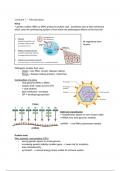
From unicellular to multicellular
New (visible) characteristics in Volvox carteri:
• 2000 cells, two cell types
• Massive complex extracellular matrix
• Asymmetric cell division
• Egg/sperm sexual program
Comparing the genomes: very little difference in genome size/gene numbers?
What are the differences?
• Only 32 ‘EST-supported’ Volvox gene models lack detectable homologs in Chlamydomonas,
suggesting that limited protein-coding innovation occurred in the Volvox lineage
• Volvox specific expansion compared to Chlamydomonas: matrix metalloproteases
(degradation of extracellular matrix proteins) & leucine-rich repeat proteins (cell-membrane-
located-receptors)
• ‘Glueing single cells together and start communication’ (cell specification became dominant
later during evolution)
What did we learn?
How can gene functions evolve?
• Through minor rewiring of existing genetic circuits
• Via (large-scale) gene amplifications and diversifications
How to study this?
• Comparative genomics!
2
,Old, new and ‘split’ functions
• Nonfunctionalization: the production of a pseudogene from a functional gene due to a
mutation event; often the result of single gene duplications.
• Neofunctionalization: one copy retains its ancestral functions, and the other acquires a
novel function, adaptive mutation process; one of the gene copies must mutate to develop
this novel function.
• Subfunctionalization: neutral mutation process; no new adaptations are formed. During the
process of gene duplication, paralogs undergo a division of labor by retaining different parts
(subfunctions) of their orginial ancestral function.
Plants vs animals – summary
• Diverged 1.6 billion years ago
• Last common ancestor was a unicellular eukaryote
• Multicellular organisms evolved independently
• Basic repertoire of regulatory proteins is similar in plant and animals, though have diverged
differently
What determines the developmental strategies of plants?
• They can’t move = sessile organisms
• Interaction with the environment is very important
Basic repertoire of regulatory proteins
Signals
• Intrinsic signals: like hormones (T2, T5, T9), metabolites and mechanical forces (T7, T12, T13)
• External signals: like light and temperature (abiotic; T8, T10), predators and symbionts
(biotic; T16)
3
, Plant hormones
→ Small organic compounds that can cross the cell wall, e.g.:
• Gibberellic acid (GA3) – a gibberellin
• Zeatin – a cytokine
• Indole-3-acetic acid (AA) – an auxin
• Brassinolide – a brassinosteriod
• Abscisic acid (ABA)
• Ethylene
Plant receptors
Type of receptor C. elegans (worm) Arabidopsis (plant)
Nuclear hormone receptors 270 1? (L2)
(LRR) ser/thr receptor kinases - >100 (L11)
Receptor tyrosine kinases Large number -
Histidine kinase 2 component - >8
receptors
G-protein-linked receptors >1000 1?
4
Lecturers: Christa Testerink (CT), Tijs Ketelaar (TK) and Richard Immink (RI)
Week 1
Lecture 1 – General introduction (RI) 2
Lecture 2 – Hormonal regulation (RI) 7
Lecture 3 – Embryogenesis (RI) 16
Lecture 4 – Root Developmental Patterning (RI) 22
Week 2
Lecture 5 – Auxin transport (TK) 31
Lecture 6 – Cell wall (TK) 45
Lecture 7 – Cell polarity and polar growth (TK) 60
Lecture 8 – Introduction, environmental control of shoot development (CT) 69
Week 3
Lecture 9 – Plasticity of root development (CT) 72
Lecture 10 – Root dynamics & hydrotropism (CT) 78
Lecture 11 – Shoot Apical Meristem (SAM) & Leaf Development (RI 81
Lecture 12 – Physics in morphogenesis I (TK) 90
Week 4
Lecture 13 – Paper: Developmental Patterning by Mechanical Signals in Arabidopsis (TK) 98
Lecture 14 – Thermomorphogenesis (CT and guest Scott Hayes) 101
Week 5
Computer case 1 – Flower initiation (RI) 104
Lecture 15 – Shade avoidance (CT and guest Ronald Pierik) 123
Week 6
Computer case 2 – ABC model (RI) 128
Lecture 16 – Evolution of root nodule formation (RI) 139
Lecture 17 – Evolutionary developmental biology: LEAFY (RI) 145
,Lecture 1 – General introduction
Learning goals
• Concepts in plant development & plant developmental regulation (molecular, cellular
physiological levels)
• Environmental cues directing plant development
• Evolution of developmental regulation
→ 17 different topics
From unicellular to multicellular
New (visible) characteristics in Volvox carteri:
• 2000 cells, two cell types
• Massive complex extracellular matrix
• Asymmetric cell division
• Egg/sperm sexual program
Comparing the genomes: very little difference in genome size/gene numbers?
What are the differences?
• Only 32 ‘EST-supported’ Volvox gene models lack detectable homologs in Chlamydomonas,
suggesting that limited protein-coding innovation occurred in the Volvox lineage
• Volvox specific expansion compared to Chlamydomonas: matrix metalloproteases
(degradation of extracellular matrix proteins) & leucine-rich repeat proteins (cell-membrane-
located-receptors)
• ‘Glueing single cells together and start communication’ (cell specification became dominant
later during evolution)
What did we learn?
How can gene functions evolve?
• Through minor rewiring of existing genetic circuits
• Via (large-scale) gene amplifications and diversifications
How to study this?
• Comparative genomics!
2
,Old, new and ‘split’ functions
• Nonfunctionalization: the production of a pseudogene from a functional gene due to a
mutation event; often the result of single gene duplications.
• Neofunctionalization: one copy retains its ancestral functions, and the other acquires a
novel function, adaptive mutation process; one of the gene copies must mutate to develop
this novel function.
• Subfunctionalization: neutral mutation process; no new adaptations are formed. During the
process of gene duplication, paralogs undergo a division of labor by retaining different parts
(subfunctions) of their orginial ancestral function.
Plants vs animals – summary
• Diverged 1.6 billion years ago
• Last common ancestor was a unicellular eukaryote
• Multicellular organisms evolved independently
• Basic repertoire of regulatory proteins is similar in plant and animals, though have diverged
differently
What determines the developmental strategies of plants?
• They can’t move = sessile organisms
• Interaction with the environment is very important
Basic repertoire of regulatory proteins
Signals
• Intrinsic signals: like hormones (T2, T5, T9), metabolites and mechanical forces (T7, T12, T13)
• External signals: like light and temperature (abiotic; T8, T10), predators and symbionts
(biotic; T16)
3
, Plant hormones
→ Small organic compounds that can cross the cell wall, e.g.:
• Gibberellic acid (GA3) – a gibberellin
• Zeatin – a cytokine
• Indole-3-acetic acid (AA) – an auxin
• Brassinolide – a brassinosteriod
• Abscisic acid (ABA)
• Ethylene
Plant receptors
Type of receptor C. elegans (worm) Arabidopsis (plant)
Nuclear hormone receptors 270 1? (L2)
(LRR) ser/thr receptor kinases - >100 (L11)
Receptor tyrosine kinases Large number -
Histidine kinase 2 component - >8
receptors
G-protein-linked receptors >1000 1?
4