Block 1.6 Clinical Psychology
Problem 6. Neurocognitive disorders
BRAIN IMPAIRMENT IN
NEUROCOGNTIVE DISORDERS
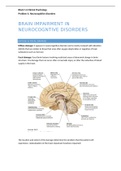
DIFFUSE & FOCAL DAMAGE
Diffuse damage: It appears in neurocognitive disorder and is mostly involved with attention
deficits that are similar to those that arise after oxygen deprivation or ingestion of toxic
substances such as mercury.
Focal damage: Focal brain lesions involving restricted areas of abnormal change in brain
structure. It is damage that can occur after a traumatic injury or after the reduction of blood
supply in the brain.
The location and extent of the damage determine the problem that the patient will
experience. (lateralization of the brain important functions impaired)
,Block 1.6 Clinical Psychology
Problem 6. Neurocognitive disorders
COGNITIVE IMPAIRMENTS IN NEUROCOGNITIVE DISORDERS
LEARNING AND MEMORY DEFICITS
Anterograde amnesia/memory dysfunction: Memory loss for information acquired after the
onset of amnesia. Unable to recall event from recent past.
DEFICITS IN ATTENTION AND AROUSAL
Examples: Lack of attention, easily distracted, slow performance in well learnt activities,
difficulty in focusing or keeping up in the conversation, need of time to make decisions.
LANGUAGE DEFICITS
Aphasias: Speech disorders resulting in difficulties producing or comprehending speech.
Fluent aphasia: The production of incoherent, jumbled speech
Non-fluent aphasia: An inability to initiate or respond to speech with anything other than
simple words.
Broca’s aphasia: Disruption of the ability to speak consisting of difficulties with word
ordering, finding the right word, converting thoughts into words e.g. Mispronunciation.
o Damage in left frontal lobe
Wernicke’s aphasia: Deficit in comprehension of speech involving difficulties in recognizing
spoken words and converting thoughts into words.
o Damage to different areas of the left hemisphere.
D
, Block 1.6 Clinical Psychology
Problem 6. Neurocognitive disorders
DEFICITS IN VISUAL PERCEPTUAL FUNCTIONING
Agnosia: The loss of the ability to recognize objects, persons, sounds, shapes, or smells while
the specific sense is not defective and there is no significant memory loss.
Prosopagnosia: Not able to recognize faces.
Amusia: Not able to recognize music.
Visual agnosia: Able to identify complex shapes but not able to discriminate faces
but only identifying them when they spoke.
MOTOR SKILLS DEFICITS
Apraxia: Loss of ability to execute or carry out learnt (familiar) movements despite having
the desire and the physical ability to perform the movements. E.g. lack of coordination,
paralysis unable to move body parts.
Interestingly, patients that display apraxia might be able to do some learnt
movements/activities under routine conditions e.g. cleaning their teeth, but not
under someone’s commands.
DEFICITS IN EXECUTIVE FUNCTIONS
Examples: Inability of problem solving, initiate, organize, monitor, inhibit complex behaviors.
Poor judgment (e.g. unsafe driving), inappropriate behavior e.g. leaving the house in
pajamas and mood swings.
Association with prefrontal cortex
Wisconsin card sorting test: Commonly used to test executive functions. Individuals
short cards for a number of trials using one rule (e.g. color) and then using another
rule (e.g. shape). This requires a shift of attention and inhibition of the established
response.
DEFICITS IN HIGH ORDER INTELLECTUAL FUNCTIONING
Impairment in abstract mental tasks: Unable to solve mathematical calculations, to reason
or to draw on general knowledge when undertaking a task or activity.
ASSESSMENT IN CLINICAL NEUROPSYCHOLOGY
Important for:
1. Determining actual nature of deficit and location of damage
2. Information about onset, type, severity and progression of symptoms
3. Discriminate between neurological deficits that are organic or psychiatric symptoms
that do not
4. Help rehabilitation programs
Problem 6. Neurocognitive disorders
BRAIN IMPAIRMENT IN
NEUROCOGNTIVE DISORDERS
DIFFUSE & FOCAL DAMAGE
Diffuse damage: It appears in neurocognitive disorder and is mostly involved with attention
deficits that are similar to those that arise after oxygen deprivation or ingestion of toxic
substances such as mercury.
Focal damage: Focal brain lesions involving restricted areas of abnormal change in brain
structure. It is damage that can occur after a traumatic injury or after the reduction of blood
supply in the brain.
The location and extent of the damage determine the problem that the patient will
experience. (lateralization of the brain important functions impaired)
,Block 1.6 Clinical Psychology
Problem 6. Neurocognitive disorders
COGNITIVE IMPAIRMENTS IN NEUROCOGNITIVE DISORDERS
LEARNING AND MEMORY DEFICITS
Anterograde amnesia/memory dysfunction: Memory loss for information acquired after the
onset of amnesia. Unable to recall event from recent past.
DEFICITS IN ATTENTION AND AROUSAL
Examples: Lack of attention, easily distracted, slow performance in well learnt activities,
difficulty in focusing or keeping up in the conversation, need of time to make decisions.
LANGUAGE DEFICITS
Aphasias: Speech disorders resulting in difficulties producing or comprehending speech.
Fluent aphasia: The production of incoherent, jumbled speech
Non-fluent aphasia: An inability to initiate or respond to speech with anything other than
simple words.
Broca’s aphasia: Disruption of the ability to speak consisting of difficulties with word
ordering, finding the right word, converting thoughts into words e.g. Mispronunciation.
o Damage in left frontal lobe
Wernicke’s aphasia: Deficit in comprehension of speech involving difficulties in recognizing
spoken words and converting thoughts into words.
o Damage to different areas of the left hemisphere.
D
, Block 1.6 Clinical Psychology
Problem 6. Neurocognitive disorders
DEFICITS IN VISUAL PERCEPTUAL FUNCTIONING
Agnosia: The loss of the ability to recognize objects, persons, sounds, shapes, or smells while
the specific sense is not defective and there is no significant memory loss.
Prosopagnosia: Not able to recognize faces.
Amusia: Not able to recognize music.
Visual agnosia: Able to identify complex shapes but not able to discriminate faces
but only identifying them when they spoke.
MOTOR SKILLS DEFICITS
Apraxia: Loss of ability to execute or carry out learnt (familiar) movements despite having
the desire and the physical ability to perform the movements. E.g. lack of coordination,
paralysis unable to move body parts.
Interestingly, patients that display apraxia might be able to do some learnt
movements/activities under routine conditions e.g. cleaning their teeth, but not
under someone’s commands.
DEFICITS IN EXECUTIVE FUNCTIONS
Examples: Inability of problem solving, initiate, organize, monitor, inhibit complex behaviors.
Poor judgment (e.g. unsafe driving), inappropriate behavior e.g. leaving the house in
pajamas and mood swings.
Association with prefrontal cortex
Wisconsin card sorting test: Commonly used to test executive functions. Individuals
short cards for a number of trials using one rule (e.g. color) and then using another
rule (e.g. shape). This requires a shift of attention and inhibition of the established
response.
DEFICITS IN HIGH ORDER INTELLECTUAL FUNCTIONING
Impairment in abstract mental tasks: Unable to solve mathematical calculations, to reason
or to draw on general knowledge when undertaking a task or activity.
ASSESSMENT IN CLINICAL NEUROPSYCHOLOGY
Important for:
1. Determining actual nature of deficit and location of damage
2. Information about onset, type, severity and progression of symptoms
3. Discriminate between neurological deficits that are organic or psychiatric symptoms
that do not
4. Help rehabilitation programs