

ECON 200 (econ 200)
University of Washington
Here are the best resources to pass ECON 200 (econ 200). Find ECON 200 (econ 200) study guides, notes, assignments, and much more.
Popular textbooks
Class notes
Chap 3
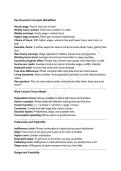
This document explains the basics of work–leisure economics, covering wages, hours, earnings, and how higher wages affect work choices. It introduces real hourly earnings and long‑run trends showing that “income rose while work hours declined.” It also outlines the work‑leisure choice model, including disposable income, the income function , and trade‑offs shown through indifference curves. Budget constraints, feasible sets, and the feasible frontier are defined, with the slope equal...
 evila
evila
Summary
Econ 200 mid
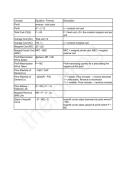
PopularThis document summarizes core microeconomic formulas for profit, cost, elasticity, and market efficiency. It lists key relationships such as profit = revenue − total costs and the constant‑cost form “(P − c) × Q.” It also defines cost functions like “F + cQ” and average cost “F/Q + c.” The notes include elasticity rules, markup formulas, and the MR–elasticity link. Graph sections illustrate deadweight loss, tax incidence, consumer/producer surplus, and externalities, includi...
evila
Summary
econ 200 chap 2
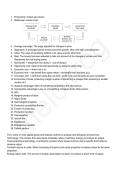
This document covers core concepts from early economic growth theory, production, technology choice, and the Industrial Revolution. It explains productivity, real wages, and the Malthusian cycle, shown as “Improved living standards → population growth → outgrow food supply → reduce population.” Key micro concepts include opportunity cost, economic rent, innovation rent, comparative advantage, production functions, isocost lines, and equilibrium. It also defines technological terms such...
evila
Summary
econ 200 up to 6.3
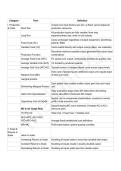
This document summarizes key microeconomic concepts across production, costs, returns to scale, pricing, demand, market structure, welfare, taxation, and externalities. It defines short‑run vs long‑run production, cost measures like “TC = FC + VC” and marginal cost as “extra cost of producing one additional output unit.” It covers returns to scale, economies/diseconomies of scale, and minimum efficient scale. Revenue and pricing concepts include marginal revenue, profit margin, marku...
evila
Summary
econ 200 first few chapters
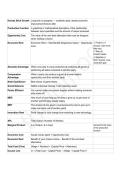
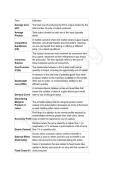
This document provides concise definitions of core microeconomic terms used in production, cost analysis, and market efficiency. It covers cost measures such as average cost, fixed costs, variable costs, and the cost function, defined as “the relationship between a firm's total costs and its quantity of output.” It also includes demand concepts like elastic and inelastic demand, competitive equilibrium, and consumer/producer surplus. Externalities are defined as situations where “a pers...
evila
Summary
econ 200 first few units
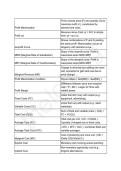
This document summarizes core microeconomic production and cost concepts, including profit maximization, cost structures, and returns to scale. It defines profit as “(p − c) q” and explains that firms maximize profit where “MR = MC.” Key cost measures are covered, including fixed costs, variable costs, total cost “C(Q) = FC + VC(Q)”, average cost, and marginal cost. It also outlines production concepts such as marginal product, average product, and diminishing marginal product, not...
evila
Class notes
Game theory
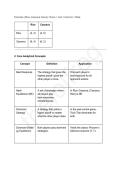
This document introduces core game‑theory tools using simple payoff matrices and real examples. It explains best responses, Nash equilibrium, dominant strategies, and Pareto efficiency, including worked cases like the Rice–Cassava game — “In Rice-Cassava: (Cassava, Rice) is NE.” It also covers major game types (Prisoner’s Dilemma, Invisible-Hand, Public-Good) and why real behavior can differ from Nash predictions, noting that “peer-punishment raises contributions.” A final sectio...
evila