

Term Definition
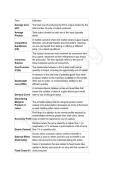
Average Cost The total cost of producing the firm’s output divided by the
(AC) total number of units of output produced.
Average Total output divided by total use of the input (typically
Product labor).
A market outcome where the market clears (supply equals
Competitive demand), and all participants are price-takers, meaning
Equilibrium no one can benefit from asking or offering a different
(CE) price. It is a Nash equilibrium.
The surplus (economic rent) received by consumers who
g
buy a good, measured as their willingness to pay minus
Consumer the price paid. The term typically refers to the sum of
Surplus these surpluses across all consumers.
(C(Q))
fro
Cost Function
Deadweight
Loss (DWL)
The relationship between a firm’s total costs and its
quantity of output, including the opportunity cost of capital.
A measure of the total loss of potential gains from trade
(surplus) relative to the maximum available in the market,
often due to under- or overproduction relative to the
efficient quantity.
ol
A correspondence between prices and quantities that
shows the number of units of a good that buyers would
Demand Curve wish to buy at any given price.
Diminishing
Marginal The principle stating that the marginal product (extra
el
Product of output) of an input (labor) decreases as more of that input
Labor is used, holding other inputs constant.
Profit that is in addition to the normal profits required by
shareholders (revenue greater than total costs, where
th
Economic Profit costs include the opportunity cost of capital).
Demand where the price elasticity is higher than 1 (in
magnitude); a 1% increase in price leads to a fall of more
Elastic Demand than 1% in quantity sold.
Occurs when a person’s action confers a benefit or
External Effect imposes a cost on others and this cost or benefit is not
(Externality) taken into account by the individual taking the action.
Costs of production that are related to fixed inputs (like
capital or factory size) and do not vary with the number of
Fixed Costs (F) units produced.
Average Cost The total cost of producing the firm’s output divided by the
(AC) total number of units of output produced.
Average Total output divided by total use of the input (typically
Product labor).
A market outcome where the market clears (supply equals
Competitive demand), and all participants are price-takers, meaning
Equilibrium no one can benefit from asking or offering a different
(CE) price. It is a Nash equilibrium.
The surplus (economic rent) received by consumers who
g
buy a good, measured as their willingness to pay minus
Consumer the price paid. The term typically refers to the sum of
Surplus these surpluses across all consumers.
(C(Q))
fro
Cost Function
Deadweight
Loss (DWL)
The relationship between a firm’s total costs and its
quantity of output, including the opportunity cost of capital.
A measure of the total loss of potential gains from trade
(surplus) relative to the maximum available in the market,
often due to under- or overproduction relative to the
efficient quantity.
ol
A correspondence between prices and quantities that
shows the number of units of a good that buyers would
Demand Curve wish to buy at any given price.
Diminishing
Marginal The principle stating that the marginal product (extra
el
Product of output) of an input (labor) decreases as more of that input
Labor is used, holding other inputs constant.
Profit that is in addition to the normal profits required by
shareholders (revenue greater than total costs, where
th
Economic Profit costs include the opportunity cost of capital).
Demand where the price elasticity is higher than 1 (in
magnitude); a 1% increase in price leads to a fall of more
Elastic Demand than 1% in quantity sold.
Occurs when a person’s action confers a benefit or
External Effect imposes a cost on others and this cost or benefit is not
(Externality) taken into account by the individual taking the action.
Costs of production that are related to fixed inputs (like
capital or factory size) and do not vary with the number of
Fixed Costs (F) units produced.


