
BIO 101 (BIO101)
Chamberlain College Of Nursing
Here are the best resources to pass BIO 101 (BIO101). Find BIO 101 (BIO101) study guides, notes, assignments, and much more.
Other
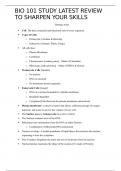
BIO 101 STUDY GUIDE LATEST REVIEW TO SHARPEN YOUR SKILLS
• Cell: The basic structural and functional unit of every organism. • Types of Cells o Prokaryotic [Archaea & Bacteria] o Eukaryotic [Animals, Plants, Fungi] • All cells have o Plasma Membrane o Cytoplasm o Chromosomes [contain genes] – Made of Chromatin o Ribosomes [make proteins] – Made of RRNA & Protein • Prokaryotic Cells [Smaller] o No nucleus o DNA in nucleoid o No membrane bound organelles • Eukaryotic Cells [Larger] o DNA in a nucleus bounded by a double membr...
 Oliver799
Other
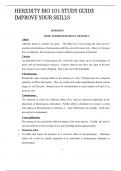
HEREDITY BIO 101 STUDY GUIDE IMPROVE YOUR SKILLS
PopularAlleles Alternate forms or varieties of a gene. The alleles for a trait occupy the same locus or position on homologous chromosomes and thus govern the same trait. However, because they are different, their action may result in different expressions of that trait. Carrier An individual who is heterozygous for a trait that only shows up in the phenotype of those who are homozygous recessive. Carriers often do not show any signs of the trait but can pass it on to their offspring. This i...
Oliver799
Exam (elaborations)
BIO 101 Lecture Exam 2 2026/2027 | 41 Questions & Answers | Macromolecules, Cells, Mitosis & Meiosis
BIO 101 Lecture Exam #2 is a 2026/2027 Biology exam-preparation resource containing 41 identifiable questions/prompts with answers across seven pages. The document focuses on high-yield introductory biology concepts, including hydrolysis and dehydration synthesis, isomers, carbohydrates, glycogen, lipids, proteins, nucleic acids, monomers and polymers, functional groups, cellular structures, organelles, prokaryotic and eukaryotic cells, viruses, mitosis, meiosis, chromosomes, genetic variation, ...
 JOSHCLAY
Exam (elaborations)
Penn Foster Introduction to Biology Final Exam Comprehensive Study Guide with Practice Questions Latest Edition (2026)
This study guide provides a comprehensive review of key concepts commonly assessed in the Penn Foster Introduction to Biology final examination, updated for 2026. It includes practice questions and review materials covering the scientific method, cell structure and function, biological molecules, genetics, DNA and heredity, evolution, ecology, classification of living organisms, human body systems, and principles of energy transfer and metabolism. Emphasis is placed on foundational biological co...
 Nursefrank
Package deal
NCLEX Bundled Exams Questions and Answers 100% Pass |Verified and Updated
NCLEX Bundled Exams Questions and Answers 100% Pass |Verified and Updated
 KatelynWhitman
Exam (elaborations)
Bio 101 Exam 4 innate immunity and adaptive immunity
Phagocytosis - engulf foreign materials/rid body fluids of cellular debris Neutrophils and Monocytes phagolysosome - digestive vesicle formed by the fusing of a lysosome with a phagosome Thymus - An immune organ located near the heart. THe thymus is the site of T cell maturation and is larger in children and adolescents. Chemotaxis - movement by a cell or organism in reaction to a chemical stimulus Cytokines - a way of cells being able to communicate with each otherfunctions of a cytokin...
Terry75
Exam (elaborations)
Bio 101 Exam 4 innate immunity and adaptive immunity
Phagocytosis - engulf foreign materials/rid body fluids of cellular debris Neutrophils and Monocytes phagolysosome - digestive vesicle formed by the fusing of a lysosome with a phagosome Thymus - An immune organ located near the heart. THe thymus is the site of T cell maturation and is larger in children and adolescents. Chemotaxis - movement by a cell or organism in reaction to a chemical stimulus Cytokines - a way of cells being able to communicate with each otherfunctions of a cytokin...
 shadow251
Package deal
Different Latest Nursing Courses Exams Bundled Together 2024
Different Latest Nursing Courses Exams Bundled Together 2024
 SavvyMind
![NUR-BIO 101 LATEST UPDATE WEEK 1,2,3,4,5 EXAM QUESTIONS AND ANSWERS AND STUDY GUIDES [to sharpen your skills] 100% A+ GRADED](/docpics/5120658/662cb1bf703b4_5120658_121_171.jpeg)
Package deal
NUR-BIO 101 LATEST UPDATE WEEK 1,2,3,4,5 EXAM QUESTIONS AND ANSWERS AND STUDY GUIDES [to sharpen your skills] 100% A+ GRADED
NUR-BIO 101 LATEST UPDATE WEEK 1,2,3,4,5 EXAM QUESTIONS AND ANSWERS AND STUDY GUIDES [to sharpen your skills] 100% A+ GRADED//NUR-BIO 101 LATEST UPDATE WEEK 1,2,3,4,5 EXAM QUESTIONS AND ANSWERS AND STUDY GUIDES [to sharpen your skills] 100% A+ GRADED
Oliver799
Exam (elaborations)
BIO 101 FINAL LATEST EXAM QUESTIONS & ANSWERS- 100% A+ GRADED
1. Declining bee populations are leading to flowers not being pollinate Organismal Ecology Population Ecology Community Ecology Ecosystems Ecology 2. A small amount of gophers can define the structure of a community. This makes them opportunistic keystone species apex predators autotrophs 3. Most crop pests ______. have an opportunistic life history consist of long-lived individuals have an equilibrial life history exhibit type I ...
Oliver799
Exam (elaborations)
Bio 101- Final Exam – with complete solution 2024
- Which of the following would best represent what a scientific hypothesis is? A) An individuals personal guess to an unanswered question that no one has tried to answer previously B) The conclusion that one draws after experimental data has been gathered C) Is the same as a theory, the two items are interchangeable D) A potential, testable explanation for an observed phenomenon E) All of these F) None of these E - Which of the following are examples of or are types of Carbohydrates? ...
Oliver799
Exam (elaborations)
BIO 101 FINAL LATEST EXAM QUESTIONS & ANSWERS- 100% A+ GRADED
1. Declining bee populations are leading to flowers not being pollinate Organismal Ecology Population Ecology Community Ecology Ecosystems Ecology 2. A small amount of gophers can define the structure of a community. This makes them opportunistic keystone species apex predators autotrophs 3. Most crop pests ______. have an opportunistic life history consist of long-lived individuals have an equilibrial life history exhibit type I ...
Oliver799
Exam (elaborations)
BIO 101 FINAL EXAM QUESTIONS WITH ANSWERS 100% A+ GRADED
1. Declining bee populations are leading to flowers not being pollinate Organismal Ecology Population Ecology Community Ecology Ecosystems Ecology 2. A small amount of gophers can define the structure of a community. This makes them opportunistic keystone species apex predators autotrophs 3. Most crop pests ______. have an opportunistic life history consist of long-lived individuals have an equilibrial life history exhibit type I ...
Oliver799
Exam (elaborations)
BIO Exam
Bio Exam One 1. The presence of a cell wall and cell membrane, but the absence of cellular organelles would be a description of which of the following classes of cells? a. prokaryotic cells b. eukaryotic cells 2. Which one of the following is a function of a protein? a. serves as an enzyme and speeds up a chemical reaction b. stores genetic material and enables its transmission to the next generation c. provides energy for a muscle contraction d. is a primary structural component of DNA 3. Whic...
 brilliantsamrt1

Exam (elaborations)
TEST BANK for BIOLOGY 13TH EDITION MADER FULL TESTBANK
TEST BANK for BIOLOGY 13TH EDITION MADER NURSINGTB.COM Biology, 13e (Mader) Chapter 2 Basic Chemistry 1) Which of the following elements would be the most reactive with other elements? A) boron, #5 B) neon, #10 C) argon, #18 D) helium, #2 Answer: A Explanation: Correct. Section: 02.01 Topic: Chemistry; Chemical Elements Bloom's: 3. Apply Learning Outcome: 02.01.04 Determine how electrons are configured around a nucleus. Accessibility: Keyboard Navigation 2) Your roommate has hea...
 lectdenis
Exam (elaborations)
BIO 101 – Fast Plants 1 – Growth and genetics: Gizmos 2021/2022: Student Exploration: Fast Plants Growth and Genetics
BIO 101 – Fast Plants 1 – Growth and genetics: Gizmos 2021/2022: Student Exploration: Fast Plants Growth and Genetics. Vocabulary: allele, dominant allele, Fast Plants, gene, genetics, genotype, heterozygous, homozygous, offspring, phenotype, pollen, pollinate, Punnett square, recessive allele, trait Prior Knowledge Questions (Do these BEFORE using the Gizmo.) 1. What do plants need to survive? Plants need nutrients from the soil, water, air and light. 2. How do plants reproduce? Plants ...
 ExcelAcademia2026
Exam (elaborations)
BIO 101 – Fast Plants 1 – Growth and genetics: Gizmos 2021/2022: Student Exploration: Fast Plants Growth and Genetics
BIO 101 – Fast Plants 1 – Growth and genetics: Gizmos 2021/2022: Student Exploration: Fast Plants Growth and Genetics. Vocabulary: allele, dominant allele, Fast Plants, gene, genetics, genotype, heterozygous, homozygous, offspring, phenotype, pollen, pollinate, Punnett square, recessive allele, trait Prior Knowledge Questions (Do these BEFORE using the Gizmo.) 1. What do plants need to survive? Plants need nutrients from the soil, water, air and light. 2. How do plants reproduce? Plants ...
 STUDYLAB2023
Exam (elaborations)
BIO 101 – Fast Plants 1 – Growth and genetics: Gizmos 2021/2022: Student Exploration: Fast Plants Growth and Genetics
BIO 101 – Fast Plants 1 – Growth and genetics: Gizmos 2021/2022: Student Exploration: Fast Plants Growth and Genetics. allele, dominant allele, Fast Plants, gene, genetics, genotype, heterozygous, homozygous, offspring, phenotype, pollen, pollinate, Punnett square, recessive allele, trait Prior Knowledge Questions (Do these BEFORE using the Gizmo.) 1. What do plants need to survive? Plants need nutrients from the soil, water, air and light. 2. How do plants reproduce? Plants reproduce se...
 DRBRIGHT2026
Exam (elaborations)
Bio 101 Exam Collection
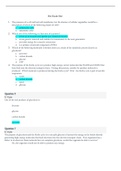
Bio 101 Exam Collection BIO EXAM 1 TO 5 (A GUARANTEED) <100% CORRECT> GRADED A+ | LATEST SOLUTIONS | BIO EXAM ONE BIO EXAM TWO BIO EXAM THREE BIO EXAM FOUR BIO EXAM FIVE 1. The presence of a cell wall and cell membrane, but the absence of cellular organelles would be a description of which of the following classes of cells? a. prokaryotic cells b. eukaryotic cells 2. Which one of the following is a function of a protein? a. serves as an enzyme and speeds up a chemical reactio...
TESTBANKED
Summary
the skeleton system.
The skull is formed by 22 bones: the cranium (8 bones) and facial bones (14 bones). The cranium protects the brains and is composed of eight bones fitted tightly together in adults. In newborns, certain bones are not completely formed and instead are joined by membranous regions called fontanelles (see Figure 4.4), commonly called “soft spots.” Fontanelles allow the bones of the skull to compress during childbirth and expand to accommodate a rapidly growing infant brain. These regions begin...
vivimwangi