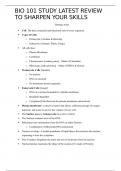
BIO 101 STUDY LATEST REVIEW
TO SHARPEN YOUR SKILLS
Biology Notes
Cell: The basic structural and functional unit of every organism.
Types of Cells
o Prokaryotic [Archaea & Bacteria]
o Eukaryotic [Animals, Plants, Fungi]
All cells have
o Plasma Membrane
o Cytoplasm
o Chromosomes [contain genes] – Made of Chromatin
o Ribosomes [make proteins] – Made of RRNA & Protein
Prokaryotic Cells [Smaller]
o No nucleus
o DNA in nucleoid
o No membrane bound organelles
Eukaryotic Cells [Larger]
o DNA in a nucleus bounded by a double membrane
o Bounded Organelles
o Cytoplasm [Fluid between the plasma membrane and nucleus]
Plasma membrane: a selective barrier that allows sufficient passage of oxygen,
nutrients, and waste to service the volume of every cell.
The Surface area to Volume ratio of a cell is critical.
The Nucleus contains most of the DNA
Ribosomes uses information from the DNA to make Proteins
o Combination of Ribosomal RNA and protein
Nuclear envelope: A double membrane of lipid bilayer that encloses the nucleus
separating it from the cytoplasm
Pore Complex: Regulates the entry and exit of molecules from the nucleus
Nuclear lamina: maintains the shape of the nucleus [it’s made of Protein]
, BIO 101 STUDY LATEST REVIEW
TO SHARPEN YOUR SKILLS
Chromosomes: DNA organized into discrete units.
Chromatin: This is one DNA molecule associated with proteins
o Euchromatin is loosed chromatin
o Heterochromatin is compact or compressed chromatin
Nucleolus: The site of Ribosomal RNA synthesis located inside the nucleus
Ribosomes carry out Protein Synthesis
o In the Cytoplasm [free Ribosomes]
o Outside the endoplasmic reticulum [Bound Ribosomes]
Endomembrane System
o Nuclear envelope
o Endoplasmic Reticulum
o Golgi apparatus
o Lysosomes
o Vacuoles
o Plasma Membrane
o # Components are either Continuous or connected via vesicles
Regions of the Endoplasmic Reticulum
o Smooth ER [ Lacks ribosomes]
Makes lipids
Breaks down Carbohydrates
Detoxifies drugs and Poison
Stores Calcium
o Rough ER [Studded with ribosomes]
Distributes transport vesicles
Is a membrane factory for the cell
Golgi apparatus: Made of flattened sacs called Cisternae
o Modifies product of the ER
o Makes certain macromolecules
TO SHARPEN YOUR SKILLS
Biology Notes
Cell: The basic structural and functional unit of every organism.
Types of Cells
o Prokaryotic [Archaea & Bacteria]
o Eukaryotic [Animals, Plants, Fungi]
All cells have
o Plasma Membrane
o Cytoplasm
o Chromosomes [contain genes] – Made of Chromatin
o Ribosomes [make proteins] – Made of RRNA & Protein
Prokaryotic Cells [Smaller]
o No nucleus
o DNA in nucleoid
o No membrane bound organelles
Eukaryotic Cells [Larger]
o DNA in a nucleus bounded by a double membrane
o Bounded Organelles
o Cytoplasm [Fluid between the plasma membrane and nucleus]
Plasma membrane: a selective barrier that allows sufficient passage of oxygen,
nutrients, and waste to service the volume of every cell.
The Surface area to Volume ratio of a cell is critical.
The Nucleus contains most of the DNA
Ribosomes uses information from the DNA to make Proteins
o Combination of Ribosomal RNA and protein
Nuclear envelope: A double membrane of lipid bilayer that encloses the nucleus
separating it from the cytoplasm
Pore Complex: Regulates the entry and exit of molecules from the nucleus
Nuclear lamina: maintains the shape of the nucleus [it’s made of Protein]
, BIO 101 STUDY LATEST REVIEW
TO SHARPEN YOUR SKILLS
Chromosomes: DNA organized into discrete units.
Chromatin: This is one DNA molecule associated with proteins
o Euchromatin is loosed chromatin
o Heterochromatin is compact or compressed chromatin
Nucleolus: The site of Ribosomal RNA synthesis located inside the nucleus
Ribosomes carry out Protein Synthesis
o In the Cytoplasm [free Ribosomes]
o Outside the endoplasmic reticulum [Bound Ribosomes]
Endomembrane System
o Nuclear envelope
o Endoplasmic Reticulum
o Golgi apparatus
o Lysosomes
o Vacuoles
o Plasma Membrane
o # Components are either Continuous or connected via vesicles
Regions of the Endoplasmic Reticulum
o Smooth ER [ Lacks ribosomes]
Makes lipids
Breaks down Carbohydrates
Detoxifies drugs and Poison
Stores Calcium
o Rough ER [Studded with ribosomes]
Distributes transport vesicles
Is a membrane factory for the cell
Golgi apparatus: Made of flattened sacs called Cisternae
o Modifies product of the ER
o Makes certain macromolecules