

CHM2211 (CHM2211)
University Of Florida
Here are the best resources to pass CHM2211 (CHM2211). Find CHM2211 (CHM2211) study guides, notes, assignments, and much more.
Class notes
Organic Chemistry 2 Notes
Master Organic Chemistry 2 – Complete Study Notes Take the stress out of Orgo 2 with this all-in-one guide to the second half of the course. These detailed, organized, and easy-to-understand notes are designed to help you tackle complex reactions and mechanisms with confidence. What you’ll get: In-depth breakdowns of key topics: aromaticity, electrophilic aromatic substitution, carbonyl chemistry, carboxylic acid derivatives, enols/enolates, amines, spectroscopy (IR, NMR), and more ...
 mayaalsopp
Summary
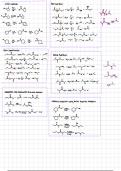
Organic Chemistry 2: Carboxylic Acids
PopularThis sheet covers reactions of carboxylic acid derivatives through nucleophilic acyl substitution mechanisms. Topics include ester hydrolysis, ester saponification, nitrile hydrolysis, and amide hydrolysis. The notes also explain reactions of acid chlorides and reductions of carbonyl compounds using metal hydride reagents. These reactions show how different derivatives interconvert within carbonyl chemistry.
 jacklyngiler
Summary
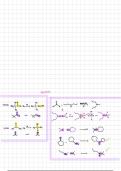
Organic Chemistry 2: Aldehydes and Ketones
This document continues carbonyl chemistry with additional reactions of aldehydes and ketones. It includes reductions using NaBH₄ and LiAlH₄, formation of imines and enamines with amines, and acetal/ketal formation under acidic conditions. The notes also demonstrate alpha-halogenation reactions and mechanisms. These examples focus on reaction pathways and intermediate formation.
jacklyngiler

Summary
Organic Chemistry 2: Enolates, Anions, and Enamines
These notes explain carbonyl chemistry involving enolates and enamine intermediates. Topics include aldol reactions, aldol condensation, Claisen condensation, and Dieckmann cyclization. The notes show how to identify acidic alpha hydrogens and form enolate nucleophiles. They also cover intramolecular aldol reactions and Michael additions, with step-by-step mechanisms and product predictions.
jacklyngiler
Summary
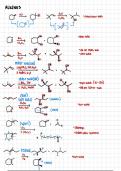
Organic Chemistry 2: Master Reaction Sheet
This is a comprehensive organic chemistry reaction summary sheet. It covers reactions of alkenes, alkynes, radicals, alcohols, ethers, and epoxides, including stereochemistry and regiochemistry. The notes include key transformations such as hydroboration-oxidation, ozonolysis, radical halogenation, and oxidation of alcohols. It also summarizes Grignard reagents, organolithium reagents, and Simmons–Smith reactions, making it a useful quick-reference sheet for exam review.
jacklyngiler
Summary
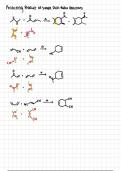
Organic Chemistry 2: Conjugated Pi Systems
This set focuses on practice problems and reaction prediction for conjugated systems. It includes examples for predicting products of Diels–Alder reactions, identifying aromatic vs antiaromatic compounds, and determining reactants from given cycloaddition products. The notes also cover Friedel–Crafts reactions used in synthesis involving benzene rings. These examples help reinforce reaction mechanisms and product prediction skills.
jacklyngiler
Summary
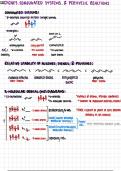
Organic Chemistry 2: Conjugated Systems, Benzene, and Benzene Derivatives
These notes explain conjugated π systems and aromatic chemistry. Topics include molecular orbital diagrams for conjugated systems, stability of dienes, and resonance effects. They also cover pericyclic reactions such as the Diels–Alder reaction, including stereochemistry, regiochemistry, and the endo rule. A large section focuses on aromaticity and Hückel’s rule, explaining how to determine if molecules are aromatic, antiaromatic, or non-aromatic. The notes finish with benzene reactions su...
jacklyngiler
Summary
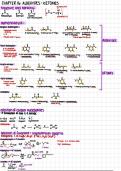
Organic Chemistry 2: Aldehydes, Ketones, and Carboxylic Acids
These notes cover the structure, nomenclature, and reactions of aldehydes and ketones, including how carbonyl compounds behave as electrophiles. They explain carbon nucleophile additions (Grignard reagents, organolithium reagents, cyanide, and acetylides) that create new C–C bonds. The notes also break down important reactions like the Wittig reaction and Horner-Wadsworth-Emmons reaction used to form alkenes from carbonyl compounds. Additional sections include oxygen and nitrogen nucleophile a...
jacklyngiler
Summary
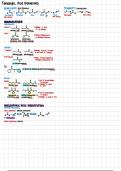
Organic Chemistry 2: Carboxylic Acid Derivatives
Reaction with carboxylic acid derivatives. Includes reagents, examples, and mechanisms. Organized by type of reaction. Study tips for each reaction. Synthesis example included.
jacklyngiler
Package deal
Organic Chemistry 2 Package Deal
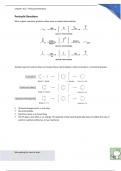
Ultimate Organic Chemistry Handouts Bundle Master key topics with this all-in-one package: IR, MS, ¹³C NMR, ¹H NMR, degree of unsaturation, integration & spin multiplicity, aromatic substitution & compounds, and pericyclic reactions. Clear, concise notes with examples—perfect for exam prep. Instant download!
mayaalsopp
Class notes
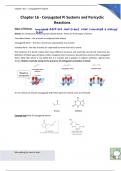
Conjugated Pi System Lecture Handout
Pericyclic Reactions Lecture Handout – Your Essential Guide to Concerted Mechanisms Master one of the most conceptually challenging topics in organic chemistry with this clear, concise, and exam-focused handout on pericyclic reactions. What’s inside: Overview of key pericyclic reaction types: electrocyclic reactions, cycloadditions (including Diels-Alder), and sigmatropic rearrangements Step-by-step breakdown of reaction mechanisms and electron flow using curved arrow notation W...
mayaalsopp
Class notes
Pericyclic Compound Lecture Handout
Pericyclic Reactions Lecture Handout – Your Essential Guide to Concerted Mechanisms Master one of the most conceptually challenging topics in organic chemistry with this clear, concise, and exam-focused handout on pericyclic reactions. What’s inside: Overview of key pericyclic reaction types: electrocyclic reactions, cycloadditions (including Diels-Alder), and sigmatropic rearrangements Step-by-step breakdown of reaction mechanisms and electron flow using curved arrow notation W...
mayaalsopp
Class notes
Aromatic Compound Lecture Handout
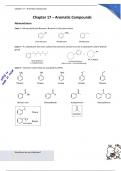
Aromatic Compounds Lecture Handout – Complete Guide to Structure, Stability & Reactions Struggling to understand what makes a compound aromatic? This comprehensive yet easy-to-digest handout covers everything you need to know about aromatic compounds—perfect for Organic Chemistry students aiming to master the topic. What’s included: Definition and criteria for aromaticity (Hückel’s Rule, planarity, cyclic conjugation) Clear comparisons of aromatic vs. antiaromatic vs. nonaroma...
mayaalsopp
Class notes
Aromatic Substitution
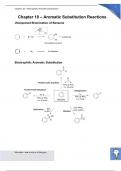
Aromatic Substitution Reactions Handout – Your Go-To Guide for EAS Mastery Nail electrophilic aromatic substitution (EAS) reactions with this clear, organized, and high-yield handout that breaks down one of Organic Chemistry’s most reaction-rich topics. What’s included: Step-by-step mechanism breakdowns for key EAS reactions: nitration, sulfonation, halogenation, Friedel-Crafts alkylation & acylation Activating vs. deactivating groups explained with real examples Ortho/para vs...
mayaalsopp
Class notes
HNMR Integration and Spin Multiplicity
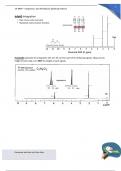
¹H NMR Integration & Spin Multiplicity Handout – Focused Guide to Signal Patterns Struggling to make sense of splitting trees and proton ratios? This streamlined handout breaks down integration and spin multiplicity in proton NMR so you can confidently analyze even the trickiest spectra. What’s inside: Simple, step-by-step guide to interpreting integration values and determining the number of equivalent protons Clear explanation of spin-spin coupling and how to predict splitting p...
mayaalsopp
Class notes
Hydrogen NMR Lecture Handout
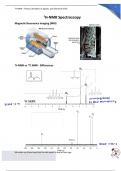
Proton NMR (¹H NMR) Lecture Handout – Ultimate Study Guide for Spectral Interpretation Confused by chemical shifts, splitting patterns, and integration? This proton NMR (¹H NMR) handout is your clear, concise guide to mastering one of the most important tools in organic chemistry. What’s inside: Step-by-step breakdown of how to interpret ¹H NMR spectra Chemical shift ranges for common proton environments (alkyl, vinyl, aromatic, aldehyde, alcohol, etc.) Integration tips to de...
mayaalsopp
Class notes
Degree of Unsaturation
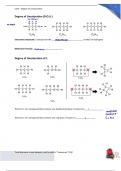
Degree of Unsaturation Lecture Handout – Quick & Easy Reference Guide Struggling with molecular formulas and ring/double bond predictions? This Degree of Unsaturation (Index of Hydrogen Deficiency) handout makes it easy to determine the number of rings and π-bonds in a molecule—fast. What’s inside: Clear explanation of what degree of unsaturation means and how to use it Simple, step-by-step calculation method (with formulas for molecules containing C, H, N, X, O) Common funct...
mayaalsopp
Class notes
Carbon NMR Lecture Handout
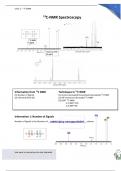
Carbon-13 NMR (¹³C NMR) Lecture Handout – Clear & Concise Study Guide Make sense of carbon NMR spectroscopy with this easy-to-follow, high-yield handout designed to help you quickly recognize patterns, interpret spectra, and master structure determination. What’s included: Overview of ¹³C NMR principles – chemical shifts, signal count, symmetry, splitting (DEPT), and more Chemical shift ranges for key carbon environments (alkanes, alkenes, aromatics, carbonyls, etc.) Annot...
mayaalsopp
Class notes
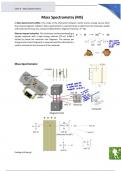
Mass Spectrometry Lecture Handout
Mass Spectrometry Lecture Handout – Fast & Focused Study Guide Unlock the power of mass spectrometry with this clear, concise, and exam-ready handout designed to simplify a notoriously tricky topic. What’s inside: Step-by-step breakdown of how mass spectrometry works: ionization, fragmentation, detection, and interpretation Key terms and concepts explained (molecular ion peak, base peak, M+1 and M+2 peaks, isotope patterns, fragmentation rules) Tips for deducing molecular formul...
mayaalsopp
Class notes
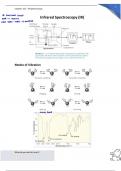
Chapter 14- Infrared Spectrum
Simplify IR spectroscopy with this concise, high-yield lecture handout designed to help you quickly identify functional groups and interpret IR spectra with confidence. What’s included: Clear summary of key IR absorption ranges for major functional groups (alkanes, alkenes, alkynes, aromatics, alcohols, carbonyls, amines, and more) Labeled sample spectra to show what common compounds look like in practice Handy functional group chart with characteristic peaks and intensities Tip...
mayaalsopp