

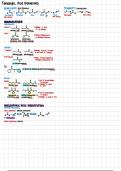
Carboxylic Acid Derivatives
REACTIVITY : Acid Derivative STABILITY : leaving group
R
-
P
C
2
or -cr --
- N
10 oi
oR
For ONt
acid chloride anhydride ester
amide i niltile
least reactive
most stable least stable
most reactive
NOMENCLATURE
ACID CHLORIDES :
:T P
acyclic
o -
*
change - is
to-y1 chloride
acid
acid
pentano pentanou
ride
cyclic : P P -
*
change carboxylic acid
Not Y 4
to carbonyl chloride
cyclopropane cyclopropane
-boxylic acid , b oepride
ny
AMIDES :
lamide
:__ ot ↑ Ruchangec acidjoicais ,
pentanoid pentanide
2 % 3 amide :
* name
P R' group bonded to
- Nitrogen using locant 'N'
H
N-ethylpentanamide
-
&: O
-
N-benzyl-N-methylcyclopentane carbonide
ESTERS :
P * list i'
group bonded
c
acyclic : to
oxygen
o
nexanoic acid
-
cuclicio cyclobutane-1 , 1-diethyl cyclobutane
dicarboxylate
L
-
* list
1 , 1-
*
to
R'group bonded
oxygen
change-ic acid To-ate
NUCLEOPHILIC ACYL SUBSTITUTION
GENERAL MECHANISM :
basic conditions :
addition elimination
-
R
P :
NationNation + 2
z =
leaving group
acidic conditions : PADPED
, REACTION WIWATER : HYDROLYSIS
REAGENTS : H2O
ACID CHLORIDE HYDROLYSIS
ACID CHLORIDES :
+ i * sometimes
pyridine added
enoscar.
1 0 - ro + He
Mechani proton tranfer
ANYDRIDE HYDROLYSIS * mechanism same
nor'wout
ANHYDRIDES
-
:
as chloridehydrolysis
R- o p R To catalyss
MECHANISM WICATALYST : HO + HCI-HODOC LG
L H
·
A
00 ,
No
AMIDE HYDROLYSIS & needs stoichiometric acid
* PADPED mechanism
AMIDES : *
requiresh e a t
acid-promoted :
~ HCI P
N
no
base-promoted mechanism :
Gi
-
-
-Ph
i
NaHN
: H
-
irreversible
In
·
O
ESTER HYDROLYSIS NITRILE HYDROLYSIS
ESTERS :
&
acid catalyzed :
*
requires heat
slightly reversible Dcid-promoted :
via on
E
②
K
amide synthesis
isolated]
N
atn
mechanism :
P
- --
0 If
+
Hz0Q
base-promoted :
Roll
7
( H20)
+
T
base-promoted :
mechanism :
:H Br
i
-
irreversible Pride synthesis G
It 4 jit TT + OH
Mechanism :
0
-
·
O
Im
REACTIVITY : Acid Derivative STABILITY : leaving group
R
-
P
C
2
or -cr --
- N
10 oi
oR
For ONt
acid chloride anhydride ester
amide i niltile
least reactive
most stable least stable
most reactive
NOMENCLATURE
ACID CHLORIDES :
:T P
acyclic
o -
*
change - is
to-y1 chloride
acid
acid
pentano pentanou
ride
cyclic : P P -
*
change carboxylic acid
Not Y 4
to carbonyl chloride
cyclopropane cyclopropane
-boxylic acid , b oepride
ny
AMIDES :
lamide
:__ ot ↑ Ruchangec acidjoicais ,
pentanoid pentanide
2 % 3 amide :
* name
P R' group bonded to
- Nitrogen using locant 'N'
H
N-ethylpentanamide
-
&: O
-
N-benzyl-N-methylcyclopentane carbonide
ESTERS :
P * list i'
group bonded
c
acyclic : to
oxygen
o
nexanoic acid
-
cuclicio cyclobutane-1 , 1-diethyl cyclobutane
dicarboxylate
L
-
* list
1 , 1-
*
to
R'group bonded
oxygen
change-ic acid To-ate
NUCLEOPHILIC ACYL SUBSTITUTION
GENERAL MECHANISM :
basic conditions :
addition elimination
-
R
P :
NationNation + 2
z =
leaving group
acidic conditions : PADPED
, REACTION WIWATER : HYDROLYSIS
REAGENTS : H2O
ACID CHLORIDE HYDROLYSIS
ACID CHLORIDES :
+ i * sometimes
pyridine added
enoscar.
1 0 - ro + He
Mechani proton tranfer
ANYDRIDE HYDROLYSIS * mechanism same
nor'wout
ANHYDRIDES
-
:
as chloridehydrolysis
R- o p R To catalyss
MECHANISM WICATALYST : HO + HCI-HODOC LG
L H
·
A
00 ,
No
AMIDE HYDROLYSIS & needs stoichiometric acid
* PADPED mechanism
AMIDES : *
requiresh e a t
acid-promoted :
~ HCI P
N
no
base-promoted mechanism :
Gi
-
-
-Ph
i
NaHN
: H
-
irreversible
In
·
O
ESTER HYDROLYSIS NITRILE HYDROLYSIS
ESTERS :
&
acid catalyzed :
*
requires heat
slightly reversible Dcid-promoted :
via on
E
②
K
amide synthesis
isolated]
N
atn
mechanism :
P
- --
0 If
+
Hz0Q
base-promoted :
Roll
7
( H20)
+
T
base-promoted :
mechanism :
:H Br
i
-
irreversible Pride synthesis G
It 4 jit TT + OH
Mechanism :
0
-
·
O
Im


