

1
Chapter 16.2 – Pericyclic Reactions
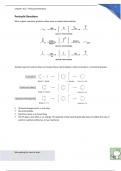
Pericyclic Reactions
Most organic reactions produce either ionic or radical intermediate
Another type of reaction does not involve those intermediates, rather proceed in a concerted process.
▪ All bond changes occur in one step
▪ No intermediate
▪ Electrons move in a closed loop
▪ The TS bears very little or no charge. The polarity of the solvent generally does not affect the rate or
yield or reaction (unlike SN1 or SN2 reactions)
Me waiting for class to start.
, 2
Chapter 16.2 – Pericyclic Reactions
[4+2] Cycloaddition (Diels-Alder Reaction)
M 8
- H 11
C
-
i I
H
4 -
-
Thermodynamic Consideration of Diels-Alder Reaction
spontaneous : negative o
⑦
neana
▪ Just like most reactions, Diels-Alder Reaction is in equilibrium.
▪ Going form two molecules to one molecule, ΔS term of Diels-Alder Reaction is negative which
makes -TΔS term positive.
▪ At lower temperature, -TΔS term is not large enough that ΔG is positive, favor the formation of
the product.
▪ At higher temperature (>200 oC), the -TΔS is highly positive. As a result, ΔG is positive and the
reaction favors the formation of the reactant.
▪ Therefore, one can perform “retro Diels-Alder reaction” under a temperature above 200 oC
Me waiting for class to start.
, 3
Chapter 16.2 – Pericyclic Reactions
The Dienophiles
Electron-withdrawing effect through resonance
e
-
Stereochemistry of Diels-Alder Reaction is Stereospecific
Alkyne can serve as a dienophile
-
7
Me waiting for class to start.
Chapter 16.2 – Pericyclic Reactions
Pericyclic Reactions
Most organic reactions produce either ionic or radical intermediate
Another type of reaction does not involve those intermediates, rather proceed in a concerted process.
▪ All bond changes occur in one step
▪ No intermediate
▪ Electrons move in a closed loop
▪ The TS bears very little or no charge. The polarity of the solvent generally does not affect the rate or
yield or reaction (unlike SN1 or SN2 reactions)
Me waiting for class to start.
, 2
Chapter 16.2 – Pericyclic Reactions
[4+2] Cycloaddition (Diels-Alder Reaction)
M 8
- H 11
C
-
i I
H
4 -
-
Thermodynamic Consideration of Diels-Alder Reaction
spontaneous : negative o
⑦
neana
▪ Just like most reactions, Diels-Alder Reaction is in equilibrium.
▪ Going form two molecules to one molecule, ΔS term of Diels-Alder Reaction is negative which
makes -TΔS term positive.
▪ At lower temperature, -TΔS term is not large enough that ΔG is positive, favor the formation of
the product.
▪ At higher temperature (>200 oC), the -TΔS is highly positive. As a result, ΔG is positive and the
reaction favors the formation of the reactant.
▪ Therefore, one can perform “retro Diels-Alder reaction” under a temperature above 200 oC
Me waiting for class to start.
, 3
Chapter 16.2 – Pericyclic Reactions
The Dienophiles
Electron-withdrawing effect through resonance
e
-
Stereochemistry of Diels-Alder Reaction is Stereospecific
Alkyne can serve as a dienophile
-
7
Me waiting for class to start.


