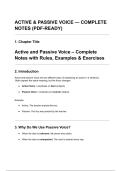
ACTIVE & PASSIVE VOICE — COMPLETE
NOTES (PDF-READY)
1. Chapter Title
Active and Passive Voice – Complete
Notes with Rules, Examples & Exercises
2. Introduction
Active and passive voice are two different ways of expressing an action in a sentence.
Both express the same meaning, but the focus changes.
● Active Voice = emphasis on doer (subject)
● Passive Voice = emphasis on receiver (object)
Example:
● Active: The teacher praised the boy.
● Passive: The boy was praised by the teacher.
3. Why Do We Use Passive Voice?
● When the doer is unknown: My phone was stolen.
● When the doer is unimportant: The road is cleaned every day.
, ● When we want to sound formal/polite: Your request has been approved.
● When we want to focus on the result, not the person.
4. Structure Table
Active vs Passive Structure
Type Active Structure Passive Structure
Simple Present S + V1 + O O + is/am/are + V3 + (by S)
Present Continuous S + is/am/are + V-ing + O O + is/am/are + being + V3
Present Perfect S + has/have + V3 + O O + has/have + been + V3
Simple Past S + V2 + O O + was/were + V3
Past Continuous S + was/were + V-ing + O O + was/were + being + V3
Past Perfect S + had + V3 + O O + had + been + V3
Simple Future S + will + V1 + O O + will + be + V3
Future with "going S + is/am/are + going to + V1 + O O + is/am/are + going to + be + V3
to"
Modal Verbs S + can/may/must/should + V1 + O + can/may/must/should + be +
O V3
5. How to Change Active to Passive
(Steps)
Step 1: Identify Subject, Verb, Object
Step 2: Move Object → Subject position
NOTES (PDF-READY)
1. Chapter Title
Active and Passive Voice – Complete
Notes with Rules, Examples & Exercises
2. Introduction
Active and passive voice are two different ways of expressing an action in a sentence.
Both express the same meaning, but the focus changes.
● Active Voice = emphasis on doer (subject)
● Passive Voice = emphasis on receiver (object)
Example:
● Active: The teacher praised the boy.
● Passive: The boy was praised by the teacher.
3. Why Do We Use Passive Voice?
● When the doer is unknown: My phone was stolen.
● When the doer is unimportant: The road is cleaned every day.
, ● When we want to sound formal/polite: Your request has been approved.
● When we want to focus on the result, not the person.
4. Structure Table
Active vs Passive Structure
Type Active Structure Passive Structure
Simple Present S + V1 + O O + is/am/are + V3 + (by S)
Present Continuous S + is/am/are + V-ing + O O + is/am/are + being + V3
Present Perfect S + has/have + V3 + O O + has/have + been + V3
Simple Past S + V2 + O O + was/were + V3
Past Continuous S + was/were + V-ing + O O + was/were + being + V3
Past Perfect S + had + V3 + O O + had + been + V3
Simple Future S + will + V1 + O O + will + be + V3
Future with "going S + is/am/are + going to + V1 + O O + is/am/are + going to + be + V3
to"
Modal Verbs S + can/may/must/should + V1 + O + can/may/must/should + be +
O V3
5. How to Change Active to Passive
(Steps)
Step 1: Identify Subject, Verb, Object
Step 2: Move Object → Subject position