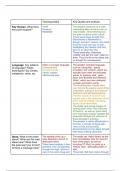
Psychology 203 Final Exam Questions And Answers With Verified Study Solutions
Vygotsky's sociocultural theory - This is the transmission of culture to a new generation (values, beliefs, customs, and skills) Social interaction is necessary (cooperative dialogues with more knowledgeable members of society) you with others how you should learn. Human Development - a field of study devoted to understand consistency and change throughout the lifespan environment contexts for development - is unique combinations of personal (genetic) and environment circumstances can result in different paths of development Nature - biologically and genetic make-up of individuals Nuture - how the person is brought up, or the physical and social world that influences experiences cross-sectional research design - groups of people differing in ages are studied at the same point in time longitudinal research design - group of participants is studied repeatedly at different ages, changes are noted as the participants mature. The strengths include identifying common patterns, and the examination of relationships between early and later events and behaviors information processing view of human development - a general approach that emerged with the design of complex computers that use mathematically specified steps to solve problems social interaction according to Vygotsky's sociocultural theory - It explains how culture (the values, beliefs, customs, and skills of a social group) is transmitted to the next generation. Social Interaction, in particular, cooperative dialogues with more knowledgeable members of society, is necessary for children to acquire the ways of thinking and behaving that make up a community's cultureFirst Trimester - one celled zygote multiplies and forms a blastocyst. Brain and spinal chord appear. Organs form. Sense of touch is developed. Gentils form. Second Trimester - enlarges rapidly. Fetal movements are felt. All neurons that will ever be in the brain are developed. Sensitive to light and sound Third Trimester - has chance of survival if born. Lungs mature. Antibodies are permitted. Rotation of upside down position Down Syndrome - It is a chromosomal abnormality in which there is a failure of the twenty first pair of chromosomes to separate during meiosis Women over 35 - Geneticists believe that the ova, present in the woman's body since her own prenatal period, weaken over time because of the aging process or increased exposure to harmful environmental agents. As a result chromosomes do not separate properly as they complete the process of meiosis at conception teratogen - It refers to an environmental agent that causes damage during the prenatal period. It is common between 3 and 16 week embryonic - what stage is a child most vulnerable to teratogens cephalocaudal trend in physical growth - translated in latin "head to tail." At birth the head takes up ¼ of the total body length, as the child ages the lower part of the body catches up. proximodistal trend in physical growth - translated "near to far," or from the center of the body outward. In the prenatal period the head, chest, and trunck grow first, followed by the arms and legs, and then the hands and feet. Continuing into childhood is the same pattern easy child - this child showed regular eating, sleeping, elimination cycles, a positive approach response to new situations, and could accept frustration with little fuss. They adapted to change, such as new food or a new school quickly. They showed a good mood most of the time, and smiled often. Mostof the problems reported with these children resulted when the child was placed in situations that required responses that were inconsistent with what they had learned at home slow to warm child - this child showed negative responses of mild intensity when exposed to new situations, but slowly came to accept them with repeated exposure. They have fairly regular biological routines. Problems with these children varied depending on the other characteristics they showed difficult child - this child showed irregular eating, sleeping, and elimination cycles. They displayed a negative approach response to new situations, for example frequent and loud crying or throwing tantrums when frustrated. They are slow to adapt to change, and need more time to get used to new food or people. Most of the problems reported with these children centers around socialization patterns, expectations of family, school, and peer groups. If pushed to become immediately involved in a situation, these children were more likely to exhibit loud refusal and sometime oppositional and aggressive behavior Harry Harlow's research - what found that baby monkeys get attached like humans they get separation anxiety. This is there first social relationship, learn how they work Attachment - is the strong, affection tie we feel for special people in our lives that leads us to experience pleasure and joy when we interact with them and to be comforted by their nearness during times of stress trust v. mistrust - when caregivers provide reliabilty, care, and affection. autonomy v. shame - Children need to develop a sense of personal control over physical skills and a sense of independence initiative v. guilt - Children need to begin asserting control and power over the environment. Success in this stage leads to a sense of purpose industry v. inferiority - Children need to cope with new social and academic demands. Success leads to a sense of competenceego identity v. role confusion - Teens need to develop a sense of self and personal identity. Success leads to an ability to stay true to yourself intimacy v. isolation - Young adults need to form loving relationships with other people. Success leads to strong relationships generativity v. stagnation - Adults need to create or nurture things that will outlast them, often by having children or creating a positive change that benefits other people. Success leads to feelings of usefulness and accomplishment, while failure results in shallow involvement in the world ego integrity v. despair - Older adults need to look back on life and feel a sense of fulfillment. Success at this stage leads to feelings of wisdom, while failure results in regret, bitterness Erik Erikson - who proposed the eight psychosocial stages of development Jean Piaget - who proposed the four stages of cognitive development sensorimotor stage - Infants learn that things continue to exist even though they cannot be seen (object permanence).They are separate beings from the people and objects around them.They realize that their actions can cause things to happen in the world around them.Learning occurs through assimilation and accommodation preoperational stage - Children at this stage tend to be egocentric and struggle to see things from the perspective of others.While they are getting better with language and thinking, they still tend to think about things in very conrete terms concrete operational stage - They begin to understand the concept of conservation; the the amount of liquid in a short, wide cup is equal to that in a tall, skinny glass.Thinking becomes more logical and organized, but still very concrete.Begin using inductive logic, or reasoning from specific information to a general principleformal operational stage - Abstract thought emerges.Teens begin to think more about moral, philosophical, ethical, social, and political issues that require theoretical and abstract reasoning.Begin to use deductive logic, or reasoning from a general principle to specific information assimilation - using our current schemes to interpret the external world accomodation - creating new schemes or adjust old ones after noticing that current ways of thinking do not fit the environment competely behaviorist - Learned through consequences, operant conditioning (reinforcement), imitation (copying) nativist - Language Acquisition Device (LAD), biologically prepares infants to learn rules of language, wired to learn language interactionist - inner capacities and environment work together, social context is important, Motivation, Exposed to language Lawrence Kohlberg - proposed three levels of moral developement Preconventional morality stage 1 - Obedience and Punishment, The earliest stage of moral development is especially common in young children, but adults are also capable of expressing this type of reasoning. At this stage, children see rules as fixed and absolute. Obeying the rules is important because it is a means to avoid punishment Preconventional morality stage 2 - Individualism and Exchange, At this stage of moral development, children account for individual points of view and judge actions based on how they serve individual needs. In the Heinz dilemma, children argued that the best course of action was the choice that best-served Heinz's needs. Reciprocity is possible at this point in moral development, but only if it serves one's own interests Conventional Morality Stage 3 - Interpersonal Relationships, Often referred to as the "good boygood girl" orientation, this stage of moral development is focused on living up to social expectations androles. There is an emphasis on conformity, being "nice," and consideration of how choices influence relationships Conventional Morality stage 4 - Maintaining Social Order, At this stage of moral development, people begin to consider society as a whole when making judgments. The focus is on maintaining law and order by following the rules, doing one's duty and respecting authority Postconventional Morlaity Stage 5 - Social Contract and Individual Rights, At this stage, people begin to account for the differing values, opinions and beliefs of other people. Rules of law are important for maintaining a society, but members of the society should agree upon these standards Postconventional Morality Stage 6 - based upon universal ethical principles and abstract reasoning. At this stage, people follow these internalized principles of justice, even if they conflict with laws and rules prefrontal cortex - area of the brain is the last to mature in humans Boys - tend to be more active, impulsive, assertive, and physically aggressive. Girls - tend to be more fearful, dependent, emotionally sensitive, compliant, advanced in effortful control, and skilled at understanding self-conscious emotions and at inflicting indirect relational aggression. adolescence - highest ratio of attempted to completed suicides James Marcia - proposed four identity statuses Diffusion - status in which the adolescent does no have a sense of having choices; he or she has not yet made (nor is attempting/willing to make) a commitment Foreclosure - status in which the adolescent seems willing to commit to some relevant roles, values, or goals for the future. Adolescents in this stage have not experienced an identity crisis. Theytend to conform to the expectations of others regarding their future (e. g. allowing a parent to determine a career direction) As such, these individuals have not explored a range of options. Moratorium - status in which the adolescent is currently in a crisis, exploring various commitments and is ready to make choices, but has not made a commitment to these choices yet Achievement - status in which adolescent has gone through a identity crisis and has made a commitment to a sense of identity (i.e. certain role or value) that he or she has chosen Remain Relatively Stable - Big five personality traits midlife crisis - a time where adults come to realize their own mortality and how much time is left in their life midlife transition - andropause or menopause, the death of parents or other causes of grief, unemployment or underemployment, realizing that a job or career is hated but not knowing how else to earn an equivalent living, or children leaving home parental imperative - gender-typed pressure in raising children, but less pressure occurs after the children leave. empty nest period - refers to feelings of depression, sadness, and/or grief experienced by parents and caregivers after children come of age and leave their childhood homes. This may occur when children go to college or get married. Sigmund Freud - proposed three components of personality Ig - represents our wants, desires, instant gratification, etc. We have no awareness of this part of our psyche, but it can be a driving force in our behavior. The Id is rooted in the desire for pleasureEgo - represents the rational part of our psyche. It is the closest of the three to our conscious awareness. Ego allows us to live in the world and balance the needs of our basic and instinctive wants and desires Super Ego - represent the moralistic and parental side of our psyche Erikson - who focused on the lifespan and being psychosocial? Freud - who focused on the late adolescence and being psychosexual? Active lifespan - Number of vigorous healthy, active life years elder maltreatment - As elders become more physically frail, they're less able to stand up to bullying and or fight back if attacked. They may not see or hear as well or think as clearly as they used to, leaving openings for unscrupulous people to take advantage of them. Mental or physical ailments may make them more trying companions for the people who live with them osteoporosis - a medical condition in which the bones become brittle and fragile from loss of tissue, typically as a result of hormonal changes, or deficiency of calcium or vitamin D kinkeeper - is a position, usually assumed by the mother or other prominent female of a household, whose role is to take care of the children and in the process to preserve family traditions and identity; to keep family members connected. problem-center coping - targets the causes of stress in practical ways which tackles the problem or stressful situation that is causing stress, consequently directly reducing the stress emotion-centered coping - would be venting to someone about a problem, distracting yourself, and building yourself up for something worse. Most often, emotion-focused coping is used when the cause of the stress is not within controlfluid intelligence - being able to think and reason abstractly and solve problems Examples include solving puzzles and coming up with problem-solving strategies crystallized intelligence - involves knowledge that comes from prior learning and past experiences.Situations that require this intelligence include reading comprehension and vocabulary exams. This type of intelligence is based upon facts and rooted in experiences. As we age and accumulate new knowledge and understanding, crystallized intelligence becomes stronger
Written for
- Institution
- Psychology 203
- Course
- Psychology 203
Document information
- Uploaded on
- May 13, 2024
- Number of pages
- 9
- Written in
- 2023/2024
- Type
- Exam (elaborations)
- Contains
- Questions & answers
Subjects

Also available in package deal