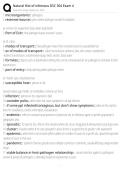
Natural Hist of infectous DSC 304 Exam 4
Study online at https://quizlet.com/_iftk70
1. microorganisms:: pathogens
2. reservoir/source:: place where pathogen survives & multiplies
ex: environ SA, equipment, food, water, body fluids
3. Port of Exit:: how pathogen leaves reservoir/ source
ex: bl, saliva
4. modes of transport:: how pathogen moves from reservoir/source to susceptible host
5. ex of modes of transport:: -direct transmission (airborne, bite, skin contact, needlestick)
-indirect transmission: contaminated equip, meds. vectors, food, water
6. formites:: objects such as doorknobs/clothing that can be contaminated w/ w/ pathogen & contribute to their
transmission
7. port of entry:: body opening where pathogen enters
ex: mouth, eyes, respiratory tract
8. susceptible host:: person at risk
(unvaccinated, age, health, co-morbidities, immune sys func)
9. infection:: person w/ dsc organism in bod
10. consider polio,: which does not cause symptoms in all ppl infected
11. if some ppl infected/contagious, but don't show symptoms:: what are the implica-
tions for surveillance, control, elimination, & eradication
12. endemic:: refers to constant/usual presence of particular dsc or infectious agent in specific population &
geographic area
13. sporadic:: for specific dsc, refers to the situation where dsc occurs ireggularly & infrequently in pop & geo area
14. cluster:: situation where # of cases grouped in place & time is suspected to be greater v the expected #
15. epidemic:: when there is an increase (often sudden) in number of causes of a specific dsc, above the expected
number of cases in that area
16. pandemic:: epidemic that has spread across multiple countries or continents, usually affecting a large number
of ppl
17. viable balance in host-pathogen relationship:: -natural selection applies to pathogens:
survival & spread of pathogens is ultimately based on reproductive success
1/3
Study online at https://quizlet.com/_iftk70
1. microorganisms:: pathogens
2. reservoir/source:: place where pathogen survives & multiplies
ex: environ SA, equipment, food, water, body fluids
3. Port of Exit:: how pathogen leaves reservoir/ source
ex: bl, saliva
4. modes of transport:: how pathogen moves from reservoir/source to susceptible host
5. ex of modes of transport:: -direct transmission (airborne, bite, skin contact, needlestick)
-indirect transmission: contaminated equip, meds. vectors, food, water
6. formites:: objects such as doorknobs/clothing that can be contaminated w/ w/ pathogen & contribute to their
transmission
7. port of entry:: body opening where pathogen enters
ex: mouth, eyes, respiratory tract
8. susceptible host:: person at risk
(unvaccinated, age, health, co-morbidities, immune sys func)
9. infection:: person w/ dsc organism in bod
10. consider polio,: which does not cause symptoms in all ppl infected
11. if some ppl infected/contagious, but don't show symptoms:: what are the implica-
tions for surveillance, control, elimination, & eradication
12. endemic:: refers to constant/usual presence of particular dsc or infectious agent in specific population &
geographic area
13. sporadic:: for specific dsc, refers to the situation where dsc occurs ireggularly & infrequently in pop & geo area
14. cluster:: situation where # of cases grouped in place & time is suspected to be greater v the expected #
15. epidemic:: when there is an increase (often sudden) in number of causes of a specific dsc, above the expected
number of cases in that area
16. pandemic:: epidemic that has spread across multiple countries or continents, usually affecting a large number
of ppl
17. viable balance in host-pathogen relationship:: -natural selection applies to pathogens:
survival & spread of pathogens is ultimately based on reproductive success
1/3