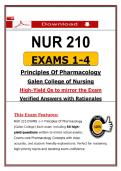
,NUR 210 Exam 1-4 – Pharmacology – Actual Questions
& Answers (GCN) 100% Guarantee Pass
1. A patient asks the nurse, "What is the difference
between pharmacokinetics and pharmacodynamics?"
Which response is correct?
A) "Pharmacokinetics is what the drug does to the body;
pharmacodynamics is what the body does to the drug."
B) "Pharmacokinetics is what the body does to the drug;
pharmacodynamics is what the drug does to the body."
C) "Pharmacokinetics is the study of drug toxicity;
pharmacodynamics is the study of drug efficacy."
D) "Both terms mean the same thing."
Correct Answer: B
Rationale: Pharmacokinetics = what the body does to the
drug (ADME). Pharmacodynamics = what the drug does
to the body (receptor interactions).
2. The nurse is teaching a patient about a newly
prescribed oral medication. Which statement indicates
the patient understands the first-pass effect?
A) "The medication will be absorbed faster if I take it with
,food."
B) "Some of the medication will be broken down by my
liver before it reaches my bloodstream."
C) "The medication will work immediately after I swallow
it."
D) "My kidneys will filter the medication before it enters
my blood."
Correct Answer: B
Rationale: The first-pass effect refers to the metabolism
of oral drugs by the liver before reaching systemic
circulation, reducing bioavailability.
3. A drug with 100% bioavailability is administered by
which route?
A) Oral
B) Sublingual
C) Intravenous
D) Rectal
Correct Answer: C
Rationale: IV administration bypasses absorption and
, first-pass metabolism, delivering the full dose directly to
systemic circulation.
4. Which phase of pharmacokinetics involves the
movement of a drug from the site of administration into
the bloodstream?
A) Distribution
B) Metabolism
C) Excretion
D) Absorption
Correct Answer: D
Rationale: Absorption is the process by which a drug
moves from its site of administration into the
bloodstream.
5. The nurse is caring for a patient with liver disease.
How might this affect drug metabolism?
A) Increased drug metabolism leading to decreased drug
effects
B) Decreased drug metabolism leading to increased risk
of toxicity
& Answers (GCN) 100% Guarantee Pass
1. A patient asks the nurse, "What is the difference
between pharmacokinetics and pharmacodynamics?"
Which response is correct?
A) "Pharmacokinetics is what the drug does to the body;
pharmacodynamics is what the body does to the drug."
B) "Pharmacokinetics is what the body does to the drug;
pharmacodynamics is what the drug does to the body."
C) "Pharmacokinetics is the study of drug toxicity;
pharmacodynamics is the study of drug efficacy."
D) "Both terms mean the same thing."
Correct Answer: B
Rationale: Pharmacokinetics = what the body does to the
drug (ADME). Pharmacodynamics = what the drug does
to the body (receptor interactions).
2. The nurse is teaching a patient about a newly
prescribed oral medication. Which statement indicates
the patient understands the first-pass effect?
A) "The medication will be absorbed faster if I take it with
,food."
B) "Some of the medication will be broken down by my
liver before it reaches my bloodstream."
C) "The medication will work immediately after I swallow
it."
D) "My kidneys will filter the medication before it enters
my blood."
Correct Answer: B
Rationale: The first-pass effect refers to the metabolism
of oral drugs by the liver before reaching systemic
circulation, reducing bioavailability.
3. A drug with 100% bioavailability is administered by
which route?
A) Oral
B) Sublingual
C) Intravenous
D) Rectal
Correct Answer: C
Rationale: IV administration bypasses absorption and
, first-pass metabolism, delivering the full dose directly to
systemic circulation.
4. Which phase of pharmacokinetics involves the
movement of a drug from the site of administration into
the bloodstream?
A) Distribution
B) Metabolism
C) Excretion
D) Absorption
Correct Answer: D
Rationale: Absorption is the process by which a drug
moves from its site of administration into the
bloodstream.
5. The nurse is caring for a patient with liver disease.
How might this affect drug metabolism?
A) Increased drug metabolism leading to decreased drug
effects
B) Decreased drug metabolism leading to increased risk
of toxicity