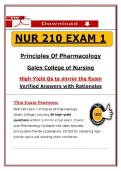
,NUR 210 Exam 1 – Pharm Principles –Actual
Questions & Answers (Galen College) 100%
Guarantee Pass
Q1. Which term best describes "what the body does to
the drug"?
A) Pharmacodynamics
B) Pharmacotherapeutics
C) Pharmacokinetics
D) Toxicology
Correct Answer: C) Pharmacokinetics
Rationale: Pharmacokinetics is the study of drug
movement through the body, including absorption,
distribution, metabolism, and excretion (ADME).
Pharmacodynamics is "what the drug does to the body" .
Q2. A drug that binds to a receptor and produces a
response is called a(n):
,A) Antagonist
B) Agonist
C) Partial agonist
D) Competitive antagonist
Correct Answer: B) Agonist
Rationale: An agonist activates a receptor and produces a
biological response. An antagonist blocks the receptor
and produces no response .
Q3. The nurse understands that the pharmaceutic phase
of drug action involves:
A) Absorption of the drug into the bloodstream
B) Dissolution of the drug in the gastrointestinal tract
C) Distribution of the drug to target tissues
D) Excretion of the drug via the kidneys
Correct Answer: B) Dissolution of the drug in the
gastrointestinal tract
, Rationale: The pharmaceutic phase is the first phase,
where the solid drug dissolves into a liquid so it can be
absorbed. Most oral absorption occurs in the small
intestine .
Q4. A patient asks the nurse, "What does 'first-pass
effect' mean?" The best response is:
A) "The drug is absorbed faster when taken on an empty
stomach."
B) "The drug is metabolized in the liver before reaching
systemic circulation, reducing its bioavailability."
C) "The drug is excreted unchanged by the kidneys."
D) "The drug binds to plasma proteins and becomes
inactive."
Correct Answer: B) "The drug is metabolized in the liver
before reaching systemic circulation, reducing its
bioavailability."
Rationale: First-pass effect refers to the metabolism of an
oral drug by the liver before it reaches systemic
Questions & Answers (Galen College) 100%
Guarantee Pass
Q1. Which term best describes "what the body does to
the drug"?
A) Pharmacodynamics
B) Pharmacotherapeutics
C) Pharmacokinetics
D) Toxicology
Correct Answer: C) Pharmacokinetics
Rationale: Pharmacokinetics is the study of drug
movement through the body, including absorption,
distribution, metabolism, and excretion (ADME).
Pharmacodynamics is "what the drug does to the body" .
Q2. A drug that binds to a receptor and produces a
response is called a(n):
,A) Antagonist
B) Agonist
C) Partial agonist
D) Competitive antagonist
Correct Answer: B) Agonist
Rationale: An agonist activates a receptor and produces a
biological response. An antagonist blocks the receptor
and produces no response .
Q3. The nurse understands that the pharmaceutic phase
of drug action involves:
A) Absorption of the drug into the bloodstream
B) Dissolution of the drug in the gastrointestinal tract
C) Distribution of the drug to target tissues
D) Excretion of the drug via the kidneys
Correct Answer: B) Dissolution of the drug in the
gastrointestinal tract
, Rationale: The pharmaceutic phase is the first phase,
where the solid drug dissolves into a liquid so it can be
absorbed. Most oral absorption occurs in the small
intestine .
Q4. A patient asks the nurse, "What does 'first-pass
effect' mean?" The best response is:
A) "The drug is absorbed faster when taken on an empty
stomach."
B) "The drug is metabolized in the liver before reaching
systemic circulation, reducing its bioavailability."
C) "The drug is excreted unchanged by the kidneys."
D) "The drug binds to plasma proteins and becomes
inactive."
Correct Answer: B) "The drug is metabolized in the liver
before reaching systemic circulation, reducing its
bioavailability."
Rationale: First-pass effect refers to the metabolism of an
oral drug by the liver before it reaches systemic