All 139 results
Sort by
Best selling NCERT Examplar Chemistry Class 12th notes
-
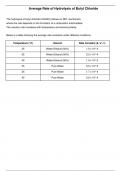
Chemistry class 12th Average_Rate_of_Hydrolysis_Butyl_Chloride
- Class notes • 1 pages • 2025 Popular
- $9.49
- + learn more
The average rate of hydrolysis of butyl chloride depends on factors such as solvent, temperature, and reaction conditions. In aqueous solutions, butyl chloride undergoes hydrolysis via an SN1 mechanism, forming butanol and hydrochloric acid. The reaction rate is influenced by the stability of the carbocation intermediate, with tertiary butyl chloride reacting faster than primary or secondary forms. In polar protic solvents like water or ethanol, the reaction rate increases due to better solvatio...
-
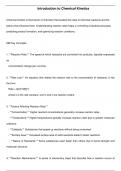
Chemistry class 12th Chemical_Kinetics_Introduction
- Class notes • 2 pages • 2025 Popular
- $9.49
- + learn more
Chemical kinetics is the study of reaction rates and the factors affecting them. It examines how quickly reactants transform into products and the molecular events involved. Key factors influencing reaction rates include concentration, temperature, catalysts, and surface area. The rate law expresses the relationship between reaction rate and reactant concentrations, while the order of reaction determines how concentration changes impact speed. The Arrhenius equation explains the effect of temper...
-
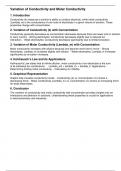
Chemistry class 12th Variation of conductivity
- Class notes • 1 pages • 2025 Popular
- $9.49
- + learn more
Conductivity varies based on factors like temperature, material composition, and impurities. In metals, conductivity typically decreases with increasing temperature due to increased electron scattering. In semiconductors, however, higher temperatures increase conductivity by exciting more charge carriers. In electrolytes, conductivity depends on ion concentration, mobility, and temperature. Higher ion concentration generally increases conductivity, but extreme concentrations can reduce it due to...
Do you also write study notes yourself? Put them up for sale and earn every time your document is purchased.
-
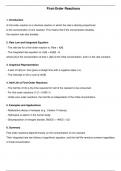
Chemistry class 12th First_Order_Reactions
- Class notes • 1 pages • 2025 Popular
- $9.49
- + learn more
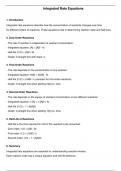
A first-order reaction is one where the reaction rate depends linearly on the concentration of a single reactant. The rate law is: text{Rate} = k[A] The integrated rate law for a first-order reaction is: ln[A] = ln[A]_0 - kt where is the rate constant, and is the initial concentration. A plot of ln[A] vs. time gives a straight line with a slope of -k. The half-life () is constant and given by: t_{1/2} = frac{0.693}{k} First-order kinetics are common in radioactive ...
-
Chemistry class 12th Integrated_Rate_Equations
- Class notes • 1 pages • 2025 Popular
- $9.49
- + learn more
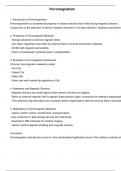
Integrated rate equations describe how reactant concentrations change over time for different reaction orders. Zero-order: (linear decrease, rate independent of concentration). First-order: (exponential decay, rate proportional to concentration). Second-order: (inverse relation, rate proportional to the square of concentration). Each equation helps determine reaction kinetics by analyzing concentration-time data. Half-life () varies with order: constant for first-order, but depe...
-
Chemistry class 12th Ferromagnetism
- Class notes • 1 pages • 2025 Popular
- $9.49
- + learn more
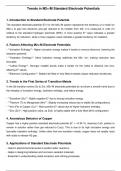
Ferromagnetism is a property of materials like iron, cobalt, and nickel, where atomic magnetic moments align in the same direction, creating strong, permanent magnetism. This alignment occurs due to exchange interactions between electrons. Ferromagnetic materials retain their magnetism even after an external magnetic field is removed, making them useful in magnets, transformers, and data storage devices. The magnetization decreases above the Curie temperature, where thermal energy disrupts align...
-
Chemistry class 12th M2+_M_Electrode_Potential_Trends
- Class notes • 1 pages • 2025 Popular
- $9.49
- + learn more
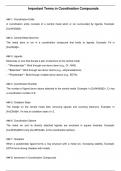
The M²⁺/M electrode potential (E°) represents the tendency of a metal (M) to be reduced from its +2 oxidation state to its metallic form. Trends in these potentials are influenced by ionization energy, hydration energy, and lattice energy. Alkaline Earth Metals (Group 2): E° becomes more negative down the group due to decreasing ionization energy. Transition Metals: Generally, E° values are less negative or even positive due to strong metal-ligand interactions. Post-Transition Met...
-
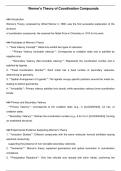
Chemistry class 12th Important_Terms_Coordination_Compounds
- Class notes • 2 pages • 2025 Popular
- $9.49
- + learn more
Coordination compounds consist of a central metal atom or ion surrounded by ligands. Key terms include ligand (molecules/ions donating electron pairs), coordination number (number of ligand attachments to the metal), and coordination sphere (metal-ligand complex). Ligands can be monodentate (one donor atom), bidentate (two donor atoms), or polydentate (multiple donor atoms). The chelate effect stabilizes complexes with polydentate ligands. Oxidation state refers to the metal’s charge. Geometri...
-
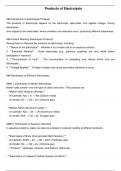
Chemistry class 12th Werner_Theory_Coordination_Compounds
- Class notes • 2 pages • 2025 Popular
- $9.49
- + learn more
Werner’s theory of coordination compounds, proposed by Alfred Werner in 1893, explains the bonding and structure of complex compounds. It states that metal atoms exhibit two types of valency: primary (oxidation state) and secondary (coordination number). The primary valency is ionizable, while the secondary valency determines the number of ligands attached to the metal. Ligands form coordinate bonds with the central metal ion, creating geometrically distinct structures like octahedral, tetrahe...
-
Chemistry class 12th Products_of_Electrolysis
- Class notes • 2 pages • 2025 Popular
- $9.49
- + learn more
Electrolysis is a process where an electric current passes through an electrolyte, causing chemical reactions that break down compounds into their elements or new substances. The products of electrolysis depend on the electrolyte and the electrodes used. In aqueous solutions, the products can be influenced by the reactivity of ions and water. For example, electrolysis of water produces hydrogen at the cathode and oxygen at the anode. Electrolysis of sodium chloride solution (brine) yields hydrog...
Newest NCERT Examplar Chemistry Class 12th summaries
-
Class 12th chemistry solutions chapter
- Class notes • 22 pages • 2025 New
- $20.49
- + learn more
These are the handwritten notes of class 12th chemistry based on the topic of solutions. These notes contains all concept and many important things in few pages.
-
CBSE-Class-12-Chem-Notes-Question-Bank-The-d-and-f-Block-Elements
- Class notes • 17 pages • 2025 New
- $9.49
- + learn more
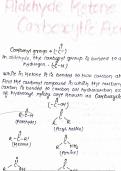
The CBSE Class 12 Chemistry chapter on d- and f-block elements covers the properties, trends, and applications of transition and inner transition metals. It explains their variable oxidation states, catalytic properties, complex formation, and colored ions due to d-d transitions. The lanthanoids and actinoids show unique electronic configurations and chemical reactivity. Important topics include magnetic properties, alloy formation, and industrial applications (e.g., catalysts, pigments, and sup...
-
Class notes Chemistry NCERT Examplar Chemistry Class 12th
- Class notes • 3 pages • 2025 New
- $5.49
- + learn more
It is a notes which is very helpful for students I'm just starting it if u want full notes then plz comment
Do you also write study notes yourself? Put them up for sale and earn every time your document is purchased.
-
Chemistry class 12th Lanthanoids_Class12_Chemistry
- Class notes • 3 pages • 2025 New
- $9.49
- + learn more
Lanthanoids (lanthanides) are 14 elements from cerium (Ce) to lutetium (Lu) in the periodic table, following lanthanum (La). They belong to the f-block and have a general electronic configuration of [Xe] 4f¹⁻¹⁴ 5d⁰⁻¹ 6s². Due to the poor shielding of 4f electrons, they exhibit the lanthanoid contraction—a gradual decrease in atomic and ionic sizes across the series. They show variable oxidation states (mainly +3) and have high reactivity, especially with water and acids. Lanthanoid...
-
Chemistry class 12th Chemical_Kinetics_Questions_Numericals
- Class notes • 3 pages • 2025 New
- $9.49
- + learn more
Chemical kinetics questions and numericals focus on reaction rates, rate laws, half-life, and activation energy. Common topics include: 1. Rate Law Calculations – Determining reaction order and rate constant () from experimental data. 2. Integrated Rate Equations – Finding concentration over time for zero, first, and second-order reactions. 3. Half-life () – Calculating decay times for different reaction orders. 4. Arrhenius Equation – Finding activation energy () using...
-
Chemistry class 12th Complex_Reactions_Explanation
- Class notes • 3 pages • 2025 New
- $9.49
- + learn more
Complex reactions involve multiple steps, consisting of two or more elementary reactions that occur sequentially or in parallel. These reactions often include intermediates, catalysts, and transition states, making their kinetics more intricate than simple reactions. They can be classified as consecutive, parallel, or chain reactions. The overall rate law is determined by the slowest step, known as the rate-determining step. Complex reactions play a crucial role in biochemical pathways, industri...
-
Chemistry class 12th Colligative properties and molar mass
- Class notes • 3 pages • 2025 New
- $9.49
- + learn more
Colligative properties are properties of solutions that depend only on the number of solute particles, not their identity. These include relative lowering of vapor pressure, boiling point elevation, freezing point depression, and osmotic pressure. They are useful for determining the molar mass of solutes by measuring their effect on a solvent. The relationship between colligative properties and molar mass follows equations like: ΔTf = iKf m (freezing point depression) ΔTb = iKb m (boi...
-
Chemistry class 12th Classification_Metals_Conductors_Semiconductors
- Class notes • 3 pages • 2025 New
- $9.49
- + learn more
Materials are classified into metals, semiconductors, and insulators based on their electrical conductivity and band structure. Metals (e.g., copper, silver) have high conductivity due to free electrons in their overlapping valence and conduction bands. Insulators (e.g., rubber, glass) have a wide band gap, preventing electron flow. Semiconductors (e.g., silicon, germanium) have a moderate band gap, allowing controlled conductivity, which increases with temperature or doping. Semiconductors are ...
-
Chemistry class 12th Important_Terms_Coordination_Compounds
- Class notes • 2 pages • 2025 New
- $9.49
- + learn more
Coordination compounds consist of a central metal atom or ion surrounded by ligands. Key terms include ligand (molecules/ions donating electron pairs), coordination number (number of ligand attachments to the metal), and coordination sphere (metal-ligand complex). Ligands can be monodentate (one donor atom), bidentate (two donor atoms), or polydentate (multiple donor atoms). The chelate effect stabilizes complexes with polydentate ligands. Oxidation state refers to the metal’s charge. Geometri...
-
Chemistry class 12th Werner_Theory_Coordination_Compounds
- Class notes • 2 pages • 2025 New
- $9.49
- + learn more
Werner’s theory of coordination compounds, proposed by Alfred Werner in 1893, explains the bonding and structure of complex compounds. It states that metal atoms exhibit two types of valency: primary (oxidation state) and secondary (coordination number). The primary valency is ionizable, while the secondary valency determines the number of ligands attached to the metal. Ligands form coordinate bonds with the central metal ion, creating geometrically distinct structures like octahedral, tetrahe...