

Physioth. Theory: locomotion
SUCCESFULL HUMAN LOCOMOTION
Postural control to support the body against gravity
Basic locomotor pattern/rythm which moves the body in the desired
direction central pattern generators
Adaptable to the needs of the individual and the demands of the
environment
Adaptability = supraspinal & peripheral efferents
Invloed supra spinal niveau & info van motor cortex
CHARACTERISTICS FOR LOCOMOTION
STABILITY: balance control
PROPULSION of the body in the intended direction.
ADAPTATION to potentially destabilising factors in an anticipatory way
- Voorspellende ractie
Dual tasking: Combinations with other movement
1. IN STANCE
STABILITY: provided through vertical forces supporting the body against gravity
PROGRESSION: through the generation of horizontal forces against the support surface to move the body
forward
ADAPTABILITY: strategies must be flexible enough to cope with changes in speed, direction or surface terrain
2. IN SWING
STABILITY: gained through the repositioning of the limb in preparation for loading
PROGRESSION is accomplished through the swing of the leg carrying it forward
ADAPTIBILITY: is evident in the ability to avoid obstacles with the swing leg
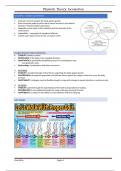
GAIT PHASES
Nala Melis Pagina 1
, Physioth. Theory: locomotion
Problems in stroke
- IC: foot flat (dropvoet)
- LR = double leg stance support
Weight shift
load the stance leg → not enough weight on the leg = insufficient loading
hip extension → stay in to much flexion or to hyperextension of the hip
Mid stance: alignment
- Absent in stroke -> no weightbearing -> no stance on one leg
Terminal stance: rise of the heel (one leg stance)
- Further hip extension → difficult for stroke patient
Heel off – propulsion
Pre-swing: double leg stance support
- Weight shift
- Push-off & toe-off → push-off absent in stroke, they pull their leg forward
Initial swing: start of swing phase
- Bringing the leg forward → pull leg forward & circumduction
- Not enough clearance when no control of foot
Mid swing: more forward movement
- Not enough ROM → pulling leg higher
Terminal swing
3 rockers
- Heel rocker
IC= hielcontact
Hiel= support
- Ankle rocker
Tibia over voet
- Forefoot rocker
Push off genereren
o Goede swing samen met heupextensie
- CVA= imbalance length & strength
Problemen 1&3 rocker
1. Observation casus patient B
R= hemi
Depressie R-schouder = hypotonische arm
trendelenburg
Nala Melis Pagina 2
SUCCESFULL HUMAN LOCOMOTION
Postural control to support the body against gravity
Basic locomotor pattern/rythm which moves the body in the desired
direction central pattern generators
Adaptable to the needs of the individual and the demands of the
environment
Adaptability = supraspinal & peripheral efferents
Invloed supra spinal niveau & info van motor cortex
CHARACTERISTICS FOR LOCOMOTION
STABILITY: balance control
PROPULSION of the body in the intended direction.
ADAPTATION to potentially destabilising factors in an anticipatory way
- Voorspellende ractie
Dual tasking: Combinations with other movement
1. IN STANCE
STABILITY: provided through vertical forces supporting the body against gravity
PROGRESSION: through the generation of horizontal forces against the support surface to move the body
forward
ADAPTABILITY: strategies must be flexible enough to cope with changes in speed, direction or surface terrain
2. IN SWING
STABILITY: gained through the repositioning of the limb in preparation for loading
PROGRESSION is accomplished through the swing of the leg carrying it forward
ADAPTIBILITY: is evident in the ability to avoid obstacles with the swing leg
GAIT PHASES
Nala Melis Pagina 1
, Physioth. Theory: locomotion
Problems in stroke
- IC: foot flat (dropvoet)
- LR = double leg stance support
Weight shift
load the stance leg → not enough weight on the leg = insufficient loading
hip extension → stay in to much flexion or to hyperextension of the hip
Mid stance: alignment
- Absent in stroke -> no weightbearing -> no stance on one leg
Terminal stance: rise of the heel (one leg stance)
- Further hip extension → difficult for stroke patient
Heel off – propulsion
Pre-swing: double leg stance support
- Weight shift
- Push-off & toe-off → push-off absent in stroke, they pull their leg forward
Initial swing: start of swing phase
- Bringing the leg forward → pull leg forward & circumduction
- Not enough clearance when no control of foot
Mid swing: more forward movement
- Not enough ROM → pulling leg higher
Terminal swing
3 rockers
- Heel rocker
IC= hielcontact
Hiel= support
- Ankle rocker
Tibia over voet
- Forefoot rocker
Push off genereren
o Goede swing samen met heupextensie
- CVA= imbalance length & strength
Problemen 1&3 rocker
1. Observation casus patient B
R= hemi
Depressie R-schouder = hypotonische arm
trendelenburg
Nala Melis Pagina 2


