
Bios 225
Chamberlain College Nursing
Here are the best resources to pass Bios 225. Find Bios 225 study guides, notes, assignments, and much more.

Case
BIOS 255 Week 1 Assignment: Case Study – Coagulation – Graded An A+
1. Discuss which clotting factors the PT and PTT test evaluate and whether each test measures the intrinsic or the extrinsic pathways. The Prothrombin Time (PT) Test is used to identify or diagnose b lood coagulation disorders or bleeding problems. Furthermore, there are a variety of reasons why this test is necessary. For example, when a patient is scheduled for major surgery, it informs the physician if the blood is clotting properly or if the patient is on warfarin (a blood thinner drug), amo...
 DocEdyth

Other
BIOS 255 Week 3 Discussion: Understanding Blood Vessel Structure – Download for Exam Success
PopularBIOS 255 Week 3 Discussion: Blood Vessel Structure – Download To Pass Exams Circulatory System Arteries • Layers o Tunica Externa – External layer o Tunica Media – Mid layer, smooth muscle and elastic fibers o Tunica Interna – Innermost, closest to Lumen • Function o Can regulate their diameter due to the smooth muscle o Absorb pressure (elastic fibers) created by the ventricles o Deliver blood to tissue • Different Types (but all have elastic laminas) o Elastic Arteries ▪ Thicke...
DocEdyth
Case
BIOS 255 Week 7 Assignment: Case Study I Carbon Monoxide Poisoning – Graded An A+
BIOS 255 Week 7 Assignment: Case Study I Carbon Monoxide Poisoning – Graded An A+ 1. Carbon monoxide binds to hemoglobin more than oxygen due to its greater affinity for hemoglobin. When exposed t o Carbon monoxide oxygen cant bind to hemoglobin resulting in lack of oxygen throughout the body. 2. The pulse oximeter is a noninvasive device typically used to measure the saturation of oxygen in a patient’s blood. This is different from a CO- Oximeter which is used to measure levels of carboxyhe...
DocEdyth

Other
BIOS-255 Week 6 Discussion: Respiratory Anatomy – Option A
BIOS-255 Week 6 Discussion: Respiratory Anatomy – Option A Option A: Describe the anatomy and histology of the respiratory system and how each of the functions are related. The Respiratory Sys tems main function is to filter air as it is breathed from external elements. The airways maintain homeostasis by monitoring pathogen entrance and preventing inflammation. The main organs are the nose, pharynx, larynx, trachea, bronchi, lungs. The respiratory system can be divided into a conducting porti...
DocEdyth
Other
BIOS-255 Week 6 Virtual Lab: Respiratory System – Graded An A+
BIOS-255 Week 6 Virtual Lab: Respiratory System – Graded An A+ Learning Objectives: • Describe the gross anatomical features of the respiratory tract. • Trace the flow of air into and out o f the lungs. • Explain how Boyle’s law relates to the changing intrapleural and alveolar air pressures and volumes during respiration. • Define various pulmonary volumes. Introduction: The respiratory tract carries air to and from the lungs. Air drawn in through the nose or mouth passes through th...
DocEdyth
Case
BIO 255 WEEK 6 Case Study – Chronic Obstructive Pulmonary Disease (COPD)
Running Head: CASE STUDY – CHRONIC OBSTRUCTIVE PULMONARY DISEASE (COPD) BIO 255 WEEK 6 Case Study – Chronic Obstructive Pulmonary Disease (COPD) How is Venti lation Different from Respiration? Ventilation is very different from respiration. Ventilation is mechanical and involves the movement of air. It is the mechanical drawing in and expelling out air via breathing. Respiration is physiologic and involves the exchange of gases in the alveoli, external respiration, and in the cells, internal...
DocEdyth

Exam (elaborations)
BIOS-255 Week 5 Examination 2 (Week 3 and 4): - Providing Responses with 100% Accuracy - Evaluated and Awarded the Highest Grade of A+
BIOS-255 Week 5 Exam 2 (Week 3 and 4): - With 100% Correct Answers- Graded An A+ 1. A missing p-wave indicated what structure is not depolarizing/firing properly thus not properly depolarizing the at rium? a. AV node b. SA node c. Bundle Branches d. Perkinje Fibers 2. When left ventricular pressure begins to increase, this will be the driving force to open what valve? a. Pulmonary valve b. Tricuspid Valve c. Aortic Valve d. Bicuspid Valve 3. What is CO with the following values: HR: 60 BPM Systo...
DocEdyth
Case
BIOS 225 Week 5 Case Study: Hypersensitivity Reactions- Graded An A+
BIOS 225 Week 5 Case Study: Hypersensitivity Reactions- Graded An A+ Required Resources Read/review the following resources for this activity: • Textbook • Weekly Concepts • Minimum of 1 scholarly source Scenario/Summary Manuel loved the outdoors and loved playing softball. There was no better way to spend a weekend than on the diamond hitting the ball and cooking burgers on the park grill. "Hey Jose, great game this afternoon," Manuel said to his friend. "Yep," Jose replied. "I loved...
DocEdyth
Other
BIOS 255 Week 5 Virtual Lab: Introduction to Immunology Part I, Part II
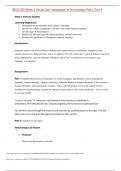
BIOS 255 Week 5 Virtual Lab: Introduction to Immunology Part I, Part II Week 5 Immune System Learning Objectives: 1. Distinguish innate immunity from adaptive immunity. a to the body's ability to defend itself against disease and infection. Immunity can be categorized into two different forms: innate or adaptive. We will explore the 2 types of defenses and learn about inflammation. Our lab challenge will take a look at how we perform test for exposure and immunity to pathogens. Assignment: Part...
DocEdyth

Other
BIOS-255 Week 4 Virtual Lab: Lymphatic System – Download For An A+
BIOS-255 Week 4 Virtual Lab: Lymphatic System – Download For An A+ Learning Objectives: 1. State the components and functions of the lymphatic system 2. Trace lymphatic drainage through the m ajor vessels of the lymphatic system. 3. Identify the mechanisms that cause movement of lymph through the lymph vessels. Introduction: The lymphatic system consists of lymphatic fluid, lymphatic vessels, lymphatic tissue, and lymphatic organs located throughout the tissues of the body. It functions to dra...
DocEdyth

Other
BIOS 255 Week 4 Discussion Post and Reply – Achieved the highest grade possible, an A+ in the assessment.
BIOS 255 WEEK 4 DISCUSSION POST AND REPLY – SCORED AN A+ OPTION A: The lymphatic system removes excess fluid from the body's tissues, distributes white blood cells (WBCs), and helps organ system s work properly. Lymph nodes are an important part of this system. Lymph nodes are important to the lymphatic system because they combat infections, regulate fluid balance, filter lymph, and control cancer. The lymphatic system is intricately linked to the immunological and circulatory systems, all of...
DocEdyth
Other
BIOS 255 Week 4 Case Study Assignment: Natural Killer Cell Deficiency – Graded An A+
BIOS 255 Week 4 Case Study Assignment: Natural Killer Cell Deficiency – Graded An A+ Required Resources Read/review the following resources for this activity: • Textbook • Weekly Concepts • Minimum of 1 scholarly source Scenario/Summary Shanice was a vibrant 16-year-old who was enjoying her high school years. As a good student, she loved attending school and woke every morning eager to start the day. A popular girl, she was surrounded by many friends who all enjoyed each other's company...
DocEdyth

Other
BIOS 255 Week 3 Exam Study Guide- Get ready for success by downloading for revision."
BIOS 255 Week 3 Exam Study Guide- Get ready for success by downloading for revision." • This examination covers content learned in weeks 3 & 4 (Ch. 20 and first half of Ch. 21) • This midt erm exam is worth 110 total points, and includes the following types of questions: o 24 Multiple choice @ 3 pts o 1 Matching @ 5 pts o 2 Multiple answers @ 4 pts o 1 Calculation question @ 5 pts o 1 Short answer @ 5 pts o 1 Essay @ 15 pts • You have 75 minutes to complete the Exam Ch. 19 (Review) Review...
DocEdyth

Other
BIOS 255 Week 3 Discussion: Understanding Blood Vessel Structure – Essential for Exam Success
BIOS 255 Week 3 Discussion: Blood Vessel Structure – Download To Pass Exams Circulatory System Arteries • Layers o Tunica Externa – External layer o Tunica Media – Mid layer, smooth muscle and elastic fibers o Tunica Interna – Innermost, closest to Lumen • Function o Can regulate their diameter due to the smooth muscle o Absorb pressure (elastic fibers) created by the ventricles o Deliver blood to tissue • Different Types (but all have elastic laminas) o Elastic Arteries ▪ Thicke...
DocEdyth

Case
BIOS 255 Week 3 Assignment: Case Study on the Topic of Hypoproteinemia, Graded with an Exceptional A+
Running head: WEEK 3 CASE STUDY HYPOPROTEINEMIA 1 BIOS 255 Week 3 Assignment: Case Study – Hypoproteinemia – Graded An A+ Components of Plasma As we have learne d in lecture, plasma is a vital component that makes up our whole blood source. Plasma is a liquid serum that contains 92% water and 8% solutes (Mathew, 2021). The solutes that plasma contains delegates its true importance to the composition and function of blood in our bodies. A key component of plasma is it’s abundant source of p...
DocEdyth

Other
BIOS 255 Week 2 Concepts: The Cardiovascular System- Heart
BIOS 255 Week 2 Concepts: The Cardiovascular System- Heart outcomes: ● Identify the chambers of the heart. ● Identify the location and function of valves within the heart. ● Describe the fl ow of blood through the heart. ● Define stroke volume and cardiac output. ● Understand how the cardiovascular system responds to exercise. ● Understand how cardiac output and blood pressure can be measured. ● Understand how heart rate, stroke volume and cardiac output change with exercise. Intro...
DocEdyth

Other
BIOS 255 Week 2 Assignment: Detailed Case Study on the Functioning of the Heart Including Accurate Responses to Questions
BIOS 255 Week 2 Assignment: Case Study – Heart – With Correct Answers What are the four valves found in the heart and where are they located? Give all names for each valve. “Tricus pid valve: located between the right atrium and the right ventricle. pulmonary semilunar valve: located between the right ventricle and the pulmonary artery. Mitral valve: located between the left atrium and the left ventricle. Aortic semilunar valve: located between the left ventricle and the aorta. (Tortora, 2...
DocEdyth

Other
BIOS-255 Week 1 Assignment: Ensure Your Success by Downloading the Necessary Materials for the Course
BIOS-255 Week 1 Assignment: Download To Pass Blood is the only liquid consisting of cells surrounded by a (plasma) There are formed elements in blood: 1. 2. 3. The plasma po rtion of the blood consists of: , , and . FUNCTIONS OF BLOOD Blood oxygen, carbon dioxide, nutrients, hormones, , and waste products. Blood homeostasis of all body fluids, , , and water content of cells. Blood against excessive loss by , and uses to protect against . FORMATION OF BLOOD CELLS ( ): is the process of producing ...
DocEdyth

Exam (elaborations)
BIOS 225 Week 2 Lab: Transferring Microbes While Using Aseptic Technique
BIOS 225 Week 2 Lab: Transferring Microbes While Using Aseptic Technique
 Tutor2

Exam (elaborations)
BIOS-225 Week 3 Lab: Kidney Filtration Simulation
BIOS-225 Week 3 Lab: Kidney Filtration Simulation
Tutor2