

Manishshaw929
On this page, you find all documents, package deals, and flashcards offered by seller manishshaw929.
- 234
- 0
- 5
Community
- Followers
- Following
239 items
Chemistry class 12th Complex_Reactions_Explanation
Complex reactions involve multiple steps, consisting of two or more elementary reactions that occur sequentially or in parallel. These reactions often include intermediates, catalysts, and transition states, making their kinetics more intricate than simple reactions. They can be classified as consecutive, parallel, or chain reactions. The overall rate law is determined by the slowest step, known as the rate-determining step. Complex reactions play a crucial role in biochemical pathways, industri...
- Book
- Class notes
- • 3 pages •
Complex reactions involve multiple steps, consisting of two or more elementary reactions that occur sequentially or in parallel. These reactions often include intermediates, catalysts, and transition states, making their kinetics more intricate than simple reactions. They can be classified as consecutive, parallel, or chain reactions. The overall rate law is determined by the slowest step, known as the rate-determining step. Complex reactions play a crucial role in biochemical pathways, industri...
Chemistry class 12th Elementary_Reactions.
Elementary reactions are single-step processes in a chemical reaction mechanism, occurring at the molecular level without intermediate steps. They involve direct collisions or interactions between reactant molecules, leading to product formation. Depending on the number of reactants involved, they can be unimolecular (one reactant), bimolecular (two reactants), or termolecular (three reactants, though rare). Each elementary reaction has a defined molecularity and a specific rate law directly bas...
- Book
- Class notes
- • 2 pages •
Elementary reactions are single-step processes in a chemical reaction mechanism, occurring at the molecular level without intermediate steps. They involve direct collisions or interactions between reactant molecules, leading to product formation. Depending on the number of reactants involved, they can be unimolecular (one reactant), bimolecular (two reactants), or termolecular (three reactants, though rare). Each elementary reaction has a defined molecularity and a specific rate law directly bas...
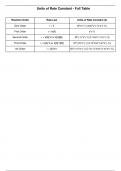
Chemistry class 12th Rate_Constant_Units
The rate constant () in chemical kinetics determines the speed of a reaction and has units that vary depending on the reaction order. For a first-order reaction, has units of ; for a second-order reaction, it is ; for a third-order reaction, it is . In general, the unit of is given by , where is the reaction order. The rate constant depends on temperature and activation energy, as described by the Arrhenius equation. It plays a crucial role in determining reaction rates in chemical and indust...
- Book
- Class notes
- • 1 pages •
The rate constant () in chemical kinetics determines the speed of a reaction and has units that vary depending on the reaction order. For a first-order reaction, has units of ; for a second-order reaction, it is ; for a third-order reaction, it is . In general, the unit of is given by , where is the reaction order. The rate constant depends on temperature and activation energy, as described by the Arrhenius equation. It plays a crucial role in determining reaction rates in chemical and indust...
Chemistry class 12th Fuel_Cells_Explained
A fuel cell is an electrochemical device that converts chemical energy from a fuel, like hydrogen, into electricity through redox reactions. It consists of an anode, a cathode, and an electrolyte. At the anode, hydrogen molecules split into protons and electrons; protons pass through the electrolyte, while electrons flow through an external circuit, generating electricity. At the cathode, oxygen reacts with protons and electrons to form water. Fuel cells are efficient, produce minimal emissions,...
- Book
- Class notes
- • 2 pages •
A fuel cell is an electrochemical device that converts chemical energy from a fuel, like hydrogen, into electricity through redox reactions. It consists of an anode, a cathode, and an electrolyte. At the anode, hydrogen molecules split into protons and electrons; protons pass through the electrolyte, while electrons flow through an external circuit, generating electricity. At the cathode, oxygen reacts with protons and electrons to form water. Fuel cells are efficient, produce minimal emissions,...
Chemistry class 12th Galvanic_Cells_Explanation
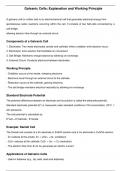
A galvanic cell is an electrochemical cell that converts chemical energy into electrical energy through spontaneous redox reactions. It consists of two different metal electrodes immersed in electrolyte solutions and connected by a salt bridge. The anode undergoes oxidation, releasing electrons, while the cathode undergoes reduction, gaining electrons. This electron flow generates an electric current. A common example is the Daniell cell, using zinc and copper electrodes. Galvanic cells power ba...
- Book
- Class notes
- • 2 pages •
A galvanic cell is an electrochemical cell that converts chemical energy into electrical energy through spontaneous redox reactions. It consists of two different metal electrodes immersed in electrolyte solutions and connected by a salt bridge. The anode undergoes oxidation, releasing electrons, while the cathode undergoes reduction, gaining electrons. This electron flow generates an electric current. A common example is the Daniell cell, using zinc and copper electrodes. Galvanic cells power ba...
Chemistry class 12th Corrosion_Explanation
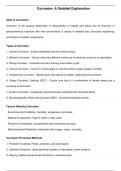
Corrosion is the gradual destruction of materials, usually metals, due to chemical reactions with their environment. The most common form is rusting, where iron reacts with oxygen and moisture to form iron oxide. Corrosion can also occur through chemical, electrochemical, or biological processes. Factors like humidity, temperature, and exposure to salts or acids accelerate corrosion. It weakens structures, leading to safety hazards and economic losses. Prevention methods include protective coati...
- Book
- Class notes
- • 2 pages •
Corrosion is the gradual destruction of materials, usually metals, due to chemical reactions with their environment. The most common form is rusting, where iron reacts with oxygen and moisture to form iron oxide. Corrosion can also occur through chemical, electrochemical, or biological processes. Factors like humidity, temperature, and exposure to salts or acids accelerate corrosion. It weakens structures, leading to safety hazards and economic losses. Prevention methods include protective coati...
Chemistry class 12th Chemical_Kinetics_Introduction
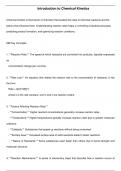
Chemical kinetics is the study of reaction rates and the factors affecting them. It examines how quickly reactants transform into products and the molecular events involved. Key factors influencing reaction rates include concentration, temperature, catalysts, and surface area. The rate law expresses the relationship between reaction rate and reactant concentrations, while the order of reaction determines how concentration changes impact speed. The Arrhenius equation explains the effect of temper...
- Book
- Class notes
- • 2 pages •
Chemical kinetics is the study of reaction rates and the factors affecting them. It examines how quickly reactants transform into products and the molecular events involved. Key factors influencing reaction rates include concentration, temperature, catalysts, and surface area. The rate law expresses the relationship between reaction rate and reactant concentrations, while the order of reaction determines how concentration changes impact speed. The Arrhenius equation explains the effect of temper...
Chemistry class 12th Electrochemistry_Introduction
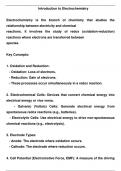
Electrochemistry is the study of chemical processes that involve the movement of electrons, leading to the conversion of chemical energy into electrical energy and vice versa. It focuses on redox reactions, where oxidation (loss of electrons) and reduction (gain of electrons) occur simultaneously. Key concepts include electrochemical cells, such as galvanic (voltaic) cells that generate electricity and electrolytic cells that use electricity to drive reactions. Standard electrode potential, the ...
- Book
- Class notes
- • 2 pages •
Electrochemistry is the study of chemical processes that involve the movement of electrons, leading to the conversion of chemical energy into electrical energy and vice versa. It focuses on redox reactions, where oxidation (loss of electrons) and reduction (gain of electrons) occur simultaneously. Key concepts include electrochemical cells, such as galvanic (voltaic) cells that generate electricity and electrolytic cells that use electricity to drive reactions. Standard electrode potential, the ...
Chemistry class 12th Solutions_Introduction_Class12.
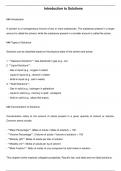
In Class 12 Chemistry, the chapter "Solutions" introduces the concept of homogeneous mixtures of two or more substances. Solutions consist of a solute (dissolved substance) and a solvent (dissolving medium). Key topics include types of solutions (solid, liquid, and gaseous), concentration terms (molarity, molality, mole fraction), solubility, and colligative properties like boiling point elevation, freezing point depression, osmotic pressure, and vapor pressure lowering. Raoult’s Law explain...
- Book
- Class notes
- • 1 pages •
In Class 12 Chemistry, the chapter "Solutions" introduces the concept of homogeneous mixtures of two or more substances. Solutions consist of a solute (dissolved substance) and a solvent (dissolving medium). Key topics include types of solutions (solid, liquid, and gaseous), concentration terms (molarity, molality, mole fraction), solubility, and colligative properties like boiling point elevation, freezing point depression, osmotic pressure, and vapor pressure lowering. Raoult’s Law explain...
Chemistry class 12th Rate_of_Chemical_Reaction
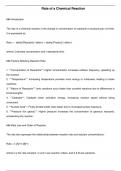
The rate of a chemical reaction measures how quickly reactants convert into products. It depends on factors like concentration, temperature, surface area, catalysts, and the nature of reactants. Increasing reactant concentration or temperature generally speeds up reactions by enhancing molecular collisions. Catalysts lower activation energy, facilitating faster reactions without being consumed. The rate can be expressed using rate laws, which relate reaction rate to reactant concentrations throu...
- Book
- Class notes
- • 2 pages •
The rate of a chemical reaction measures how quickly reactants convert into products. It depends on factors like concentration, temperature, surface area, catalysts, and the nature of reactants. Increasing reactant concentration or temperature generally speeds up reactions by enhancing molecular collisions. Catalysts lower activation energy, facilitating faster reactions without being consumed. The rate can be expressed using rate laws, which relate reaction rate to reactant concentrations throu...