Chapter 2: The Marketing Environment
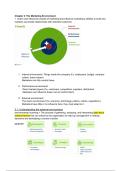
= Actors and influences outside of marketing that influence marketing’s abilities to build and
maintain successful relationships with selected customers
1. Internal environment: Things inside the company (f.e. employees, budget, company
culture, brand values)
Marketers can fully control these.
2. Performance environment:
Direct market players (f.e. customers, competitors, suppliers, distributors.
Marketers can influence these, but not control them)
3. External environment:
The macro environment (f.e. economy, technology, politics, culture, regulations.)
Marketers have little or no influence here, they must adapt to it.
2.1. Understanding the external environment
environmental scanning = The process of gathering, analyzing, and interpreting data about
external factors that can influence the organization to help top management in making
decisions and developing a course of action
DESTEP:
, 2.1a. The demographic environment
=The study of human population in terms of size, density, location, age, education, gender,
race, and profession
key elements/ factors: Population size and growth, Population density, Age distribution,
Gender distribution, Education levels, Income distribution, Urbanization, Household
composition, Migration patterns
marketing adapts: f.e. changing households: a blended family→ ikea ad where a kid has 2
exactly the same rooms
2.1b. The economic environment = The factors that affect consumer buying power and
spending patterns
such as: Gross Domestic Product (GDP), Disposable (=beschikbaar) income, Income
distribution, Price inflation, Unemployment rates, Interest rates, Exchange rates
(=wisselkoers), Consumer spending patterns, Export quota and duties,...
2.1c. The socio-cultural environment = Institutions and other forces that affect society’s basic
values and lifestyles
Cultural norms and values: The shared beliefs and practices within a society, f.e. Lifestyle
trends, Health and wellness, Education and literacy, Consumer attitudes and opinions,
Social mobility
Global consumer culture: People are united by their common devotion to brand-name
consumer goods, movie/ rock stars, and service. a brand operates globally → people get
the same preferences
- Standardization of products and brands → Unified consumption experience,
f.e. Coca Cola
- Influence of global media and technology → Similar lifestyles and consumption
trends across different cultures
f.e. Netflix
- Cultural homogenization (= cultures become more alike)
- Global symbols and status
f.e. Rolex
- Global consumer trends
f.e. Patagonia: the trend of sustainability
Glocalization : global + local = Process by which global companies adapt their products,
services and marketing strategies to suit local cultures
One-stop shopping Marketers use one-step shopping as a strategy to position themselves
as the most convenient and complete solution for customers. → popular in modern,
fast-paced, convenience-oriented cultures.
f.e. Walmart
= Actors and influences outside of marketing that influence marketing’s abilities to build and
maintain successful relationships with selected customers
1. Internal environment: Things inside the company (f.e. employees, budget, company
culture, brand values)
Marketers can fully control these.
2. Performance environment:
Direct market players (f.e. customers, competitors, suppliers, distributors.
Marketers can influence these, but not control them)
3. External environment:
The macro environment (f.e. economy, technology, politics, culture, regulations.)
Marketers have little or no influence here, they must adapt to it.
2.1. Understanding the external environment
environmental scanning = The process of gathering, analyzing, and interpreting data about
external factors that can influence the organization to help top management in making
decisions and developing a course of action
DESTEP:
, 2.1a. The demographic environment
=The study of human population in terms of size, density, location, age, education, gender,
race, and profession
key elements/ factors: Population size and growth, Population density, Age distribution,
Gender distribution, Education levels, Income distribution, Urbanization, Household
composition, Migration patterns
marketing adapts: f.e. changing households: a blended family→ ikea ad where a kid has 2
exactly the same rooms
2.1b. The economic environment = The factors that affect consumer buying power and
spending patterns
such as: Gross Domestic Product (GDP), Disposable (=beschikbaar) income, Income
distribution, Price inflation, Unemployment rates, Interest rates, Exchange rates
(=wisselkoers), Consumer spending patterns, Export quota and duties,...
2.1c. The socio-cultural environment = Institutions and other forces that affect society’s basic
values and lifestyles
Cultural norms and values: The shared beliefs and practices within a society, f.e. Lifestyle
trends, Health and wellness, Education and literacy, Consumer attitudes and opinions,
Social mobility
Global consumer culture: People are united by their common devotion to brand-name
consumer goods, movie/ rock stars, and service. a brand operates globally → people get
the same preferences
- Standardization of products and brands → Unified consumption experience,
f.e. Coca Cola
- Influence of global media and technology → Similar lifestyles and consumption
trends across different cultures
f.e. Netflix
- Cultural homogenization (= cultures become more alike)
- Global symbols and status
f.e. Rolex
- Global consumer trends
f.e. Patagonia: the trend of sustainability
Glocalization : global + local = Process by which global companies adapt their products,
services and marketing strategies to suit local cultures
One-stop shopping Marketers use one-step shopping as a strategy to position themselves
as the most convenient and complete solution for customers. → popular in modern,
fast-paced, convenience-oriented cultures.
f.e. Walmart