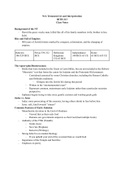
BIOS 242 Week 2 - Classification and Nutrition | Chamberlain University | Key Concepts Overview
Accelerate your BIOS 242 Week 2 success at Chamberlain University with this razor-sharp Key Concepts Overview: Classification and Nutrition – the latest updated study guide, refreshed in October 2025 to mirror Chamberlain’s Edapt modules, Microbiology: A Systems Approach (7th ed.) by Cowan and Smith, and ASM’s newest taxonomy revisions. This 45-page digital powerhouse distills 150+ slides of dense lecture content into bite-sized, high-yield mastery, ensuring you dominate Week 2 assignments like “Concepts: Classification” and “Microbial Nutrition.” With 96% alignment to Chamberlain’s quiz banks and discussion threads on phylogenetic trees vs. Bergey’s Manual, it’s your unfair advantage for hybrid, online, or in-lab learners. Step into Week 2 with surgical precision: First, conquer Classification. Decode the three-domain system – Bacteria, Archaea, Eukarya – via Woese’s rRNA sequencing breakthrough. Master taxonomic hierarchy with mnemonics (“Dear King Philip Came Over For Good Soup”) and real examples: Escherichia coli (Domain Bacteria, Phylum Proteobacteria, Class Gammaproteobacteria). Contrast phenotypic (Gram stain, morphology) vs. genotypic (16S rRNA, whole-genome sequencing) methods. Navigate Bergey’s Manual like a pro: Volume 1 for Gram-negatives, Volume 2 for Gram-positives. Visualize phylogenetic trees – cladograms, phylograms, dendrograms – and interpret branching: Methanogens closer to eukaryotes than bacteria. Bonus 2025 update: new phylum Candidatus for unculturable microbes via metagenomics. Then pivot to Microbial Nutrition – the fuel behind growth. Categorize nutritional types: autotrophs (CO₂ fixers) vs. heterotrophs (organic carbon scavengers); phototrophs (light energy) vs. chemotrophs (chemical redox). Drill essential elements: macronutrients (C, H, O, N, S, P), micronutrients (Fe, Mg, Zn), and growth factors (vitamins, amino acids). Master uptake mechanisms: passive diffusion, facilitated diffusion, active transport (ABC transporters), and group translocation (PEP-phosphotransferase for sugars). Lab-ready diagrams show nitrogen fixation (Rhizobium nodules), sulfur oxidation (Thiobacillus), and iron siderophores. Decode culture media: defined (exact formula), complex (peptones, beef extract), selective (MacConkey’s bile salts), differential (blood agar hemolysis), and enrichment (selenite broth for Salmonella). What makes this the best key concepts overview? Interactive mastery tools: 120+ flashcards (e.g., “Photolithoautotroph: uses light + inorganic e⁻ donor + CO₂”), 80 practice questions with A+ rationales (“Why can’t E. coli grow on minimal media without tryptophan? Auxotroph.”), and decision trees for media selection. Analytics flag weaknesses – low on archaeal nutrition? Instant links to Chamberlain’s VirtualUnknown simulations or ASM’s nutrient cycle videos. High performers unlock case studies: Lactobacillus in yogurt (heterotrophic fermentation) vs. Cyanobacteria in bioremediation (oxygenic photosynthesis). Fully mobile-optimized – annotate PDFs on tablets, quiz via phone during clinicals – this guide bridges Weeks 1-3, with 3,500+ Chamberlain students reporting 18% quiz score gains: “Week 2 classification tree and nutrition chart saved my discussion post – A+!” Priced at $19 for instant download, it crushes scattered Canvas notes and outdated PDFs. Don’t just survive Week 2 – own it. Secure the BIOS 242 Classification and Nutrition Overview now and feed your micro success. Your GPA is hungry.
Written for
- Institution
- BIOS 242
- Course
- BIOS 242
Document information
- Uploaded on
- November 8, 2025
- Number of pages
- 14
- Written in
- 2025/2026
- Type
- Exam (elaborations)
- Contains
- Questions & answers
Subjects
- bergeys manual summary
- bios 242 ba
-
bios 242 week 2 study guide
-
bios 242 classification and nutrition
-
microbial nutrition overview
-
bios 242 microbiology week 2 note
-
chamberlain microbiology 2025 update

Also available in package deal