
D184 Exam Study Guide
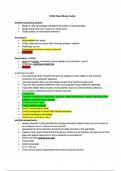
traditional grading system ● Based on the percentage average of all grades or holistic grades ● Single grade given per course on report cards ● Grade based on most recent evidence Procedural ● demonstrate their ability ● written response to explain their thinking- analyze - level 4 ● What they can do ● Composes sentences using a keyboard ● EXECUTE Declarative -VERBAL ● recall and identify vocabulary terms related to the standard. Level 2 ● What they understand determine ● KNOWS proficiency scales ● four-point scale that indicates the learning targets for each stage on the learning continuum for a particular standard. ● provide specifics about what students at each level should be able to do. ● They can help students determine their own progress toward different standards. ● It provides details about exactly what students must do to demonstrate proficiency. ● can provide a detailed account of student learning. ● 1-assistance ● 2-explain or describe -determine - drawing - select use precise - create - describe -play- organize drop and drag - arrange ● 3- solve, format - apply ● 4-demonstrate, evaluate ● Level 1=recognize or recall ● Level 2=recognize or recall AND identify examples ● Level 3=understand the effects ● Level4=demonstrate in depth parallel assessments ● assess students on the identified knowledge and skills multiple times over the course of an academic term to capture student growth ● assessing the same discrete concepts and skills included in the standards. ● measure and record student learning along a continuum so teachers can see growth and gaps and adjust instruction to move students to competence. ● need to be both reliable and valid ● Taxonomies ● Unidimensionality ● Same difficulty ● They remove some measurement errors from observed scores. ● track student progress on singular learning objectives ● They assess the full scope of a standard or learning objective. Reliable ● an assessment accurately and consistently measures the same content for all students. ● consistency and stability Valid ● the degree to which the assessment is relevant and specific to the actual content intended to be measured. ● measures what it is intended to measure Assessment blueprint ● creates consistency and connection between assessment items and corresponding complexity levels from the proficiency scale to which the assessment will be aligned. ● represents the specifications of the completed assessment and provides the teacher with guidance for developing the individual assessment items ● you will consider what is being measured, what students should know or be able to do, and how you will represent the learning target levels from the corresponding proficiency scale. ● 1. the first step is to identify the standard and determine the specific skills and content knowledge addressed at each level of the proficiency scale. ● 2. identifying which types of items are most appropriate to assess student understanding or skills at each level of the proficiency scale. ● 3. determining the number of items necessary at each level to achieve sufficient evidence of student knowledge ● Item types last - selected response, short constructed response, essay, performance assessment ● Proper coverage:Percentage of items and difficulty level for each topic Point scoring ● used to determine the percentage of available points a student earned on sections of a test, which is translated into a score on a proficiency scale. ● cut score to determine proficiency. Mounting evidence ● multiple indicators to find patterns of student achievement and determine students' summative scores. ● It estimates summative scores over time based on observed patterns. ● The most frequent score on all assessments Linear trend ● trend operates, assuming a steady and equal increase in learning. ● Rounded score up The Curvilinear Trend ● that when initially learning something, a student demonstrates rather large jumps in his or her understanding of a topic, but over time, the increase in learning tends to flatten out.
Document information
- Uploaded on
- April 15, 2025
- Number of pages
- 4
- Written in
- 2024/2025
- Type
- Exam (elaborations)
- Contains
- Questions & answers


