

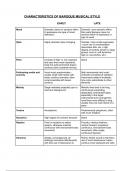
CHARACTERISTICS OF BAROQUE MUSICAL STYLE
EARLY LATE
Mood Dramatic; piece (or sections within Dramatic, more dynamic effect
it) expresses one type of mood than early Baroque; piece (or
(affection) sections within it) expresses or
type of mood
Style Highly dramatic style of singing Grander, more ornate expression
- much use of ornamentation
(decorative trills, etc.), high
degree of contrast (small vs. large
groups, loud vs. soft dynamics,
high vs. low pitches, etc.)
Pitch Contrast of high vs. low (soprano Same
and bass lines most important);
bass line quite prominent (basso
continuo) and constantly moving
Performing media and Vocal music predominates - Both instrumental and vocal;
sonority usually small violin family with orchestra consisted of standard
basso continuo primarily, other instruments added if available;
vocal ensemble with basso tone color subordinate to other
continuo elements
Melody Single melodies projected upon a Melodic lines tend to be long,
harmonic background continuously expanding,
elaborately ornamented types,
especially in the larger
instrumental and vocal genres;
vocal lines more difficult to sing;
usually only one main theme in a
piece
Texture Homophonic Predominantly polyphonic, often
with much imitation
Dynamics High degree of contrast; terraced Same
Rhythm Freer in recitative to reflect Forceful, metrical rhythms;
speech, otherwise metrical; motoric forward, propulsion;
continuous with ever-present bass continuous, ever-present bass
movement movement; often single,
continuous figure(s)
Harmony Simple, as background, or Richer, thicker sound to harmony;
strikingly innovative (Monteverdi) use of much dissonance; basso
with free use of dissonance to continuo (now keyboard and cello
EARLY LATE
Mood Dramatic; piece (or sections within Dramatic, more dynamic effect
it) expresses one type of mood than early Baroque; piece (or
(affection) sections within it) expresses or
type of mood
Style Highly dramatic style of singing Grander, more ornate expression
- much use of ornamentation
(decorative trills, etc.), high
degree of contrast (small vs. large
groups, loud vs. soft dynamics,
high vs. low pitches, etc.)
Pitch Contrast of high vs. low (soprano Same
and bass lines most important);
bass line quite prominent (basso
continuo) and constantly moving
Performing media and Vocal music predominates - Both instrumental and vocal;
sonority usually small violin family with orchestra consisted of standard
basso continuo primarily, other instruments added if available;
vocal ensemble with basso tone color subordinate to other
continuo elements
Melody Single melodies projected upon a Melodic lines tend to be long,
harmonic background continuously expanding,
elaborately ornamented types,
especially in the larger
instrumental and vocal genres;
vocal lines more difficult to sing;
usually only one main theme in a
piece
Texture Homophonic Predominantly polyphonic, often
with much imitation
Dynamics High degree of contrast; terraced Same
Rhythm Freer in recitative to reflect Forceful, metrical rhythms;
speech, otherwise metrical; motoric forward, propulsion;
continuous with ever-present bass continuous, ever-present bass
movement movement; often single,
continuous figure(s)
Harmony Simple, as background, or Richer, thicker sound to harmony;
strikingly innovative (Monteverdi) use of much dissonance; basso
with free use of dissonance to continuo (now keyboard and cello


