William Rainey Harper College
Latest uploads at William Rainey Harper College. Looking for notes at William Rainey Harper College? We have lots of notes, study guides and study notes available for your school.
-
58
- 0
-
5
All courses for William Rainey Harper College
Latest content William Rainey Harper College
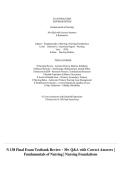
William Rainey Harper College BIO 161 Study Guide for Exam 4 Questions And Verified Solutions
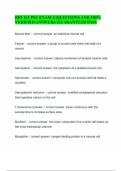
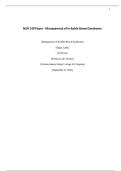
BIO 161 PSU EXAM 4 |QUESTIONS AND 100% VERIFIED ANSWERS |GUARANTEED PASS
[Irritable Bowel Syndrome] 2 
[What Is IBS?] 
The large intestine is impacted by the illness known as irritable bowel syndrome (IBS). It is an idiopathic disease that results from environmental and/or genetic factors. There are two types of IBS which are Crohn’s Disease which is a terminal ileum with colon patchy involvement throughout all layers of the bowel from mouth to rectum. Can have skip lesions. 
Ulcerative Colitis is the second one which occurs in the colon and rectum. Constipation, d...
1. 
What labs and levels tell you that someone has Hypothyroidism? Hyperthyroidism? TSH labs, T3, T4 with both hypo and hyperthyroidism 
TSH: 0.4-4.2 
T4: 4.6-12 
T3: low is less than 70mg/dL 
2. 
Describe the symptoms of hypothyroidism. Describe what labs you might see and describe why. Which symptoms may you need to call the healthcare provider for? 
Hypothyroidism: everything is low. Cold, slow heart rate, fatigue, lethargic, constipation, dry skin, anorexia, LOW, weight loss, edema around th...
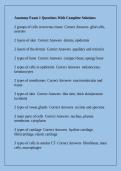
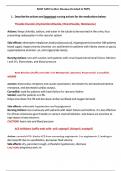
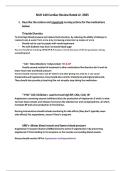
1. Describe the actions and important nursing actions for the medications below: 
Thiazide Diuretics (Hydrochlorothiazide, Chlorothiazide, Metolazone) 
Actions: Keeps chloride, sodium, and water in the tubule to be excreted in the urine, thus preventing reabsorption in the vascular system. 
Side effects: electrolyte imbalances (sodium/potassium), Hyperglycemia (monitor DM patients blood sugar), Hyperuricemia (monitor uric acid levels for patients with kidney stones or gout), Hyperlipidemia (moni...
1. 
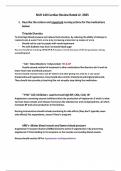
Describe the actions and important nursing actions for the medications below: 
Thiazide Diuretics 
To treat high blood pressure and reduce fluid retention, by reducing the ability of kidneys to reabsorb salt & water from urine & by increasing production & output of urine 
• 
Should not be used in people with renal impairment 
• 
Pts with diabetes may have increased blood sugar 
Nurses should be checking HR & BP & Potassium levels because of all the potassium being wasted/spared 
“-lols...
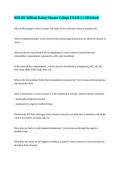
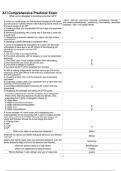
A nurse on a med surge unit has recieved change of shift report 
and will care for 4 clients. Which of the following clients needs will 
the nurse assign to an AP? 
A. Feeding a client who was admitted 24 hours ago with aspiration 
pneumonia 
B. Reinforcing teaching with a client who is learning to walk with 
a quad cane 
C. Reapplying a condom catheter for a client who has urinary 
incontinence 
D. Applying a sterile dressing to a pressure ulcer 
A nurse is delegating the ambulation of a client...
A nurse is caring for a client who has bipolar disorder and is 
experiencing acute mania. The nurse obtained a verbal 
prescription for restraints. Which of the following should the 
actions the nurse take? 
A nursing planning care for a school-age child who is 4 hr postoperative 
following perforated appendicitis. Which of the following 
actions should the nurse include in the plan of care? 
A nurse is receiving change-of-shift report for a group of clients. 
Which of the following clients shou...
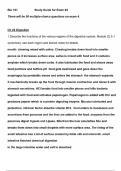
NUR 140 Cardiac Review Graded A 2025 
1. Describe the actions and important nursing actions for the medications below: 
Thiazide Diuretics (Hydrochlorothiazide, Chlorothiazide, Metolazone) 
Actions: Keeps chloride, sodium, and water in the tubule to be excreted in the urine, thus preventing reabsorption in the vascular system. 
Side effects: electrolyte imbalances (sodium/potassium), Hyperglycemia (monitor DM patients blood sugar), Hyperuricemia (monitor uric acid levels for patients with kidney...
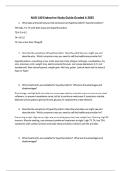
1. 
What labs and levels tell you that someone has Hypothyroidism? Hyperthyroidism? TSH labs, T3, T4 with both hypo and hyperthyroidism 
TSH: 0.4-4.2 
T4: 4.6-12 
T3: low is less than 70mg/dL 
2. 
Describe the symptoms of hypothyroidism. Describe what labs you might see and describe why. Which symptoms may you need to call the healthcare provider for? 
Hypothyroidism: everything is low. Cold, slow heart rate, fatigue, lethargic, constipation, dry skin, anorexia, LOW, weight loss, edema around th...