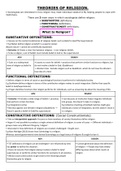
THEORIES OF RELIGION.
• Sociologists are interested in how religion may meet individual needs.E.G By helping people to cope with
misfortune.
There are 3 main ways in which sociologists define religion:
• SUBSTANTIVE definitions.
• FUNCTIONAL definitions.
• CONSTRUCTIONIST definitions.
What Is Religion?
SUBSTANTIVE DEFINITIONS:
• Focuses on the content (substance) of religious belief, such as Belief in God/The Supernatural.
• E.g Weber define religion as belief in a superior power.
(Above nature + cannot be scientifically explained)
• Exclusive → Draws a clear line between religious + non-religious beliefs.
• To be a religion, a set of beliefs must include belief in God or the supernatural.
ADV DISADV
• Suits to a widespread • Leaves no room for beliefs + practices that perform similar functions to religions, but
view of religion as belief in do not involve a belief in God. (Buddhism)
God. • Western bias - Exclude religion such as Buddhism. which do not have the Western
bias idea of a God.
FUNCTIONAL DEFINITIONS:
• Defines religion in terms of social or psychological functions it performs for individuals/society.
E.g Durkheim defines religion in terms of the contribution religion makes to social integration. (Rather than specific
belief in God/Supernatural)
E.g Yinger identifies functions that religion performs for individuals, such as answering Qs about the meaning of life.
ADV DISADV
• Inclusive → Includes a wide range of beliefs + practices • Just because an institution helps integrate individuals
that perform certain functions into groups, this doesn’t make it a religion.
E.g Integration (unity) E.g Collective chanting at football matches might give
• Not bias against non-Western religions (Buddhism) → individuals a sense of integration, but this doesn’t mean it
Doesn’t specify a belief in God/the supernatural. is a religion.
CONSTRUCTIVE DEFINITIONS: (Social Constructionists)
• Take an interpretivist approach: Focuses on how members of society themselves define religion.
• Argue it’s not possible to produce a single universal definition of religion, to cover all cases → Different individuals +
groups mean very different things by ‘religion’.
• Interested in how definitions of religions are created, challenged + fought over.
E.g Alan Aldridge (2013) shows how Scientology is a religion.
Whereas several governments have denied Scientology as a legal status of religions & sought to ban it.
ADV DISADV
• TST definitions of religion can be challenged + are influenced by who • Cannot generalise about the definition
has power to define the situation. of religion → People may have widely
• Does not assume that religion always involves a belief in God/ differing views about what counts as
supernatural, or performs similar functions for everyone in all societies. religion.
• Allows social constructions to get close to the meanings people
themselves give to religion.
, FUNCTIONALIST THEORIES OF RELIGION.
• Society is a system of interrelated parts / social institutions
(economy, religion, family)
• Society is like an organism, with basic needs that it must meet to survive.
• These needs are met by the diff institutions + each perform certain function to maintain the social system.
• Society’s most basic need is social order + solidarity, so its members can cooperate.
• What makes social order possible is the existence of value consensus. (avoid anomie)
V.C [A set of shared N&V by which society’s members live] (existing norms becomes unclear)
Without this, ind would pursue their own selfish desires + society would disintegrate.
DURKHEIM ON RELIGION.
The Sacred + The Profane
• For Durkheim (1915,1962) the key feature of religion was not a belief in God/the Supernatural, but a distinction between:
The Sacred Things set apart + forbidden, inspire feelings of awe, fear & wonder, surrounded
by taboos & prohibitions (restrictions)
The Profane Things with no special significance (ordinary)
• A religion is never simply a set of beliefs. It also involves particular rituals in relation to the sacred.
• These rituals are collective (Performed by social groups)
• Sacred things evoke such powerful feelings in believers.
• For Durkheim, this is because these sacred things are symbols representing something of great power.
• In Durkheim's view it is society itself, because society is the only thing powerful enough to command such feelings.
• ∴ When they worship the sacred symbols, people are worshipping society itself.
• Although sacred symbols vary, they all perform the essential function of uniting behaviours into a single moral community.
Totemism (Durkheim)
• Durkheim believed that the core (nature) of all religion could be found by studying its simplest form, in the simplest type of society
→ CLAN SOCIETY.
• ∴ He used studies of the Arunta, an Aboriginal Australian Tribe with a clan system.
• Arunta clans consist of bands of kin (family) who come together periodically to perform rituals, involving worship
of a sacred totem.
• The totem is the clan’s emblem (symbol) such as an animal/ plant that symbolises the clan’s origins + identity.
• The sacred rituals serve to reinforce (strengthen) the group’s solidarity + sense of belonging.
• For Durkheim, when clan members worship their totemic animal, they are in reality worshipping society → Even though the clans
are not aware of this.
• The totem inspire feelings of awe in the clan’s members, because the totem represents the power of the group, on which the
individual is dependent on.
Worsley (1956): Evidence of totemism is unstable. T here’s no sharp division between the sacred + the profane, +
that diff clans share the same totems.
Even if Durkheim is correct about totemism, this doesn’t prove that he has discovered the essence of all other
religion.
Collective Conscience (Durkheim)
• In D’s view, the sacred symbols represents society's collective conscience (conscience + consciousness) or consciousness.
Collective The shared norms, values, beliefs + knowledge that make cooperation between individuals possible.
Conscience: (Without these society would disintegrate)
• Regular shared religious rituals reinforce the collective conscience + maintain social integration.
• These rituals binds individuals together, reminding them that they are part of a single moral community. It also reminds them of
the power of society - Without which they themselves are nothing.
• In this case, religion also performs an important function for the individual.
Making us feel part of something greater than ourselves.
Religion strengthens us to face life’s trial + motivates us to overcome obstacles.
,Cognitive Functions Of Religion. (Durkheim)
• Durkheim also sees religion as the source of our intellectual/cognitive capacities.
(Our ability to reason + think conceptually)
E.g to think, we need categories, such as time, space, cause, substance etc. +
In order to share our thought, we need to use the same categories as others.
• Religion is the origin of the concepts + categories we need for reasoning, understanding the world + communicating.
• In their book - Primitive Classification, Durkheim + Marcel Mauss (1903-2009) argue that religion provides basic categories such
as time, space + causation.
E.g With ideas about a creator bringing word into life at the beginning of time.
Similarly, the division of tribes into clans, gives humans their 1st notion of classification (grouping)
• Thus religion is the origin of human thought, reason + science.
ADV DISADV
• Durkheim's • ⬆ diff to apply the theory to a large scale societies where 2 or more religious communities may be in
theory may conflict.
apply better to • His theory may explain social integration within communities, but not the conflicts between them.
small-scale • Postmodernists - Stjepan Mestrovic(2001) argue that D’s ideas cannot be applied to contemporary society,
societies with a cos ⬆ diversity has fragmented the collective conscience, ∴ no longer a single shared value system for
single religions. religion to reinforce.
PSYCHOLOGICAL FUNCTIONS. (Malinowski)
- Malinowski agrees with Durkheim that religion promotes solidarity, but it does so by performing psychological functions for
individuals. + Help them to cope with emotional stress that would undermine social solidarity.
He identifies 2 types of situation in which religion performs this role:
1) Where the outcome is important, but is uncontrollable + thus uncertain.
• Seen in study of Trobriand Islanders of the Western Pacific.
• Contrasts fishing in the Lagoon + fishing in the ocean.
LAGOON FISHING: OCEAN FISHING:
• Safe, uses • Dangerous + uncertain.
predictable + • Supported by ‘canoe magic’ (rituals to ensure safe + successful expedition)
successful method • Give people a sense of control + confidence to undertake hazardous tasks + reinforce social solidarity.
of poisoning. • Malinowski sees rituals serving as a ‘God of the gaps’ - the rituals fills the gaps in human beings’ control
• No ritual. over the world e.g being unable to control the outcome of fishing.
2) At times of life crisis.
• Events such as birth, marriage + death cause disruptive changes in social groups.
• ∴ Religion helps to ⬇ disruption.
E.G Funeral rituals reinforce a feeling of solidarity among the survivors + the notion of immortality gives comfort to the bereaved, by
denying the fact of death.
• Malinowski argues death is the main reason for the existence of religious belief.
PARSONS: VALUES + MEANINGS. & Mechanism Of Adjustment
- Agrees with Malin + sees religion as a mechanism of adjustment → Helpings individuals to cope with unforeseen events +
uncontrollable outcomes.
- ALSO identifies 2 other essential functions that religion performs in modern society:
1) Religion creates + legitimates society's central values (N+V):
• By sacralising them.
∴ in USA, Protestantism has sacralised the core American values of individualism, meritocracy + self-discipline.
• This serves to promote value consensus + social solidarity.
2) Religion is the primary source of meaning:
• Religion answers ‘ultimate Qs’ about the human condition e.g ‘why the good suffer;.
• Such events make life appear meaningless + may undermine (damage) our commitment to society’s values.
• Religion provide answers to such Q’s.
E.g by explaining ‘suffering as a test of faith, that will be rewarded in heaven’
• ∴ Religion enables people to adjust to unfavourable events, which helps to maintain society
, CIVIL RELIGION. (Bellah) Neo-functionalists
- Bellah (1991;2013) interested how religion unifies society.
- Especially in a multi-faith society. E.g AMERICA.
- What unifies American society is...
CIVIL RELIGION: A belief system that attaches sacred qualities to society itself.
• In the American case, civil religion is a case in Americanism (The American way of life)
• Civil religion integrates society in a way that American churches cannot.
• American C.R involves loyalty to the nation state + a belief in God, both of which are equated with being a true American.
• It is expressed in various ritual, symbols + beliefs e.g…
# The Pledge Of Allegiance To The Flag.
# Singing The National Anthem.
• However, this is not a specific Jewish, Protestant or Catholic God, but rather an ‘American’ God.
↳ It centralises the American way of life + binds together Americans from many different ethnic + religious backgrounds.
Functional Alternatives:
• Functional alternatives/functional equivalents to religion are non-religious beliefs + practices that perform similar functions to
those of organised religion. E.g reinforcing shared values or maintaining cohesion.
• Bellah argues that even though America C.R involves a belief in God, this does not have to be the case.
• Some other belief system could perform the same functions.
E.g Nazi Germany + The Soviet Union had non-religious political beliefs + rituals which they sought to unite society.
Issues → Like the functional definitions of religion, it ignores what makes religion distinctive + different.
Overall Evaluation Of Functionalism.
ADVANTAGES DISADVANTAGES
• Emphasises the social nature of religion + • Too happy + content with the roles it performs in society.
the +ve functions it performs • Neglects -ve a spects → Religion as a source of oppression of the poor/women
• The idea of Civil Religion overcomes the • Ignores religion as a source of division + conflict, especially in modern societies
problem of religious pluralism, by arguing where there is more than 1 religion e.g N.Ireland
that societies may still have a belief system • Where there is religious pluralism, it is hard to see how religion can unite
shared by everyone. But.. people + promotes integration.
↳ ↳ ↳ ↳ ↳ ↳ • C.R has been criticised as to whether is it really a religion, especially when it is
not based on beliefs in the supernatural.
_____________________________________________________________________
MARXIST THEORIES OF RELIGION.
- Sees all societies as divided into 2 classes.
- One of which exploits the labour of the other.
- In modern capitalist society its the capitalist class, who own the M of P exploit the w/c.
- There is always the potential for class conflict.
- Marx predicted the w/c would become conscious of their exploitation + unite to overthrow capitalism = no more
exploitation → Classless Society
- Sees religion as a feature of class-divided society.
- Argues religion would not be needed in a classless society, and religion would disappear.
☁ RELIGION AS IDEOLOGY ☁
• Ideology = A belief system that distorts people’s perception of reality that serves the interests of the ruling class.
• The class that controls the economic production also controls the production + distribution of ideas in society, through
institutions e.g religion, the education system.
• Religion as a ISA, used by the ruling class, to legitimate the suffering of the poor as something inevitable + God-given.
• Religion misleads the poor into believing that their suffering is virtuous (good) + they will be rewarded in the afterlife.
E.g According to Christianity..
- It is easier for a camel to pass through the eye of a needle, than it is for a rich man to enter the kingdom of heaven.
• Such ideas create a false class consciousness.
(A distorted view of reality that prevents the poor from acting to change their situation)
• Sociologists are interested in how religion may meet individual needs.E.G By helping people to cope with
misfortune.
There are 3 main ways in which sociologists define religion:
• SUBSTANTIVE definitions.
• FUNCTIONAL definitions.
• CONSTRUCTIONIST definitions.
What Is Religion?
SUBSTANTIVE DEFINITIONS:
• Focuses on the content (substance) of religious belief, such as Belief in God/The Supernatural.
• E.g Weber define religion as belief in a superior power.
(Above nature + cannot be scientifically explained)
• Exclusive → Draws a clear line between religious + non-religious beliefs.
• To be a religion, a set of beliefs must include belief in God or the supernatural.
ADV DISADV
• Suits to a widespread • Leaves no room for beliefs + practices that perform similar functions to religions, but
view of religion as belief in do not involve a belief in God. (Buddhism)
God. • Western bias - Exclude religion such as Buddhism. which do not have the Western
bias idea of a God.
FUNCTIONAL DEFINITIONS:
• Defines religion in terms of social or psychological functions it performs for individuals/society.
E.g Durkheim defines religion in terms of the contribution religion makes to social integration. (Rather than specific
belief in God/Supernatural)
E.g Yinger identifies functions that religion performs for individuals, such as answering Qs about the meaning of life.
ADV DISADV
• Inclusive → Includes a wide range of beliefs + practices • Just because an institution helps integrate individuals
that perform certain functions into groups, this doesn’t make it a religion.
E.g Integration (unity) E.g Collective chanting at football matches might give
• Not bias against non-Western religions (Buddhism) → individuals a sense of integration, but this doesn’t mean it
Doesn’t specify a belief in God/the supernatural. is a religion.
CONSTRUCTIVE DEFINITIONS: (Social Constructionists)
• Take an interpretivist approach: Focuses on how members of society themselves define religion.
• Argue it’s not possible to produce a single universal definition of religion, to cover all cases → Different individuals +
groups mean very different things by ‘religion’.
• Interested in how definitions of religions are created, challenged + fought over.
E.g Alan Aldridge (2013) shows how Scientology is a religion.
Whereas several governments have denied Scientology as a legal status of religions & sought to ban it.
ADV DISADV
• TST definitions of religion can be challenged + are influenced by who • Cannot generalise about the definition
has power to define the situation. of religion → People may have widely
• Does not assume that religion always involves a belief in God/ differing views about what counts as
supernatural, or performs similar functions for everyone in all societies. religion.
• Allows social constructions to get close to the meanings people
themselves give to religion.
, FUNCTIONALIST THEORIES OF RELIGION.
• Society is a system of interrelated parts / social institutions
(economy, religion, family)
• Society is like an organism, with basic needs that it must meet to survive.
• These needs are met by the diff institutions + each perform certain function to maintain the social system.
• Society’s most basic need is social order + solidarity, so its members can cooperate.
• What makes social order possible is the existence of value consensus. (avoid anomie)
V.C [A set of shared N&V by which society’s members live] (existing norms becomes unclear)
Without this, ind would pursue their own selfish desires + society would disintegrate.
DURKHEIM ON RELIGION.
The Sacred + The Profane
• For Durkheim (1915,1962) the key feature of religion was not a belief in God/the Supernatural, but a distinction between:
The Sacred Things set apart + forbidden, inspire feelings of awe, fear & wonder, surrounded
by taboos & prohibitions (restrictions)
The Profane Things with no special significance (ordinary)
• A religion is never simply a set of beliefs. It also involves particular rituals in relation to the sacred.
• These rituals are collective (Performed by social groups)
• Sacred things evoke such powerful feelings in believers.
• For Durkheim, this is because these sacred things are symbols representing something of great power.
• In Durkheim's view it is society itself, because society is the only thing powerful enough to command such feelings.
• ∴ When they worship the sacred symbols, people are worshipping society itself.
• Although sacred symbols vary, they all perform the essential function of uniting behaviours into a single moral community.
Totemism (Durkheim)
• Durkheim believed that the core (nature) of all religion could be found by studying its simplest form, in the simplest type of society
→ CLAN SOCIETY.
• ∴ He used studies of the Arunta, an Aboriginal Australian Tribe with a clan system.
• Arunta clans consist of bands of kin (family) who come together periodically to perform rituals, involving worship
of a sacred totem.
• The totem is the clan’s emblem (symbol) such as an animal/ plant that symbolises the clan’s origins + identity.
• The sacred rituals serve to reinforce (strengthen) the group’s solidarity + sense of belonging.
• For Durkheim, when clan members worship their totemic animal, they are in reality worshipping society → Even though the clans
are not aware of this.
• The totem inspire feelings of awe in the clan’s members, because the totem represents the power of the group, on which the
individual is dependent on.
Worsley (1956): Evidence of totemism is unstable. T here’s no sharp division between the sacred + the profane, +
that diff clans share the same totems.
Even if Durkheim is correct about totemism, this doesn’t prove that he has discovered the essence of all other
religion.
Collective Conscience (Durkheim)
• In D’s view, the sacred symbols represents society's collective conscience (conscience + consciousness) or consciousness.
Collective The shared norms, values, beliefs + knowledge that make cooperation between individuals possible.
Conscience: (Without these society would disintegrate)
• Regular shared religious rituals reinforce the collective conscience + maintain social integration.
• These rituals binds individuals together, reminding them that they are part of a single moral community. It also reminds them of
the power of society - Without which they themselves are nothing.
• In this case, religion also performs an important function for the individual.
Making us feel part of something greater than ourselves.
Religion strengthens us to face life’s trial + motivates us to overcome obstacles.
,Cognitive Functions Of Religion. (Durkheim)
• Durkheim also sees religion as the source of our intellectual/cognitive capacities.
(Our ability to reason + think conceptually)
E.g to think, we need categories, such as time, space, cause, substance etc. +
In order to share our thought, we need to use the same categories as others.
• Religion is the origin of the concepts + categories we need for reasoning, understanding the world + communicating.
• In their book - Primitive Classification, Durkheim + Marcel Mauss (1903-2009) argue that religion provides basic categories such
as time, space + causation.
E.g With ideas about a creator bringing word into life at the beginning of time.
Similarly, the division of tribes into clans, gives humans their 1st notion of classification (grouping)
• Thus religion is the origin of human thought, reason + science.
ADV DISADV
• Durkheim's • ⬆ diff to apply the theory to a large scale societies where 2 or more religious communities may be in
theory may conflict.
apply better to • His theory may explain social integration within communities, but not the conflicts between them.
small-scale • Postmodernists - Stjepan Mestrovic(2001) argue that D’s ideas cannot be applied to contemporary society,
societies with a cos ⬆ diversity has fragmented the collective conscience, ∴ no longer a single shared value system for
single religions. religion to reinforce.
PSYCHOLOGICAL FUNCTIONS. (Malinowski)
- Malinowski agrees with Durkheim that religion promotes solidarity, but it does so by performing psychological functions for
individuals. + Help them to cope with emotional stress that would undermine social solidarity.
He identifies 2 types of situation in which religion performs this role:
1) Where the outcome is important, but is uncontrollable + thus uncertain.
• Seen in study of Trobriand Islanders of the Western Pacific.
• Contrasts fishing in the Lagoon + fishing in the ocean.
LAGOON FISHING: OCEAN FISHING:
• Safe, uses • Dangerous + uncertain.
predictable + • Supported by ‘canoe magic’ (rituals to ensure safe + successful expedition)
successful method • Give people a sense of control + confidence to undertake hazardous tasks + reinforce social solidarity.
of poisoning. • Malinowski sees rituals serving as a ‘God of the gaps’ - the rituals fills the gaps in human beings’ control
• No ritual. over the world e.g being unable to control the outcome of fishing.
2) At times of life crisis.
• Events such as birth, marriage + death cause disruptive changes in social groups.
• ∴ Religion helps to ⬇ disruption.
E.G Funeral rituals reinforce a feeling of solidarity among the survivors + the notion of immortality gives comfort to the bereaved, by
denying the fact of death.
• Malinowski argues death is the main reason for the existence of religious belief.
PARSONS: VALUES + MEANINGS. & Mechanism Of Adjustment
- Agrees with Malin + sees religion as a mechanism of adjustment → Helpings individuals to cope with unforeseen events +
uncontrollable outcomes.
- ALSO identifies 2 other essential functions that religion performs in modern society:
1) Religion creates + legitimates society's central values (N+V):
• By sacralising them.
∴ in USA, Protestantism has sacralised the core American values of individualism, meritocracy + self-discipline.
• This serves to promote value consensus + social solidarity.
2) Religion is the primary source of meaning:
• Religion answers ‘ultimate Qs’ about the human condition e.g ‘why the good suffer;.
• Such events make life appear meaningless + may undermine (damage) our commitment to society’s values.
• Religion provide answers to such Q’s.
E.g by explaining ‘suffering as a test of faith, that will be rewarded in heaven’
• ∴ Religion enables people to adjust to unfavourable events, which helps to maintain society
, CIVIL RELIGION. (Bellah) Neo-functionalists
- Bellah (1991;2013) interested how religion unifies society.
- Especially in a multi-faith society. E.g AMERICA.
- What unifies American society is...
CIVIL RELIGION: A belief system that attaches sacred qualities to society itself.
• In the American case, civil religion is a case in Americanism (The American way of life)
• Civil religion integrates society in a way that American churches cannot.
• American C.R involves loyalty to the nation state + a belief in God, both of which are equated with being a true American.
• It is expressed in various ritual, symbols + beliefs e.g…
# The Pledge Of Allegiance To The Flag.
# Singing The National Anthem.
• However, this is not a specific Jewish, Protestant or Catholic God, but rather an ‘American’ God.
↳ It centralises the American way of life + binds together Americans from many different ethnic + religious backgrounds.
Functional Alternatives:
• Functional alternatives/functional equivalents to religion are non-religious beliefs + practices that perform similar functions to
those of organised religion. E.g reinforcing shared values or maintaining cohesion.
• Bellah argues that even though America C.R involves a belief in God, this does not have to be the case.
• Some other belief system could perform the same functions.
E.g Nazi Germany + The Soviet Union had non-religious political beliefs + rituals which they sought to unite society.
Issues → Like the functional definitions of religion, it ignores what makes religion distinctive + different.
Overall Evaluation Of Functionalism.
ADVANTAGES DISADVANTAGES
• Emphasises the social nature of religion + • Too happy + content with the roles it performs in society.
the +ve functions it performs • Neglects -ve a spects → Religion as a source of oppression of the poor/women
• The idea of Civil Religion overcomes the • Ignores religion as a source of division + conflict, especially in modern societies
problem of religious pluralism, by arguing where there is more than 1 religion e.g N.Ireland
that societies may still have a belief system • Where there is religious pluralism, it is hard to see how religion can unite
shared by everyone. But.. people + promotes integration.
↳ ↳ ↳ ↳ ↳ ↳ • C.R has been criticised as to whether is it really a religion, especially when it is
not based on beliefs in the supernatural.
_____________________________________________________________________
MARXIST THEORIES OF RELIGION.
- Sees all societies as divided into 2 classes.
- One of which exploits the labour of the other.
- In modern capitalist society its the capitalist class, who own the M of P exploit the w/c.
- There is always the potential for class conflict.
- Marx predicted the w/c would become conscious of their exploitation + unite to overthrow capitalism = no more
exploitation → Classless Society
- Sees religion as a feature of class-divided society.
- Argues religion would not be needed in a classless society, and religion would disappear.
☁ RELIGION AS IDEOLOGY ☁
• Ideology = A belief system that distorts people’s perception of reality that serves the interests of the ruling class.
• The class that controls the economic production also controls the production + distribution of ideas in society, through
institutions e.g religion, the education system.
• Religion as a ISA, used by the ruling class, to legitimate the suffering of the poor as something inevitable + God-given.
• Religion misleads the poor into believing that their suffering is virtuous (good) + they will be rewarded in the afterlife.
E.g According to Christianity..
- It is easier for a camel to pass through the eye of a needle, than it is for a rich man to enter the kingdom of heaven.
• Such ideas create a false class consciousness.
(A distorted view of reality that prevents the poor from acting to change their situation)