
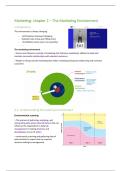
Marketing: chapter 2 – The Marketing Environment
Introduction
The environment is always changing.
- Self-checkout improved shopping
- Zalando trials virtual jean fitting room
- shrinkflation (same price, less quantity)
- …
The marketing environment
= Actors and influences outside of marketing that influence marketing’s abilities to build and
maintain successful relationships with selected customers.
= People or things outside marketing that makes marketing build good relationship with selected
customers.
2.1. Understanding the external environment
Environmental scanning
= The process of gathering, analyzing, and
interpreting data about external factors that can
influence the organization to help top
management in making decisions and
developing a course of action.
= continuously scanning and gathering data of
external factor's impact that can improve
decision making by management
,DESTEP-model: Exam Q: need to know the 6 elements
+examples
a) Demographic environment
= The study of human population in terms of size, density, location, age, education, gender, race,
and profession.
Population size and growth Gender distribution Urbanization
Population density Education levels Household composition
Age distribution Income distribution Migration patterns
Examples:
• Boom in world population: In 2100 more people than in 1950
• Increasing migration and connectivity: more companies have branches everywhere,
worldwide.
• Increasing urbanization= Ikea moves major cities => more people
• Ageing population: Amazon echo silver: also, for older gen to use. More features specific to
target them.
• Changing households: more single parents, two dads,…
, b) Economic environment
= The factors that affect consumer buying power and spending patterns
Factors (don’t learn everything) Exchange rates
Economic climate and growth Wage inflation Consumer spending patterns
rate
Gross Domestic Product (GDP) Price inflation Export quota and duties
Disposable income Unemployment rates Debt
Income distribution Interest rates Consumer saving
- GDP = total value of the produced goods in 1 year
- Examples
• Argentina’s inflation Challenge = government
difficulties with slowing price increases
• Unemployment, interest, exchange rates
• Economic climate and growth rate = how is the
country/EU doing?
• (Schengen Area= free flow of goods and people with
no tariffs)
• …
c) Socio-cultural environment
Socio-cultural environment
= Institutions and other forces that affect society’s basic values and lifestyles
=> Cultural norms and values: The shared beliefs and practices within a society
Lifestyle trend Education and literacy Social mobility
Health and wellness Consumer attitudes and opinions
Global consumer culture (lifestyle trends)
= Lifestyle trends: common devotion to consumers, goods, movies/rock stars and services. =people
united by similar preferences
- Standardization of products and brands: unified consumption experience
• Pe. Coca Cola and Pepsi
- Influence of global media and technology: similar consumption trends/lifestyles across
cultures:
• Pe. NETFLIX
- Cultural homogenization = local cultures becoming similar => reduce social diversity
- Global symbols and status : High-end brands
- like cars and watches (ROLEX)
- …
Glocalization (also in chapter 9 mentioned)
- Global and local
- Process by which global companies tailor their
products, services and marketing strategies to suit
local cultures
, One-stop shopping: everything at one place
- Pe. Ikea or Walmart
Increase Health and fitness
- Pe. organic food, veganism, Nutri-label, …
Second-hand sales (Sustainable, Consumer attitudes)
- Pe. Vinted, bring people in touch, buy second-hand stuff
Online communities and sharing (Consumer opinions)
- Pe. food blogs, Instagram
Q: As marketeer, what’s going on online?
Social mobility
- social hierarchy, social class, wealth education, or occupation to move up or down the social
ladder
d) Technological environment
= Forces that create new technologies, creating new
products and market opportunities.
- Innovation and research
• Pe. drones to deliver medicines and
organs to hospital
- Technology adoption rates
• companies updating to quick changes of
disruptive tech
• Pe. Smart cities
- Digitalization and connectivity
- Automation and AI: chatbots
• Pe. BOL.COM web shop: decrease waiting lines, easy questions answered by AI
• How to use AI to be more efficient?
- Intellectual property issues
- Technical issues
- Changes in lifestyle because of tech: electric garbage bins, smart traffic light, real time info
about transport
- Information access (internet)
- Crowdsourcing: outsiders perform a task on behalf of company for a fee or prize
e) Ecological environment
• Changing trends in sustainability = try to pursue a circular economy
Introduction
The environment is always changing.
- Self-checkout improved shopping
- Zalando trials virtual jean fitting room
- shrinkflation (same price, less quantity)
- …
The marketing environment
= Actors and influences outside of marketing that influence marketing’s abilities to build and
maintain successful relationships with selected customers.
= People or things outside marketing that makes marketing build good relationship with selected
customers.
2.1. Understanding the external environment
Environmental scanning
= The process of gathering, analyzing, and
interpreting data about external factors that can
influence the organization to help top
management in making decisions and
developing a course of action.
= continuously scanning and gathering data of
external factor's impact that can improve
decision making by management
,DESTEP-model: Exam Q: need to know the 6 elements
+examples
a) Demographic environment
= The study of human population in terms of size, density, location, age, education, gender, race,
and profession.
Population size and growth Gender distribution Urbanization
Population density Education levels Household composition
Age distribution Income distribution Migration patterns
Examples:
• Boom in world population: In 2100 more people than in 1950
• Increasing migration and connectivity: more companies have branches everywhere,
worldwide.
• Increasing urbanization= Ikea moves major cities => more people
• Ageing population: Amazon echo silver: also, for older gen to use. More features specific to
target them.
• Changing households: more single parents, two dads,…
, b) Economic environment
= The factors that affect consumer buying power and spending patterns
Factors (don’t learn everything) Exchange rates
Economic climate and growth Wage inflation Consumer spending patterns
rate
Gross Domestic Product (GDP) Price inflation Export quota and duties
Disposable income Unemployment rates Debt
Income distribution Interest rates Consumer saving
- GDP = total value of the produced goods in 1 year
- Examples
• Argentina’s inflation Challenge = government
difficulties with slowing price increases
• Unemployment, interest, exchange rates
• Economic climate and growth rate = how is the
country/EU doing?
• (Schengen Area= free flow of goods and people with
no tariffs)
• …
c) Socio-cultural environment
Socio-cultural environment
= Institutions and other forces that affect society’s basic values and lifestyles
=> Cultural norms and values: The shared beliefs and practices within a society
Lifestyle trend Education and literacy Social mobility
Health and wellness Consumer attitudes and opinions
Global consumer culture (lifestyle trends)
= Lifestyle trends: common devotion to consumers, goods, movies/rock stars and services. =people
united by similar preferences
- Standardization of products and brands: unified consumption experience
• Pe. Coca Cola and Pepsi
- Influence of global media and technology: similar consumption trends/lifestyles across
cultures:
• Pe. NETFLIX
- Cultural homogenization = local cultures becoming similar => reduce social diversity
- Global symbols and status : High-end brands
- like cars and watches (ROLEX)
- …
Glocalization (also in chapter 9 mentioned)
- Global and local
- Process by which global companies tailor their
products, services and marketing strategies to suit
local cultures
, One-stop shopping: everything at one place
- Pe. Ikea or Walmart
Increase Health and fitness
- Pe. organic food, veganism, Nutri-label, …
Second-hand sales (Sustainable, Consumer attitudes)
- Pe. Vinted, bring people in touch, buy second-hand stuff
Online communities and sharing (Consumer opinions)
- Pe. food blogs, Instagram
Q: As marketeer, what’s going on online?
Social mobility
- social hierarchy, social class, wealth education, or occupation to move up or down the social
ladder
d) Technological environment
= Forces that create new technologies, creating new
products and market opportunities.
- Innovation and research
• Pe. drones to deliver medicines and
organs to hospital
- Technology adoption rates
• companies updating to quick changes of
disruptive tech
• Pe. Smart cities
- Digitalization and connectivity
- Automation and AI: chatbots
• Pe. BOL.COM web shop: decrease waiting lines, easy questions answered by AI
• How to use AI to be more efficient?
- Intellectual property issues
- Technical issues
- Changes in lifestyle because of tech: electric garbage bins, smart traffic light, real time info
about transport
- Information access (internet)
- Crowdsourcing: outsiders perform a task on behalf of company for a fee or prize
e) Ecological environment
• Changing trends in sustainability = try to pursue a circular economy


