

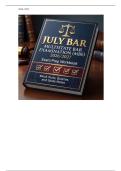
2026/2027
,2026/2027
July Bar Multistate Bar Examination
(MBE) 2026/2027 Complete Review
All-Inclusive Certification Study
Guide: Extensive Practice Questions,
Complete Test Bank Review, Detailed
Knowledge Assessment, and Final
Exam Prep Manual
Question 16
Question 1
A federal court hears a diversity action involving a state-law medical-malpractice
claim. State law imposes a substantive damages cap, while the Federal Rules
prescribe how motions and pleadings are filed. Which law should the federal court
apply?
A. Federal law to both the damages cap and filing procedures
B. State law to the damages cap and federal law to filing procedures
C. State law to both the damages cap and filing procedures
D. Federal law to the damages cap and state law to filing procedures
Correct Answer: B. State law to the damages cap and federal law to filing
procedures
Rationale: Under the Erie doctrine, a federal court exercising diversity jurisdiction
applies state substantive law and federal procedural law. A damages cap affects the
parties’ substantive rights and is generally governed by state law. Filing and motion
procedures are governed by valid federal procedural rules.
Question 2
A corporation is incorporated in Delaware. Its executive officers direct and coordinate
corporate operations from Illinois, although most of its employees and physical
facilities are located in Texas. For diversity jurisdiction, where is the corporation a
citizen?
A. Delaware and Texas only
B. Illinois and Texas only
C. Delaware, Illinois, and Texas
D. Delaware and Illinois only
,2026/2027
Correct Answer: D. Delaware and Illinois only
Rationale: A corporation is a citizen of every state in which it is incorporated and the
single state containing its principal place of business. The principal place of business
is ordinarily the corporation’s “nerve center,” where senior officers direct and
coordinate activities. Thus, Delaware and Illinois control.
Question 3
A defendant resides in District A. The contract was negotiated, executed, and
breached in District B, where most witnesses and records are located. Both districts
are within different states. Which statement best describes proper venue?
A. Venue is proper only in District A because the defendant resides there
B. Venue is proper only where the plaintiff resides
C. District B is proper because a substantial part of the events occurred there
D. Venue is improper in both districts unless the defendant consents
Correct Answer: C. District B is proper because a substantial part of the events
occurred there
Rationale: Venue is proper in a judicial district where a substantial part of the events
or omissions giving rise to the claim occurred. District B therefore qualifies.
Defendant residence can also support venue in appropriate circumstances, but it is not
the exclusive basis.
Question 4
A plaintiff files a state-law negligence action in federal court. The complaint alleges
that the defendant will likely argue that a federal safety statute preempts the plaintiff’s
claim. The defendant moves to dismiss for lack of federal-question jurisdiction. How
should the court rule?
A. Deny the motion because a federal defense is anticipated
B. Deny the motion because federal preemption always creates federal jurisdiction
C. Grant the motion because the federal issue does not appear in the plaintiff’s
properly pleaded claim
D. Grant the motion only if the parties are citizens of the same state
Correct Answer: C. Grant the motion because the federal issue does not appear
in the plaintiff’s properly pleaded claim
Rationale: Under the well-pleaded complaint rule, federal-question jurisdiction exists
only when the plaintiff’s properly pleaded complaint establishes a claim arising under
, 2026/2027
federal law. A federal defense, including preemption, generally does not create
jurisdiction. Diversity is irrelevant to whether federal-question jurisdiction exists.
Question 5
A limited partnership has one general partner who is a citizen of Florida and three
limited partners who are citizens of Georgia, Alabama, and Tennessee. In which states
is the partnership considered a citizen for diversity purposes?
A. Florida only
B. Florida and the state where the partnership maintains its headquarters
C. Florida, Georgia, Alabama, and Tennessee
D. The state in which the partnership was organized only
Correct Answer: C. Florida, Georgia, Alabama, and Tennessee
Rationale: An unincorporated association, including a partnership, takes the
citizenship of every one of its partners or members. Both general and limited partners
count. The partnership’s headquarters and state of organization do not determine
citizenship in the same manner as a corporation’s incorporation and nerve center.
Question 6
A plaintiff brings a federal employment-discrimination claim and a related state-law
contract claim arising from the same termination. Before trial, the federal claim is
dismissed. What may the federal court properly do with the remaining state claim?
A. It must retain the state claim until final judgment
B. It may decline supplemental jurisdiction and dismiss the state claim
C. It must transfer the claim to the state supreme court
D. It may retain the claim only if diversity jurisdiction independently exists
Correct Answer: B. It may decline supplemental jurisdiction and dismiss the
state claim
Rationale: A federal court may decline supplemental jurisdiction when all claims
supporting original federal jurisdiction have been dismissed, particularly when
dismissal occurs before trial. The court is not required to retain the state claim.
Federal courts do not directly transfer claims to state supreme courts.
Question 7
,2026/2027
July Bar Multistate Bar Examination
(MBE) 2026/2027 Complete Review
All-Inclusive Certification Study
Guide: Extensive Practice Questions,
Complete Test Bank Review, Detailed
Knowledge Assessment, and Final
Exam Prep Manual
Question 16
Question 1
A federal court hears a diversity action involving a state-law medical-malpractice
claim. State law imposes a substantive damages cap, while the Federal Rules
prescribe how motions and pleadings are filed. Which law should the federal court
apply?
A. Federal law to both the damages cap and filing procedures
B. State law to the damages cap and federal law to filing procedures
C. State law to both the damages cap and filing procedures
D. Federal law to the damages cap and state law to filing procedures
Correct Answer: B. State law to the damages cap and federal law to filing
procedures
Rationale: Under the Erie doctrine, a federal court exercising diversity jurisdiction
applies state substantive law and federal procedural law. A damages cap affects the
parties’ substantive rights and is generally governed by state law. Filing and motion
procedures are governed by valid federal procedural rules.
Question 2
A corporation is incorporated in Delaware. Its executive officers direct and coordinate
corporate operations from Illinois, although most of its employees and physical
facilities are located in Texas. For diversity jurisdiction, where is the corporation a
citizen?
A. Delaware and Texas only
B. Illinois and Texas only
C. Delaware, Illinois, and Texas
D. Delaware and Illinois only
,2026/2027
Correct Answer: D. Delaware and Illinois only
Rationale: A corporation is a citizen of every state in which it is incorporated and the
single state containing its principal place of business. The principal place of business
is ordinarily the corporation’s “nerve center,” where senior officers direct and
coordinate activities. Thus, Delaware and Illinois control.
Question 3
A defendant resides in District A. The contract was negotiated, executed, and
breached in District B, where most witnesses and records are located. Both districts
are within different states. Which statement best describes proper venue?
A. Venue is proper only in District A because the defendant resides there
B. Venue is proper only where the plaintiff resides
C. District B is proper because a substantial part of the events occurred there
D. Venue is improper in both districts unless the defendant consents
Correct Answer: C. District B is proper because a substantial part of the events
occurred there
Rationale: Venue is proper in a judicial district where a substantial part of the events
or omissions giving rise to the claim occurred. District B therefore qualifies.
Defendant residence can also support venue in appropriate circumstances, but it is not
the exclusive basis.
Question 4
A plaintiff files a state-law negligence action in federal court. The complaint alleges
that the defendant will likely argue that a federal safety statute preempts the plaintiff’s
claim. The defendant moves to dismiss for lack of federal-question jurisdiction. How
should the court rule?
A. Deny the motion because a federal defense is anticipated
B. Deny the motion because federal preemption always creates federal jurisdiction
C. Grant the motion because the federal issue does not appear in the plaintiff’s
properly pleaded claim
D. Grant the motion only if the parties are citizens of the same state
Correct Answer: C. Grant the motion because the federal issue does not appear
in the plaintiff’s properly pleaded claim
Rationale: Under the well-pleaded complaint rule, federal-question jurisdiction exists
only when the plaintiff’s properly pleaded complaint establishes a claim arising under
, 2026/2027
federal law. A federal defense, including preemption, generally does not create
jurisdiction. Diversity is irrelevant to whether federal-question jurisdiction exists.
Question 5
A limited partnership has one general partner who is a citizen of Florida and three
limited partners who are citizens of Georgia, Alabama, and Tennessee. In which states
is the partnership considered a citizen for diversity purposes?
A. Florida only
B. Florida and the state where the partnership maintains its headquarters
C. Florida, Georgia, Alabama, and Tennessee
D. The state in which the partnership was organized only
Correct Answer: C. Florida, Georgia, Alabama, and Tennessee
Rationale: An unincorporated association, including a partnership, takes the
citizenship of every one of its partners or members. Both general and limited partners
count. The partnership’s headquarters and state of organization do not determine
citizenship in the same manner as a corporation’s incorporation and nerve center.
Question 6
A plaintiff brings a federal employment-discrimination claim and a related state-law
contract claim arising from the same termination. Before trial, the federal claim is
dismissed. What may the federal court properly do with the remaining state claim?
A. It must retain the state claim until final judgment
B. It may decline supplemental jurisdiction and dismiss the state claim
C. It must transfer the claim to the state supreme court
D. It may retain the claim only if diversity jurisdiction independently exists
Correct Answer: B. It may decline supplemental jurisdiction and dismiss the
state claim
Rationale: A federal court may decline supplemental jurisdiction when all claims
supporting original federal jurisdiction have been dismissed, particularly when
dismissal occurs before trial. The court is not required to retain the state claim.
Federal courts do not directly transfer claims to state supreme courts.
Question 7


