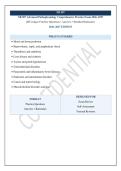
NR 507
NR 507 Advanced Pathophysiology Comprehensive Practice Exam 2026–2027
200 Unique Practice Questions • Answers • Detailed Rationales
2026–2027 EDITION
WHAT'S COVERED
• Shock and tissue perfusion
• Hypovolemic, septic, and anaphylactic shock
• Thrombosis and embolism
• Liver disease and cirrhosis
• Ascites and portal hypertension
• Gastrointestinal disorders
• Pancreatitis and inflammatory bowel disease
• Endocrine and autoimmune disorders
• Cancer and tumor biology
• Musculoskeletal disorders and gout
DESIGNED FOR
FORMAT
Exam Review
Practice Questions
Self-Assessment
Answers + Rationales
Focused Revision
,1. [Shock] What is the defining physiological problem in shock Which finding best supports
this conclusion? In a hospitalized adult, which finding best supports this conclusion?
• A. Inadequate tissue perfusion
• B. An increase in normal physiological reserve
• C. Complete absence of any compensatory response
• D. An isolated change unrelated to the disease process
Answer: Inadequate tissue perfusion
Rationale: The best answer is inadequate tissue perfusion because it directly reflects the
underlying pathophysiological process described in the question. Understanding this mechanism
helps connect the disease process with expected clinical findings and potential complications.
2. [Hypovolemic shock] What causes hypovolemic shock Which finding best supports this
conclusion? In a community setting, which finding best supports this conclusion?
• A. An increase in normal physiological reserve
• B. Reduced circulating intravascular volume
• C. Complete absence of any compensatory response
• D. An isolated change unrelated to the disease process
Answer: Reduced circulating intravascular volume
Rationale: The best answer is reduced circulating intravascular volume because it directly
reflects the underlying pathophysiological process described in the question. Understanding this
mechanism helps connect the disease process with expected clinical findings and potential
complications.
3. [Septic shock] What mechanism contributes to hypotension in septic shock Which finding
best supports this conclusion? In a follow-up assessment, which finding best supports this
conclusion?
• A. An increase in normal physiological reserve
• B. Complete absence of any compensatory response
• C. Systemic vasodilation and abnormal vascular permeability
• D. An isolated change unrelated to the disease process
Answer: Systemic vasodilation and abnormal vascular permeability
,Rationale: The best answer is systemic vasodilation and abnormal vascular permeability because
it directly reflects the underlying pathophysiological process described in the question.
Understanding this mechanism helps connect the disease process with expected clinical findings
and potential complications.
4. [Anaphylaxis] What mechanism can cause rapid hypotension during anaphylaxis Which
finding best supports this conclusion? In a complex clinical presentation, which finding best
supports this conclusion?
• A. An increase in normal physiological reserve
• B. Complete absence of any compensatory response
• C. An isolated change unrelated to the disease process
• D. Widespread mediator-induced vasodilation and increased permeability
Answer: Widespread mediator-induced vasodilation and increased permeability
Rationale: The best answer is widespread mediator-induced vasodilation and increased
permeability because it directly reflects the underlying pathophysiological process described in
the question. Understanding this mechanism helps connect the disease process with expected
clinical findings and potential complications.
5. [Thrombosis] Which factor is part of Virchow's triad Which finding best supports this
conclusion? In a patient with multiple risk factors, which finding best supports this
conclusion?
• A. Hypercoagulability
• B. Complete absence of any compensatory response
• C. An isolated change unrelated to the disease process
• D. An increase in normal physiological reserve
Answer: Hypercoagulability
Rationale: The best answer is hypercoagulability because it directly reflects the underlying
pathophysiological process described in the question. Understanding this mechanism helps
connect the disease process with expected clinical findings and potential complications.
6. [Embolism] What is an embolus Which finding best supports this conclusion? In a
hospitalized adult, which finding best supports this conclusion?
• A. Complete absence of any compensatory response
, • B. A traveling intravascular mass that can obstruct blood flow
• C. An isolated change unrelated to the disease process
• D. An increase in normal physiological reserve
Answer: A traveling intravascular mass that can obstruct blood flow
Rationale: The best answer is a traveling intravascular mass that can obstruct blood flow because
it directly reflects the underlying pathophysiological process described in the question.
Understanding this mechanism helps connect the disease process with expected clinical findings
and potential complications.
7. [Cirrhosis] What process contributes to portal hypertension in cirrhosis Which finding
best supports this conclusion? In a community setting, which finding best supports this
conclusion?
• A. Complete absence of any compensatory response
• B. An isolated change unrelated to the disease process
• C. Increased resistance to portal blood flow through damaged liver tissue
• D. An increase in normal physiological reserve
Answer: Increased resistance to portal blood flow through damaged liver tissue
Rationale: The best answer is increased resistance to portal blood flow through damaged liver
tissue because it directly reflects the underlying pathophysiological process described in the
question. Understanding this mechanism helps connect the disease process with expected clinical
findings and potential complications.
8. [Ascites] Why does cirrhosis promote ascites Which finding best supports this
conclusion? In a follow-up assessment, which finding best supports this conclusion?.
• A. Complete absence of any compensatory response
• B. An isolated change unrelated to the disease process
• C. An increase in normal physiological reserve
• D. Portal hypertension and altered plasma protein balance
Answer: Portal hypertension and altered plasma protein balance
Rationale: The best answer is portal hypertension and altered plasma protein balance because it
directly reflects the underlying pathophysiological process described in the question.
NR 507 Advanced Pathophysiology Comprehensive Practice Exam 2026–2027
200 Unique Practice Questions • Answers • Detailed Rationales
2026–2027 EDITION
WHAT'S COVERED
• Shock and tissue perfusion
• Hypovolemic, septic, and anaphylactic shock
• Thrombosis and embolism
• Liver disease and cirrhosis
• Ascites and portal hypertension
• Gastrointestinal disorders
• Pancreatitis and inflammatory bowel disease
• Endocrine and autoimmune disorders
• Cancer and tumor biology
• Musculoskeletal disorders and gout
DESIGNED FOR
FORMAT
Exam Review
Practice Questions
Self-Assessment
Answers + Rationales
Focused Revision
,1. [Shock] What is the defining physiological problem in shock Which finding best supports
this conclusion? In a hospitalized adult, which finding best supports this conclusion?
• A. Inadequate tissue perfusion
• B. An increase in normal physiological reserve
• C. Complete absence of any compensatory response
• D. An isolated change unrelated to the disease process
Answer: Inadequate tissue perfusion
Rationale: The best answer is inadequate tissue perfusion because it directly reflects the
underlying pathophysiological process described in the question. Understanding this mechanism
helps connect the disease process with expected clinical findings and potential complications.
2. [Hypovolemic shock] What causes hypovolemic shock Which finding best supports this
conclusion? In a community setting, which finding best supports this conclusion?
• A. An increase in normal physiological reserve
• B. Reduced circulating intravascular volume
• C. Complete absence of any compensatory response
• D. An isolated change unrelated to the disease process
Answer: Reduced circulating intravascular volume
Rationale: The best answer is reduced circulating intravascular volume because it directly
reflects the underlying pathophysiological process described in the question. Understanding this
mechanism helps connect the disease process with expected clinical findings and potential
complications.
3. [Septic shock] What mechanism contributes to hypotension in septic shock Which finding
best supports this conclusion? In a follow-up assessment, which finding best supports this
conclusion?
• A. An increase in normal physiological reserve
• B. Complete absence of any compensatory response
• C. Systemic vasodilation and abnormal vascular permeability
• D. An isolated change unrelated to the disease process
Answer: Systemic vasodilation and abnormal vascular permeability
,Rationale: The best answer is systemic vasodilation and abnormal vascular permeability because
it directly reflects the underlying pathophysiological process described in the question.
Understanding this mechanism helps connect the disease process with expected clinical findings
and potential complications.
4. [Anaphylaxis] What mechanism can cause rapid hypotension during anaphylaxis Which
finding best supports this conclusion? In a complex clinical presentation, which finding best
supports this conclusion?
• A. An increase in normal physiological reserve
• B. Complete absence of any compensatory response
• C. An isolated change unrelated to the disease process
• D. Widespread mediator-induced vasodilation and increased permeability
Answer: Widespread mediator-induced vasodilation and increased permeability
Rationale: The best answer is widespread mediator-induced vasodilation and increased
permeability because it directly reflects the underlying pathophysiological process described in
the question. Understanding this mechanism helps connect the disease process with expected
clinical findings and potential complications.
5. [Thrombosis] Which factor is part of Virchow's triad Which finding best supports this
conclusion? In a patient with multiple risk factors, which finding best supports this
conclusion?
• A. Hypercoagulability
• B. Complete absence of any compensatory response
• C. An isolated change unrelated to the disease process
• D. An increase in normal physiological reserve
Answer: Hypercoagulability
Rationale: The best answer is hypercoagulability because it directly reflects the underlying
pathophysiological process described in the question. Understanding this mechanism helps
connect the disease process with expected clinical findings and potential complications.
6. [Embolism] What is an embolus Which finding best supports this conclusion? In a
hospitalized adult, which finding best supports this conclusion?
• A. Complete absence of any compensatory response
, • B. A traveling intravascular mass that can obstruct blood flow
• C. An isolated change unrelated to the disease process
• D. An increase in normal physiological reserve
Answer: A traveling intravascular mass that can obstruct blood flow
Rationale: The best answer is a traveling intravascular mass that can obstruct blood flow because
it directly reflects the underlying pathophysiological process described in the question.
Understanding this mechanism helps connect the disease process with expected clinical findings
and potential complications.
7. [Cirrhosis] What process contributes to portal hypertension in cirrhosis Which finding
best supports this conclusion? In a community setting, which finding best supports this
conclusion?
• A. Complete absence of any compensatory response
• B. An isolated change unrelated to the disease process
• C. Increased resistance to portal blood flow through damaged liver tissue
• D. An increase in normal physiological reserve
Answer: Increased resistance to portal blood flow through damaged liver tissue
Rationale: The best answer is increased resistance to portal blood flow through damaged liver
tissue because it directly reflects the underlying pathophysiological process described in the
question. Understanding this mechanism helps connect the disease process with expected clinical
findings and potential complications.
8. [Ascites] Why does cirrhosis promote ascites Which finding best supports this
conclusion? In a follow-up assessment, which finding best supports this conclusion?.
• A. Complete absence of any compensatory response
• B. An isolated change unrelated to the disease process
• C. An increase in normal physiological reserve
• D. Portal hypertension and altered plasma protein balance
Answer: Portal hypertension and altered plasma protein balance
Rationale: The best answer is portal hypertension and altered plasma protein balance because it
directly reflects the underlying pathophysiological process described in the question.